

How often can you publish on KDP? Technically, up to three new titles a day. That’s the limit Amazon set in September 2023, and it works out to 1,095 titles a year, a ceiling no real author will ever touch.
The better question is how often you should publish to build a portfolio that pays. Here the data is surprisingly clear. In Written Word Media’s 2025 survey, authors with 25 or more books had a median income of about $3,000 a month. At one book a month, you reach 25 books in 25 months. At one a year, it takes 25 years.
So cadence isn’t a vanity metric. It decides whether your catalog hits the income zone while you’re still motivated. This post does the napkin math, with a small Python script you can rerun.
If you’re building a series catalog with AI, the tool I’d start with is ImagineYourBook. It’s an AI book-writing tool that turns a prompt or your notes into a full draft with Word and EPUB export; its Author plan covers about one 40,000-word novel a month, and Book Two remembers Book One, so a series stays consistent at a monthly pace.
TL;DR
- KDP’s limit is 3 new titles a day (since September 2023), or 1,095 a year in theory.
- Written Word Media 2025: authors with 25+ books earn a median of about $3,000/month; 1-3 books, about 80% earn under $100.
- From zero, 25 books takes 300 months at one a year, 50 every two months and 25 at one a month.
- Monthly 40,000-word novels mean 1,315 words a day, every day, which is why AI drafting changes the math.
- KDP requires you to disclose AI-generated text and images; AI-assisted editing doesn’t need disclosure.
The hard limit: 3 new titles a day
On September 18, 2023, KDP posted an update on title creation limits. It said it was “lowering the volume limits we have in place on new title creations” to protect against abuse, while noting it had “not seen a spike in our publishing numbers.”
The post didn’t name a number. Amazon told The Guardian the limit is three titles, and that it may be adjusted “if needed.” Publishers Weekly reported the same three-a-day figure and that it could be lowered again.
Two practical notes from KDP’s own post. First, “very few publishers will be impacted,” and those who are get notified and can ask for an exception (think of an author moving a big backlist onto KDP). Second, the limit sits next to the content rules, not instead of them.
That second point matters more for AI-assisted publishers than the cap does. KDP’s content guidelines require you to tell Amazon about AI-generated text, images or translations when you publish or republish a book. AI-assisted work (you wrote it, AI helped edit or refine) doesn’t need disclosure. And KDP is explicit that content an AI tool created counts as AI-generated “even if you applied substantial edits afterwards.”
So the real constraint on how often you publish isn’t Amazon’s cap. It’s quality, disclosure and how fast your readers want the next book.
What the data says about cadence and income
No survey I found measures “books per year” directly against income. But several measure catalog size against income, and catalog size is just cadence multiplied by time.
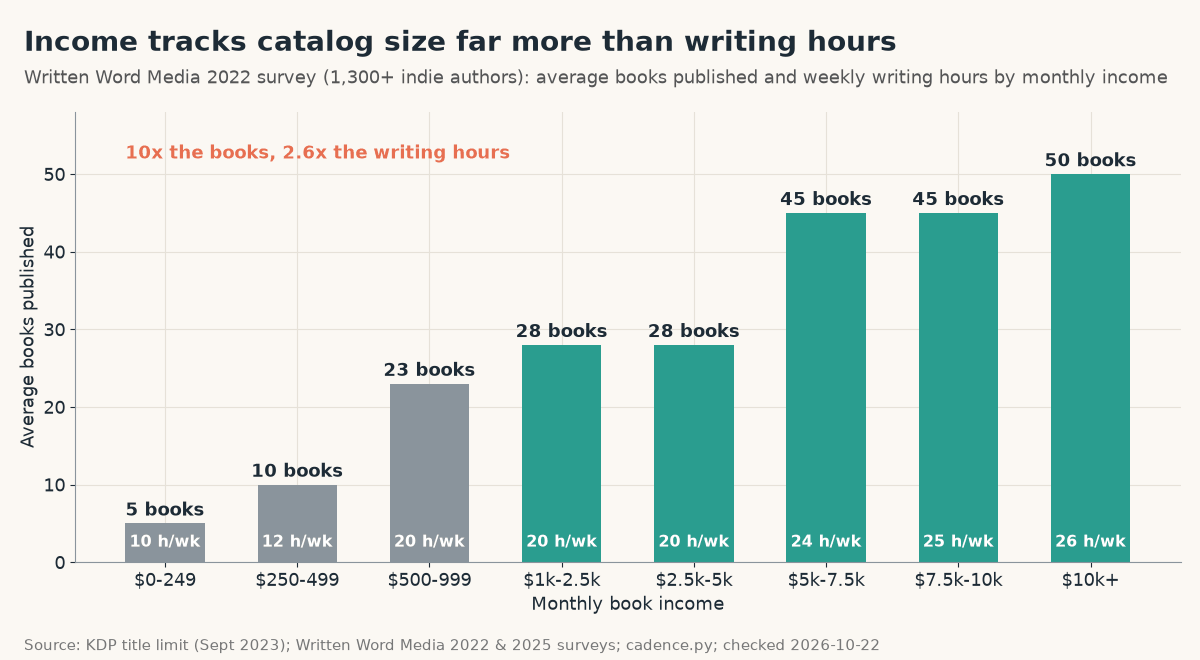
Written Word Media’s 2022 survey of 1,300+ authors split respondents into eight income stages. Average books published climbed from 5 at $0 to $249 a month to 50 at $10,000+. Weekly writing hours only went from 10 to 26. Ten times the books, 2.6 times the hours.
The same survey hints at the pace behind those catalogs. About 80% of Stage 4 authors ($1,000 to $2,499 a month, 28 books on average) had been published for more than three years. Eighty percent of Stage 6 authors ($5,000 to $7,499, 45 books) had been published for more than five years. Napkin math: most of them averaged under about 9 books a year to get there. Fast, but not frantic.
Written Word Media’s 2023 State of Indie Authorship adds a genre twist. The median author had published 8 titles. For authors who mainly write romance, the median jumped to 18 (average 28). Authors earning $0 to $249 a month had a median of 5 titles; those earning $5,000 to $7,500 had a median of 30.
And the 2025 survey of 1,346 authors puts the thresholds plainly. About 80% of authors with one to three books earn under $100 a month. Five to nine books lifts the median to about $50. The income ramp starts at 10+ books, and at 25+ books the median is about $3,000, with more than 40% earning $5,000+. Romance writers are 21% of respondents but about 44% of the over-$10k group.
The Alliance of Independent Authors 2023 income survey points the same way: over half of its self-published respondents had published more than 10 books, and 20% more than 30.
A caveat on all of these: they’re self-reported, and they show correlation. More books don’t cause income on their own; experience, series and marketing grow alongside the catalog. If you want the full books-versus-income breakdown, I covered it in how many KDP books to make money.
The napkin math: how long to 10 and 25 books?
Here’s the simplest possible model. Start from zero, release at an even pace, count live books. No income assumptions, just time.
KDP_DAILY_CAP = 3                      # new titles per day (KDP, Sept 18 2023; Guardian/PW report the number)
CADENCES = {                           # label: books per year
    "1 a year": 1, "Quarterly": 4, "Every 2 months": 6, "Monthly": 12, "Every 2 weeks": 26}
MILESTONES = {5: "WWM 2022 Stage 1 average ($0-249/mo)",
              10: "WWM 2025: income ramp starts at 10+ books",
              25: "WWM 2025: median about $3,000/mo at 25+ books"}
WWM_STAGES = [("$0-249", 5, 10), ("$250-499", 10, 12), ("$500-999", 23, 20), ("$1k-2.5k", 28, 20),
              ("$2.5k-5k", 28, 20), ("$5k-7.5k", 45, 24), ("$7.5k-10k", 45, 25), ("$10k+", 50, 26)]  # (income/mo, avg books, weekly writing hrs)

def months_to(books, per_year):
    """Months from a standing start until `books` are live, releasing at an even pace."""
    return books / per_year * 12

def catalog(per_year, month):
    return int(per_year * month / 12)

def words_per_day(book_words, per_year, writing_days=365):
    return book_words * per_year / writing_days

if __name__ == "__main__":
    cap_year = KDP_DAILY_CAP * 365
    print(f"KDP ceiling: {KDP_DAILY_CAP}/day = {cap_year:,} new titles a year")
    print(f"{'Cadence':<15}{'books/yr':>9}{'to 10':>9}{'to 25':>9}{'live at 36 mo':>15}{'words/day (40k)':>17}")
    for lab, r in CADENCES.items():
        print(f"{lab:<15}{r:>9}{months_to(10, r):>8.0f}m{months_to(25, r):>8.0f}m{catalog(r, 36):>15}{words_per_day(40000, r):>17,.0f}")
    print("\nWWM 2022 stage | avg books | writing hrs/wk")
    for s, b, h in WWM_STAGES: print(f"{s:<14} | {b:>9} | {h:>3}")
    print(f"\nStage 6 ($5k-7.5k): 45 books, 80% published 5+ years -> at most {45/5:.0f} books/yr for most of them")
    print(f"Stage 4 ($1k-2.5k): 28 books, ~80% published 3+ years -> at most {28/3:.1f} books/yr for most of them")
Output:
KDP ceiling: 3/day = 1,095 new titles a year
Cadence         books/yr    to 10    to 25  live at 36 mo  words/day (40k)
1 a year               1     120m     300m              3              110
Quarterly              4      30m      75m             12              438
Every 2 months         6      20m      50m             18              658
Monthly               12      10m      25m             36            1,315
Every 2 weeks         26       5m      12m             78            2,849

WWM 2022 stage | avg books | writing hrs/wk
$0-249         |         5 |  10
$250-499       |        10 |  12
$500-999       |        23 |  20
$1k-2.5k       |        28 |  20
$2.5k-5k       |        28 |  20
$5k-7.5k       |        45 |  24
$7.5k-10k      |        45 |  25
$10k+          |        50 |  26

Stage 6 ($5k-7.5k): 45 books, 80% published 5+ years -> at most 9 books/yr for most of them
Stage 4 ($1k-2.5k): 28 books, ~80% published 3+ years -> at most 9.3 books/yr for most of them
| Cadence | Books/year | Months to 10 books | Months to 25 books | Live after 3 years | Words/day (40k novels) |
|---|---|---|---|---|---|
| 1 a year | 1 | 120 | 300 | 3 | 110 |
| Quarterly | 4 | 30 | 75 | 12 | 438 |
| Every 2 months | 6 | 20 | 50 | 18 | 658 |
| Monthly | 12 | 10 | 25 | 36 | 1,315 |
| Every 2 weeks | 26 | 5 | 12 | 78 | 2,849 |
The table is the whole argument in one view. At one book a year, you hit the 25-book zone in 300 months. Quarterly takes 75. Every two months takes 50. Monthly takes 25. Every two weeks takes 12.
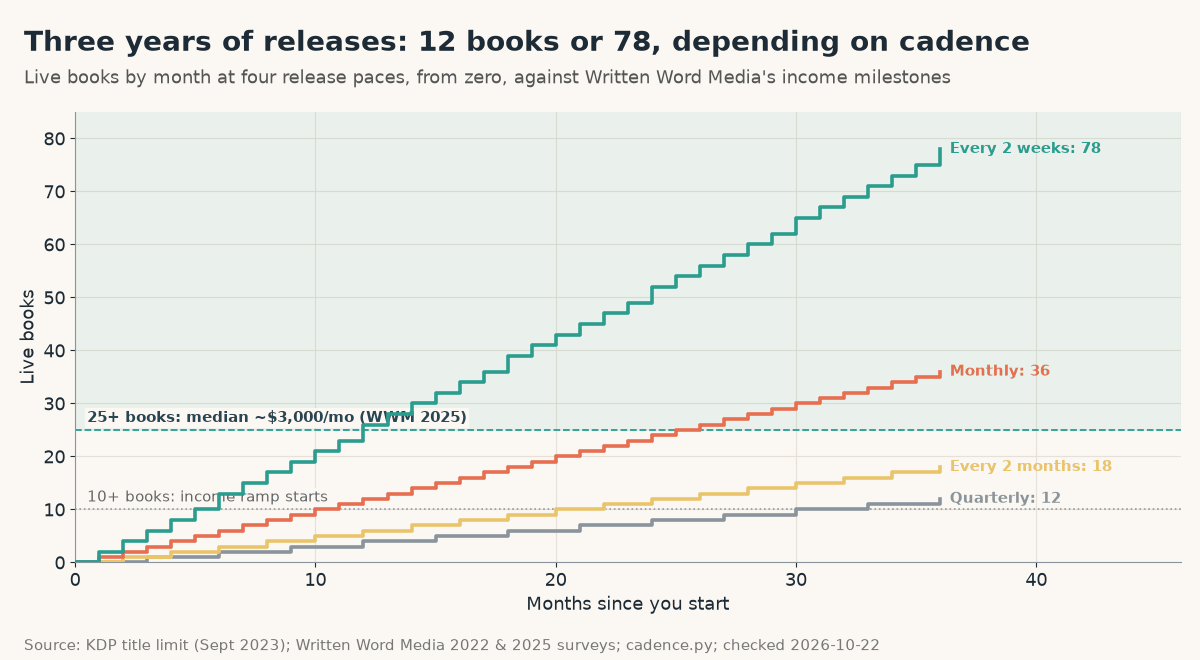
After three years, a quarterly author has 12 books live. A monthly author has 36. A rapid releaser shipping every two weeks has 78. Watch the same race month by month:
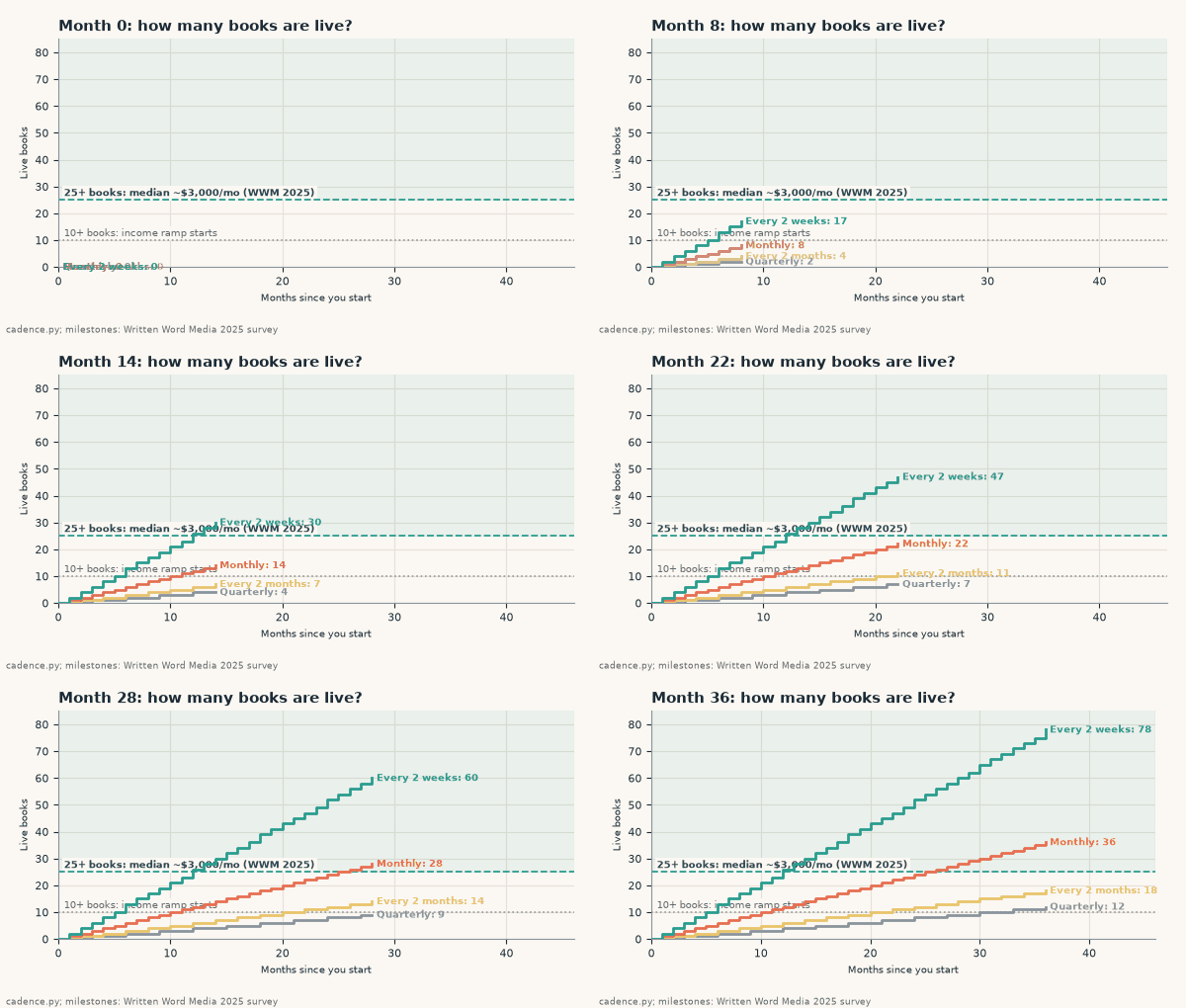
The last column of the script’s output is the uncomfortable one. A 40,000-word novel every month means 1,315 words a day, every day, before revisions, covers, blurbs and ads. Every two weeks means 2,849 a day. That’s where most monthly-release plans quietly die, and where AI drafting changes the math.
Picking your cadence: four rules
1. Match cadence to series, not to the calendar. The surveys say high earners write series, and the 2025 data explains why: a promo for Book 1 can turn into several full-price sales across the series. A monthly pace inside one series keeps readers moving from book to book. Four unrelated books a year don’t stack the same way. For series pricing math, see how to price a KDP ebook series.
2. In Kindle Unlimited, the next book is the product. KU pays per page read, so a reader who finishes Book 2 and finds Book 3 waiting reads on. I worked through four ways to raise those reads in how to get more Kindle Unlimited page reads.
3. Budget words, not wishes. Pick a cadence, multiply by your book length, divide by 365. If the daily number isn’t something you can sustain for two years, pick a slower cadence or a shorter format. Novellas count as titles too.
4. Stay well below the cap, and disclose. Three titles a day is a ceiling meant to stop abuse, not a target. If you use AI to generate text or covers, KDP requires you to say so at publish time. Readers in romance and romantasy notice continuity slips fast, so a slower clean series beats a fast sloppy one.
Where AI fits into a monthly cadence
Most of the 1,315 words a day is first-draft labor. If AI produces the draft, your hours shift to outlining, editing and voice, the parts readers actually notice.
Cost-wise, drafting is cheap now. I estimated the raw LLM API cost of a 50,000-word novel separately; a purpose-built tool adds the structure (chapters, series memory, export) you’d otherwise have to script yourself. For tool picks in this genre, see the best AI for writing romance novels, and you can model royalties per book with the KDP royalty calculator in Python.
| Plan (ImagineYourBook pricing page) | Price | Words a month | Fits this cadence |
|---|---|---|---|
| $0 trial (card required) | $0 for 7 days | One 10,000-word book | Test Book One’s voice |
| Author | $29.99/month | About 40,000 (about 1 novel) | Monthly |
| Publisher | $59.99/month | About 120,000 (3 × 40k novels) | Every 2 weeks, with room to spare |
| Mogul | $179.99/month | About 480,000 (about 12 novels) | Several pen names |
The takeaway
You can publish three new titles a day on KDP. Nobody building a lasting catalog should. The surveys point to a different target: get to 25+ books, ideally in series, and pick the fastest cadence you can keep up for two or three years without the quality slipping. For most series authors, that’s somewhere between every two months (50 months to 25 books) and monthly (25 months).
If a monthly series is your plan, ImagineYourBook is the next step I’d try. Its $0 trial includes one 10,000-word book, needs a card, and the first $29.99 charge comes after 7 days unless you cancel before day 8. Draft Book One, see whether the voice fits your series, then decide whether the monthly cadence is real for you.
Sources (checked October 22, 2026): KDP: Update on title creation limits (Sept 18, 2023) · The Guardian: three books a day · Publishers Weekly: KDP daily title limit · KDP content guidelines (AI disclosure) · Written Word Media: how authors evolve with their income (2022) · Written Word Media: state of indie authorship (2023) · Written Word Media: 2025 indie author survey · ALLi: Independent Author Income Survey (2023) · ImagineYourBook pricing. Script: cadence.py (shown above).
