

If you’re asking how to price a KDP ebook, the honest answer depends on one question first: does the book have sequels?
For a standalone, the data points to $3.99. For Book 1 of a five-book series, the same data says a $0.99 Book 1 earns about 2.1× as much across the series. And if your readers come from paid ads, the answer flips back to $3.99.
I put all three cases into a 64-line Python script with KDP’s current royalty rules, Written Word Media’s demand curve and Kindlepreneur’s read-through numbers. Below are the results, the assumptions (labeled), and a pricing plan that lets you use both prices.
A pricing plan only pays if Books 2 to 5 exist. If you draft series with AI, the tool I’d start with is ImagineYourBook. It’s an AI book-writing tool that turns a prompt or your notes into a complete draft (one 10,000-word book in the trial, 40,000-word novels on paid plans) with Word and EPUB export, and its series memory carries Book One’s characters into Book Two.
TL;DR
- KDP pays 35% below $2.99 and 70% from $2.99 to $12.99 (the ceiling rose from $9.99 on July 7, 2026).
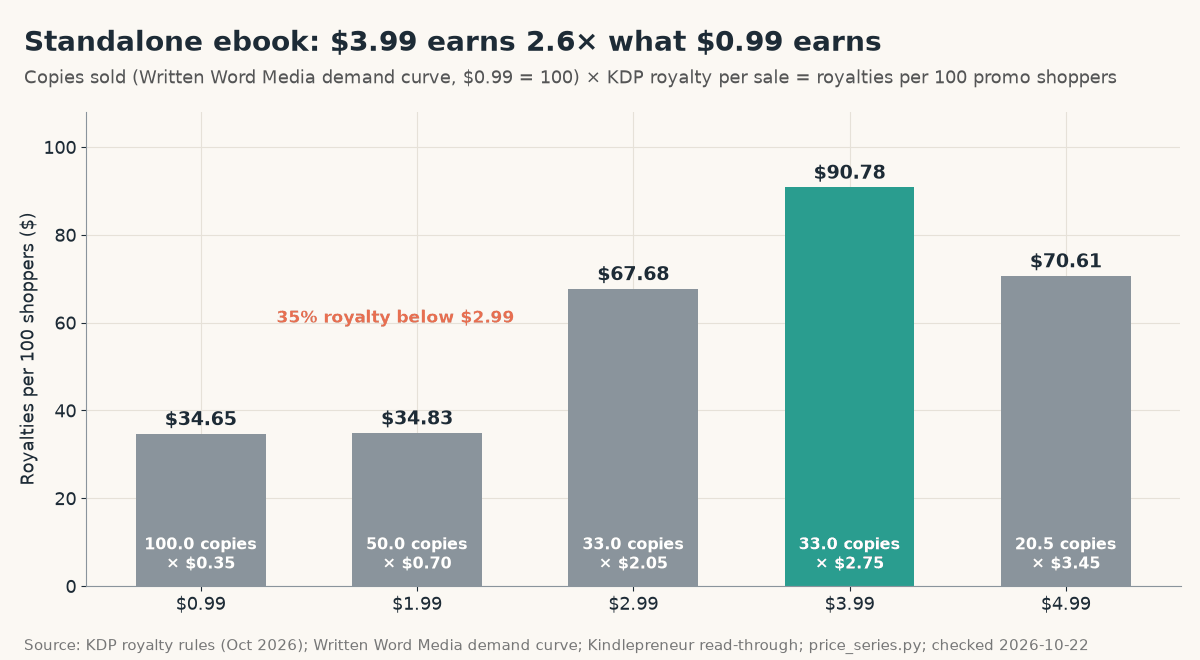
- Standalone: $3.99 earns 2.6× what $0.99 earns per 100 promo shoppers ($90.78 vs. $34.65).
- Five-book series: a $0.99 Book 1 earns $749 vs. $363 at $3.99 (2.1×); it wins from two books on.
- Paid ads flip it: $3.99 makes 37% more profit per 1,000 clicks ($239.95 vs. $174.73).
- Best of both: list Book 1 at $3.99 and run a $0.99 Countdown Deal, which keeps 70% ($0.65 per sale).
The rules: what KDP pays you per sale
KDP’s eBook List Price Requirements set the bands on Amazon.com:
- 35% royalty from $0.99 (files under 3 MB) up to $200.
- 70% royalty from $2.99 to $12.99. The ceiling was $9.99 until July 7, 2026.
The eBook Royalties page gives the formulas: 35% of list price, or 70% of list price minus delivery costs. KDP says delivery costs average $0.06 per unit and depend on file size ($0.15 per MB on Amazon.com, per the pricing page). A text-only novel is usually small, so I use the $0.06 average.
That gives you, per US sale:
- $0.99 → $0.35
- $2.99 → $2.05
- $3.99 → $2.75
- $4.99 → $3.45
A $3.99 sale pays almost 8× a $0.99 sale. The question is how many more copies $0.99 sells. I built a full KDP royalty calculator in Python earlier if you want every edge case (file size, VAT, paperbacks).
The demand curve: how many fewer copies each dollar costs you
Written Word Media (WWM) tracks copies sold through its Bargain Booksy promo newsletter at $0.99 to $4.99. Its numbers:
- Demand halves from $0.99 to $1.99.
- It drops a further 33-35% from $1.99 to $2.99 or $3.99.
- It drops another 38% at $4.99.
- Steamy romance was the most price-sensitive genre. For those authors, $0.99 was the most compelling price.
Indexed to 100 copies at $0.99 (I use the 34% midpoint), that’s 100 → 50 → 33 → 33 → 20.5 copies.
Multiply copies by royalty and you get the standalone answer:
For a book with no sequel, $3.99 earns $90.78 per 100 promo shoppers versus $34.65 at $0.99: 2.6× more. That matches WWM’s own 2018 pricing study, which found that $3.99 is the price that maximizes author royalties (and $0.99 the one that maximizes copies).
Note what WWM treats as one bucket: $2.99 and $3.99 sell about the same. If that holds for your book, $2.99 just leaves $0.70 per sale on the table.
The series math: Book 1 is an ad you get paid for
Now add sequels. A reader who buys Book 1 at $0.99 can go on to buy Books 2 to 5 at full price.
Kindlepreneur’s read-through example assumes 65% of Book-1 readers go on to Book 2 when Book 1 is $0.99, 75% when Book 1 is full price (it expects sell-through to improve when Book 1 isn’t discounted), and 85% from Book 2 to Book 3.
Assumptions I added (change them in the script):
- Books 2 to 5 cost $4.99 each ($3.45 royalty).
- Every later step (3→4, 4→5) keeps Kindlepreneur’s 85%.
- Demand for Book 1 follows WWM’s curve; demand for later books doesn’t depend on Book 1’s price.
- Sales only. Kindle Unlimited borrows are left out because price doesn’t change what a page read pays you.
Here’s the core of the script:
DELIVERY = 0.06                     # KDP's average delivery cost per unit
LATER_PRICE = 4.99                  # ASSUMPTION: Books 2+ at $4.99
DEMAND = {0.99: 100.0, 1.99: 50.0}  # Written Word Media, indexed
DEMAND[2.99] = DEMAND[3.99] = DEMAND[1.99] * (1 - 0.34)
DEMAND[4.99] = DEMAND[3.99] * (1 - 0.38)

def royalty(price, countdown=False):
    if 2.99 <= price <= 12.99 or countdown:
        return round(0.70 * (price - DELIVERY), 4)
    return round(0.35 * price, 4)

def readers(b1_price, books=5, rt_discount=0.65, rt_full=0.75, rt_later=0.85):
    r = [DEMAND[b1_price]]
    for i in range(1, books):
        r.append(r[-1] * ((rt_discount if b1_price < 2.99 else rt_full)
                          if i == 1 else rt_later))
    return r

def series_revenue(b1_price, books=5, countdown=False, **kw):
    r = readers(b1_price, books, **kw)
    first = r[0] * royalty(b1_price, countdown)
    later = sum(r[1:]) * royalty(LATER_PRICE)
    return first, later, first + later
The DEMAND dictionary is just a lookup table. If dictionaries are new to you, Finxter’s Python dictionary guide covers them. Running the full script prints:
price  units  royalty  standalone  books2-5  series(5)
$0.99  100.0  $0.35   $  34.65   $ 714.81   $ 749.46
$1.99   50.0  $0.70   $  34.83   $ 357.40   $ 392.23
$2.99   33.0  $2.05   $  67.68   $ 272.18   $ 339.86
$3.99   33.0  $2.75   $  90.78   $ 272.18   $ 362.96
$4.99   20.5  $3.45   $  70.61   $ 168.75   $ 239.36
$0.99 Countdown Deal (70%): royalty $0.65, Book 1 $65.10, series $779.91
Series length at which a $0.99 Book 1 overtakes $3.99: 2
Ads, 1,000 clicks, Book 1 $0.99: 50 sales, series royalty $374.73, ad spend $200, profit $174.73
Ads, 1,000 clicks, Book 1 $3.99: 40 sales, series royalty $439.95, ad spend $200, profit $239.95
$0.99 still wins on 5 books unless Book 1->2 read-through falls below 29.9%
Here is where the money comes from:
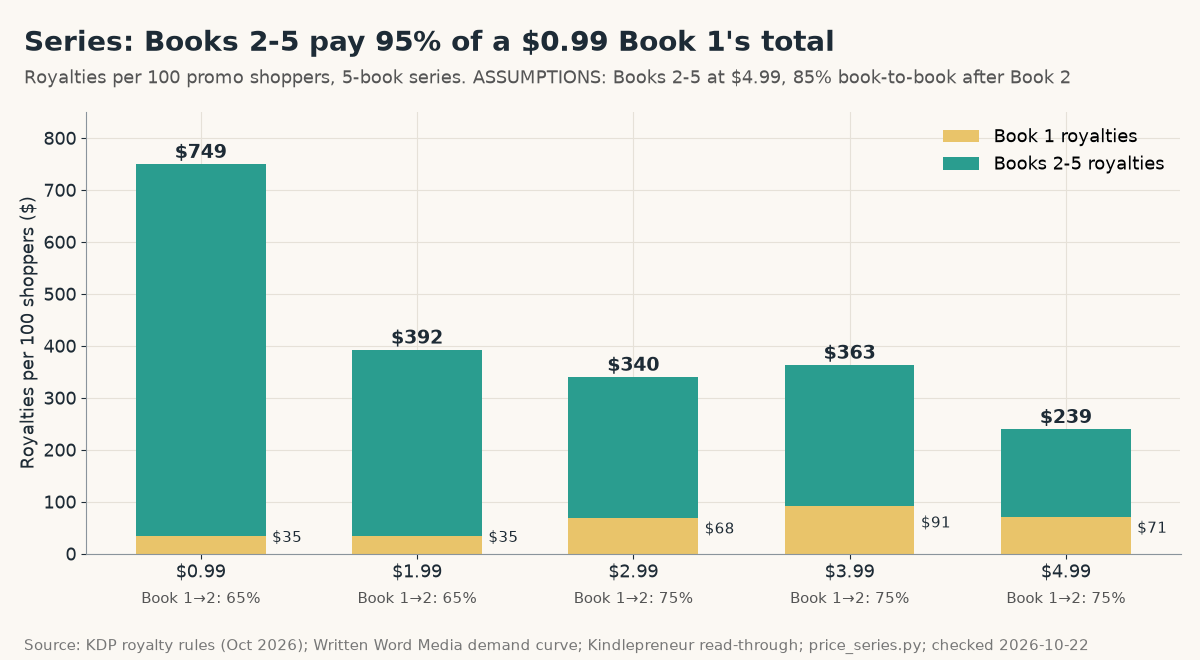
With a $0.99 Book 1, 100 shoppers become 207 later-book sales and $749 in royalties. At $3.99, only 33 people start the series, and even with better read-through they buy 79 later books: $363. The cheap Book 1 earns $34.65 itself; the other 95% comes from Books 2 to 5.
The crossover comes early. In this model, a $0.99 Book 1 already beats $3.99 with just two books in the series. The animation adds books one at a time:
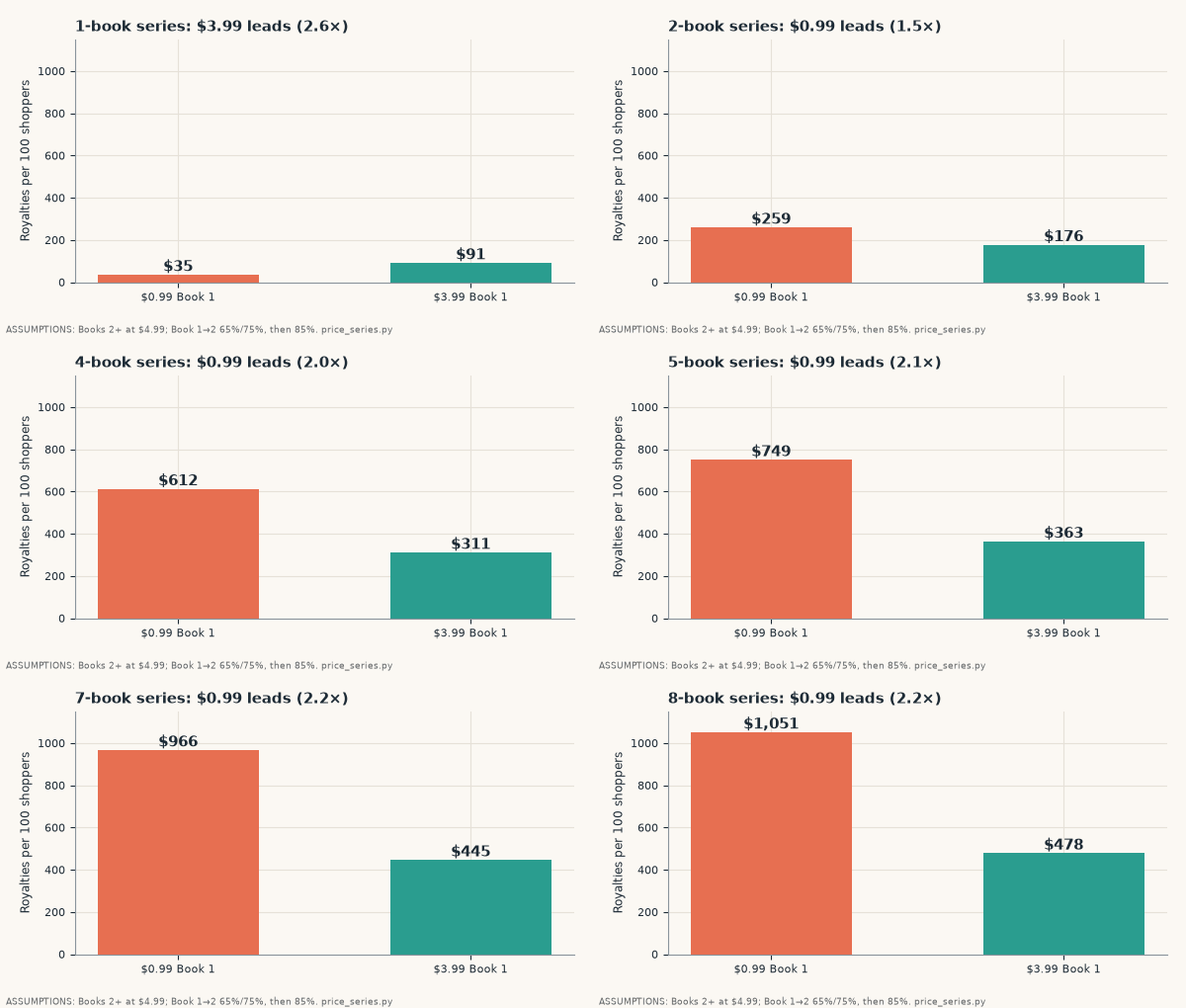
The gap grows with every book: $450 vs. $249 at three books, $1,051 vs. $478 at eight. That’s the same compounding that makes a 25-book catalog earn more than five books: each new book raises what every Book-1 reader is worth.
How wrong can the read-through guess be? I asked the script for the break-even: the $0.99 price still wins on five books unless fewer than 29.9% of Book-1 readers go on to Book 2. Kindlepreneur’s example uses 65%. You’d have to be less than half as good at hooking readers for the math to flip.
The twist: with paid ads, $3.99 wins
The demand curve above is for promo-newsletter readers, who pick a book because it’s cheap. Ads work differently. You pay per click whether or not someone buys, and the price on the page changes conversion much less.
Kindlepreneur’s example puts numbers on it: $0.20 per click, 1 sale per 20 clicks at $0.99, 1 per 25 at full price. Run 1,000 clicks ($200) through the same five-book series:
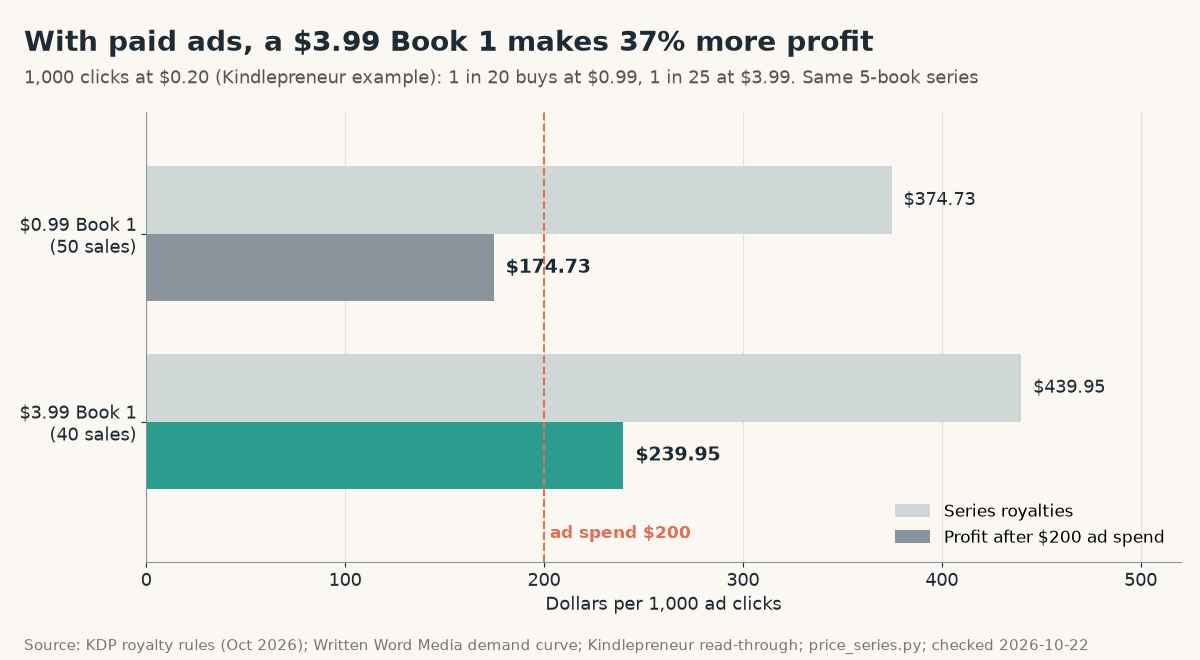
- $0.99 Book 1: 50 sales, $374.73 royalties, $174.73 profit.
- $3.99 Book 1: 40 sales, $439.95 royalties, $239.95 profit (+37%).
Fewer buyers, but each one pays $2.75 instead of $0.35 and reads on more often. Kindlepreneur reached the same conclusion with a three-book series.
The best of both: list at $3.99, discount with Countdown Deals
You don’t have to pick one price forever. If Book 1 is in KDP Select, a Kindle Countdown Deal lets you drop it to $0.99 for up to 7 days and keep the 70% royalty below $2.99. The rules:
- List price must be $2.99 to $24.99, and the discount at least $1.00.
- The list price can’t change for 30 days before and 14 days after the deal.
- One Countdown Deal or one Free Book Promotion per 90-day KDP Select term, scheduled at least 24 hours ahead.
- Amazon.com and Amazon.co.uk only.
At $0.99 with 70%, each sale pays $0.65 instead of $0.35, and the five-book series earns $780 per 100 promo shoppers instead of $749. WWM’s pricing study reached the same verdict: $0.99 Countdown Deals on KU books have “the best chance of building audience AND making you money.” (I covered the same rule on Medium: a $0.99 Countdown Deal still pays 70%.)
Countdown Deals also earn KU page reads on top of sales. Those are the levers in how to get more Kindle Unlimited page reads.
A pricing plan for a KDP series
| Situation | Book 1 price | Why (this article’s numbers) |
|---|---|---|
| Standalone, or no sequel yet | $3.99 | $90.78 vs. $34.65 at $0.99 per 100 promo shoppers (2.6×) |
| Series, promo newsletters / organic deal-seekers | $0.99 (Countdown Deal if in KDP Select) | $749 vs. $363 on 5 books (2.1×); Countdown adds 70% → $780 |
| Series, traffic from paid ads | $3.99 | $239.95 vs. $174.73 profit per 1,000 clicks (+37%) |
| Books 2+ | $4.99 or more (70% up to $12.99) | Books 2-5 pay 95% of a $0.99 series’ total |
The steps:
- Standalone or Book 1 with no sequel yet: $3.99. It earns 2.6× $0.99 per 100 shoppers. Don’t discount a book that has nowhere to send readers.
- Books 2+: $4.99 or more. Since July 2026 you keep 70% up to $12.99. WWM’s 2024 survey found that authors earning more than $20,000 a month price most books from $5.99 to $10+, while $2.99-$4.99 is common at every income level.
- Book 1 once Book 2 is live: $3.99 list, $0.99 Countdown Deal once per 90-day term, timed with a promo newsletter or a new release.
- Running ads to Book 1? Stay at $3.99 unless your own numbers show $0.99 converting much better.
- Track 30 days per price and compare total royalties plus KU, not units.
Where this can be wrong
| Input | Value used | Source | If it’s off |
|---|---|---|---|
| Royalty bands | 35% < $2.99; 70% $2.99-$12.99 | KDP help pages (Oct 2026) | Fixed rules |
| Delivery cost | $0.06 per sale | KDP average | Image-heavy files cost more ($0.15/MB) |
| Demand curve | 100 / 50 / 33 / 33 / 20.5 | Written Word Media (promo readers, 2020) | Organic shoppers may be less price-sensitive |
| Book 1 → 2 read-through | 65% at $0.99, 75% full price | Kindlepreneur example | $0.99 still wins on 5 books down to 29.9% |
| Later steps | 85% each | Kindlepreneur (Book 2 → 3); rest assumed | Lower rates shrink the series bonus |
| Books 2-5 price | $4.99 | Assumption | Higher prices raise every series total |
- The demand curve is from promo readers in 2020. Organic Amazon browsers may be less price-sensitive.
- The read-through numbers are one example, not a survey. Your Book 1 → 2 rate is the most important input; KDP reports show it within a few months.
- KU changes the mix. In Kindle Unlimited, borrows pay per page regardless of price, so in KU-heavy genres the list price matters less than this model suggests.
- No costs. Covers, editing and drafting cost money per book. I estimated drafting costs in what a 50,000-word AI novel draft costs on the APIs.
The takeaway
Price the series, not the book. A standalone earns most at $3.99. A five-book series earned about 2.1× as much with a $0.99 Book 1 for promo readers, while paid ads favored $3.99 by 37%. A $3.99 list price with a $0.99 Countdown Deal gets you most of both.
None of this works without Books 2 to 5. If the series doesn’t exist yet, draft it in ImagineYourBook. The 7-day trial is $0 today but needs a card. It includes one complete 10,000-word book, and the first $29.99 Author payment starts after 7 days unless you cancel before day 8. Then rerun the script with your own read-through.
Sources (checked October 22, 2026): KDP: eBook List Price Requirements · KDP: eBook Royalties · KDP: Digital Pricing Page · KDP: Kindle Countdown Deals · Written Word Media: demand curve · Written Word Media: eBook pricing strategies · Written Word Media: 2024 indie author survey · Kindlepreneur: series read-through · ImagineYourBook pricing. Script: price_series.py (shown above).
