

## TLDR
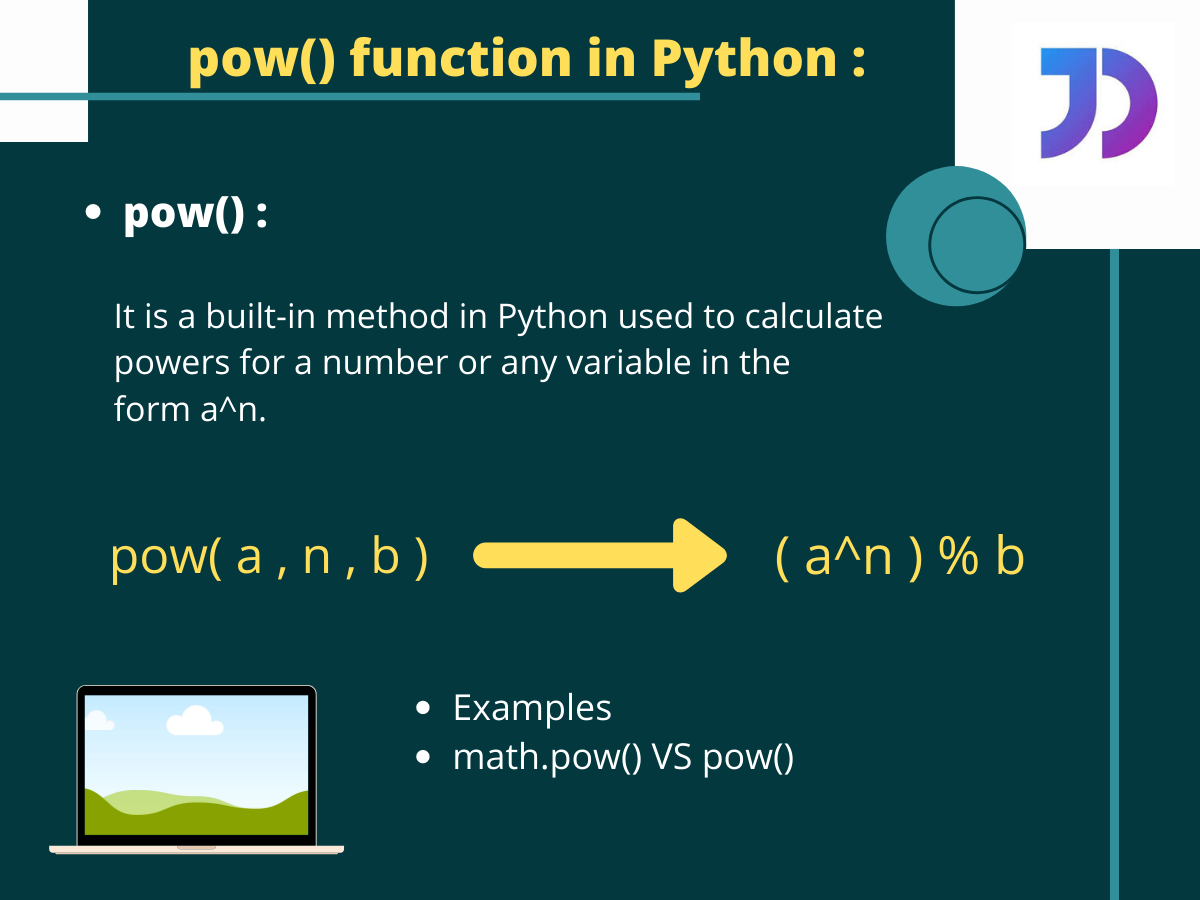
- pow(a, n) raises a to the power n – same as a ** n
- pow(a, n, b) adds modular exponentiation: (a ** n) % b – faster for large numbers
- The third argument requires a positive exponent – negative exponents with modulus raise a ValueError
- pow() beats math.pow() for integers – no float conversion, supports modulus, and handles big integers natively
- Both two-argument and three-argument forms accept any numeric type, including negative exponents and fractions
## How pow() Works in Python
### Two-Argument Form
x = pow(2, 5)      # 2 raised to the power 5
print(x)           # 32

y = pow(4, -2)     # 1 / (4 squared)
print(y)           # 0.0625

z = pow(2, 0.5)    # square root of 2
print(z)           # 1.4142135623730951
### Three-Argument Form (Modular Exponentiation)
x = pow(2, 5)      # 2 raised to the power 5
print(x)           # 32

y = pow(4, -2)     # 1 / (4 squared)
print(y)           # 0.0625

z = pow(2, 0.5)    # square root of 2
print(z)           # 1.4142135623730951
x = pow(2, 5)      # 2 raised to the power 5
print(x)           # 32

y = pow(4, -2)     # 1 / (4 squared)
print(y)           # 0.0625

z = pow(2, 0.5)    # square root of 2
print(z)           # 1.4142135623730951
### Supporting Both Forms in a Single Function
x = pow(2, 5)      # 2 raised to the power 5
print(x)           # 32

y = pow(4, -2)     # 1 / (4 squared)
print(y)           # 0.0625

z = pow(2, 0.5)    # square root of 2
print(z)           # 1.4142135623730951
## pow() vs math.pow() – What’s the Difference?
x = pow(2, 5)      # 2 raised to the power 5
print(x)           # 32

y = pow(4, -2)     # 1 / (4 squared)
print(y)           # 0.0625

z = pow(2, 0.5)    # square root of 2
print(z)           # 1.4142135623730951
### Performance Difference
x = pow(2, 5)      # 2 raised to the power 5
print(x)           # 32

y = pow(4, -2)     # 1 / (4 squared)
print(y)           # 0.0625

z = pow(2, 0.5)    # square root of 2
print(z)           # 1.4142135623730951
## Practical Use Cases
### Modular Arithmetic in Cryptography
x = pow(2, 5)      # 2 raised to the power 5
print(x)           # 32

y = pow(4, -2)     # 1 / (4 squared)
print(y)           # 0.0625

z = pow(2, 0.5)    # square root of 2
print(z)           # 1.4142135623730951
### Compound Interest Calculations
x = pow(2, 5)      # 2 raised to the power 5
print(x)           # 32

y = pow(4, -2)     # 1 / (4 squared)
print(y)           # 0.0625

z = pow(2, 0.5)    # square root of 2
print(z)           # 1.4142135623730951
### Finding Large Powers Modulo a Number
x = pow(2, 5)      # 2 raised to the power 5
print(x)           # 32

y = pow(4, -2)     # 1 / (4 squared)
print(y)           # 0.0625

z = pow(2, 0.5)    # square root of 2
print(z)           # 1.4142135623730951
## FAQ
