
A game master with a folder of campaign notes asks: can I turn this into a book people pay for, and what do I keep per copy? The platform rules answer the first question before the math answers the second.
Type “how to turn a dnd campaign into a book” into Google and it autocompletes, as do “can you sell homebrew dnd campaigns” and “how to publish a dnd adventure” (suggestions I pulled on October 15, 2026). Over on Reddit, a DM in r/DMAcademy asked how to turn an adventure he had run for his own party into a PDF for DMs Guild. He already used Homebrewery for layout and was unsure “what to put at the start, how to introduce the adventure, how to lay it all out”.
If you play with AI drafting tools, there is a bigger question underneath: are you even allowed to sell the result? On the biggest D&D marketplace, no. Elsewhere, yes, if you disclose. Here are the rules, the per-copy math in Python, and a workflow that respects both.
TL;DR
- DMs Guild and DriveThruRPG do not accept products that include text from AI language generators (DMsGuild guidelines page dated March 2, 2026).
- itch.io and Kindle do not ban it: KDP requires you to disclose AI-generated text, itch.io asks you to tag generative AI use.
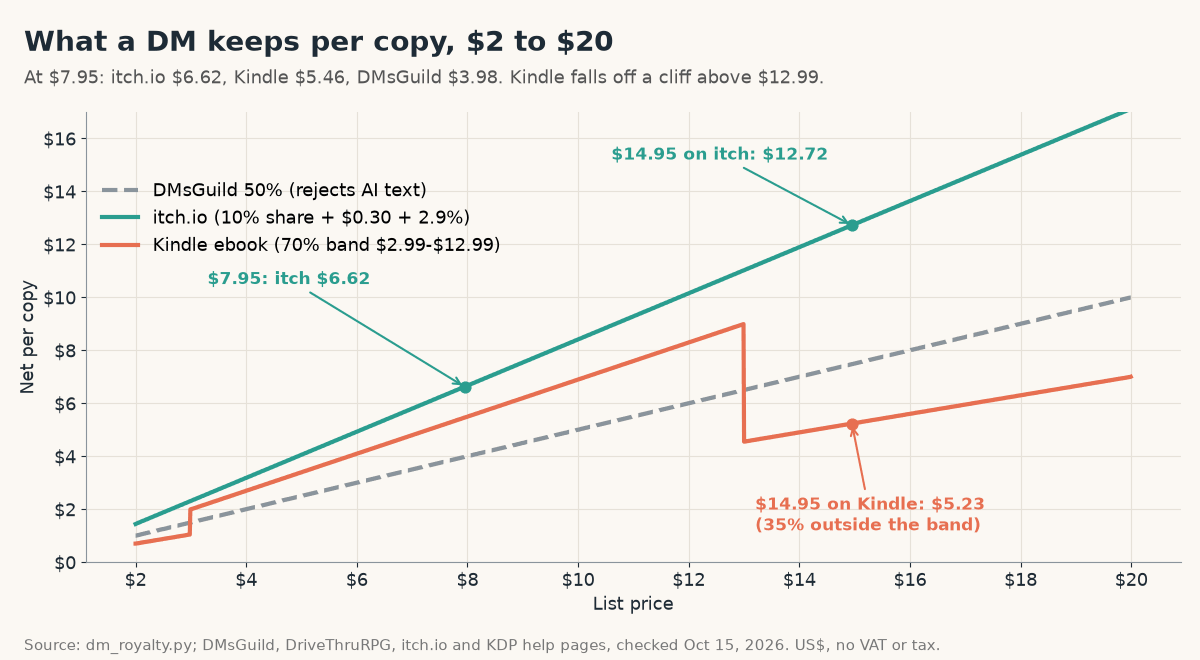
- At a $7.95 price you keep $6.62 on itch.io, $5.46 on Kindle and $3.98 on DMsGuild (50% royalty).
- A $50 art budget plus a $29.99 AI-draft month is paid back after 13 copies on itch.io (21 on DMsGuild).
- Kindle’s 70% band ends at $12.99: a $14.95 adventure nets $5.23 there against $12.72 on itch.io.
The rule that decides everything
Dungeon Masters Guild’s content guidelines (page dated March 2, 2026) say: “Roll20, DriveThru Marketplaces, and DMsGuild do not accept any product that include any text generated by AI language generators. A final product should be the result of human creativity and not AI generation. Products should begin and end with human writing.”
Two details matter:
- Images are treated differently. In adventures and sourcebooks, AI-generated images are acceptable inside the PDF, but not as separate tokens, maps or handouts, and the title must carry the “Contains AI-Generated Content” filter. Print-on-demand titles on DMsGuild cannot use AI images at all.
- DriveThruRPG is no escape hatch. Its General Content Guidelines carry the same rule: no product that includes text generated by AI language generators.
The guidelines do not say exactly where brainstorming ends and generating begins. If your notes come from AI-assisted brainstorming, ask the marketplace before you upload; the guidelines list dmsguild-help@roll20.net for questions.
| Marketplace | AI-drafted text | What you must do | You keep at $7.95 |
|---|---|---|---|
| DMs Guild | Not accepted | Write the final text yourself; AI images only inside the PDF, with the AI filter | $3.98 (50%) |
| DriveThruRPG | Not accepted | Same Roll20 / DriveThru rule | $5.56 exclusive, $5.17 non-exclusive |
| itch.io | Not banned | Tag generative AI use; no mass-produced pages | $6.62 |
| Kindle (KDP) | Allowed | Tell KDP about AI-generated text when you publish | $5.46 |
The per-copy math
Every number below comes from the platforms’ own pages: the DMsGuild accounting page (50% royalty, $1 PayPal withdrawal fee, 30-day holdback), the DriveThruRPG publisher comparison (70% exclusive, 65% non-exclusive), itch.io’s payments docs (default 10% revenue share plus roughly $0.30 + 2.9% processor fee) and KDP’s eBook Royalties and price requirements pages. I covered the KDP rules in detail in my KDP royalty calculator in Python.
# dm_royalty.py - what a DM nets per copy of a campaign book, October 2026
import math

KDP_BAND = (2.99, 12.99)   # 70% band on Amazon.com since July 7, 2026

def dmsguild(price):            return round(price * 0.50, 2)
def drivethru(price, exclusive=True):
    return round(price * (0.70 if exclusive else 0.65), 2)
def itch(price, share=0.10):    return round(price - price * share - 0.30 - price * 0.029, 2)

def kdp_ebook(price, mb=1.0):
    delivery = max(0.01, round(mb * 0.15, 2))
    r35 = round(0.35 * price, 2)
    if KDP_BAND[0] <= price <= KDP_BAND[1]:
        return max(r35, round(0.70 * (price - delivery), 2))
    return r35

def copies_to_break_even(cost, net):
    return math.ceil(cost / net)
The price points are the ones DMsGuild lists as most successful for PDFs: $1.00, $2.00, $2.95, $3.95, $4.99, $7.95, $10.00, $14.95 and $19.99. Running them:
  price  DMsGuild  DTRPG65  DTRPG70   itch    KDP
$  2.00      1.00     1.30     1.40   1.44   0.70
$  2.95      1.48     1.92     2.06   2.27   1.03
$  4.99      2.50     3.24     3.49   4.05   3.39
$  7.95      3.98     5.17     5.56   6.62   5.46
$  9.99      5.00     6.49     6.99   8.40   6.89
$ 14.95      7.47     9.72    10.46  12.72   5.23
At $7.95, itch.io leaves you $6.62, Kindle $5.46 and DMsGuild $3.98. So the one marketplace that rejects AI-written text is also the one that pays least per copy. DMsGuild is also the dedicated D&D marketplace, and that audience is something this math cannot measure.
Two traps show up in the output:
- Kindle’s band ends at $12.99. A $14.95 book sits outside the 70% band, so KDP pays 35%: $5.23, against $12.72 on itch.io. If you go to Kindle, price at or under $12.99.
- Cheap prices get eaten by the fixed fee. On itch.io a $2.00 sale nets $1.44, because the $0.30 processor fee is 15% of the price. itch.io itself recommends selling at $2 or more for that reason.
How many copies pay back the project?
Say the costs are an AI draft plus art. For art I used $50, the amount one DMsGuild author said he spent on stock art in a r/DMAcademy thread about whether DMsGuild pays. For the draft I used two cases: $0 (a free trial draft) and $29.99 (one paid month of a subscription tool). At $7.95:
for name, net in (("DMsGuild", dmsguild(7.95)), ("itch.io", itch(7.95)), ("KDP", kdp_ebook(7.95))):
    print(name, copies_to_break_even(50.00, net), copies_to_break_even(79.99, net))
# DMsGuild 13 21
# itch.io 8 13
# KDP 10 15
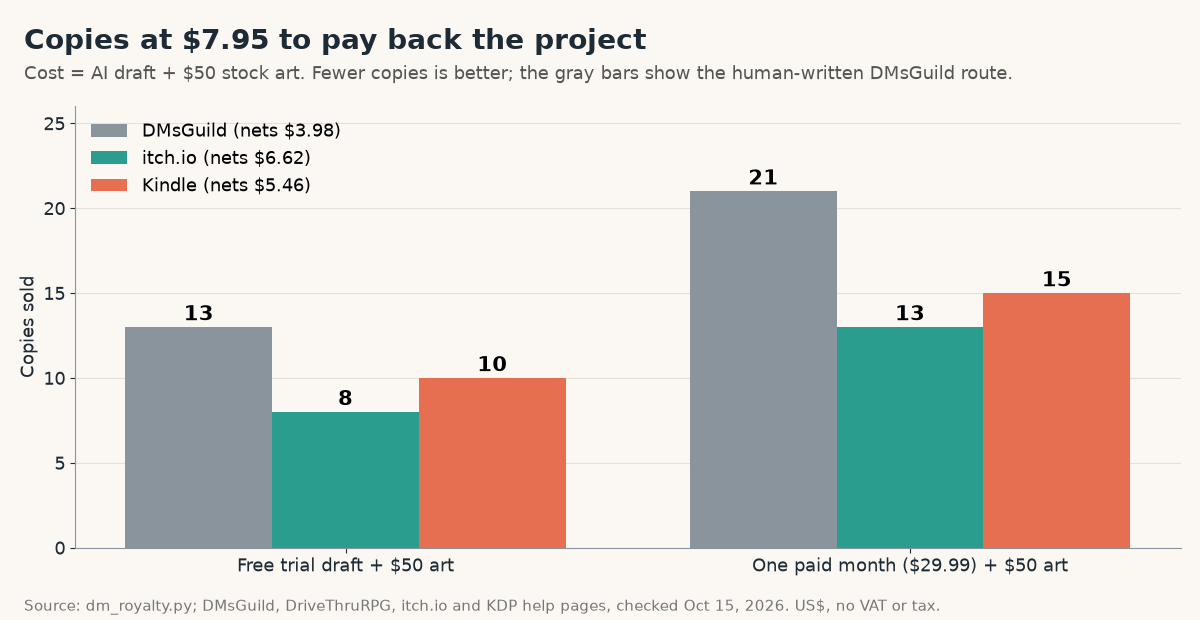
Thirteen to twenty-one copies is not a high bar. Reaching those buyers is the hard part. The author of the $50 figure also reported nearly $2,000 over six years from a single DMsGuild product, which he put at about $40 an hour for roughly 48 hours of work. Another reply in the thread advised releasing free content first and building a following before a big paid module, because a paid file from an unknown name tends to lose to free ones.
A workflow that respects the rules
- Sell an adventure, not the whole campaign. A commenter in r/DnD’s semi-homebrew campaign thread put it as “we don’t need more campaigns, but we always need more adventure modules.” Pick one arc from your notes.
- Decide the marketplace first. If it is DMsGuild or DriveThruRPG, the final text has to be yours. If it is itch.io or Kindle, neither bans AI-drafted text, but both want disclosure: KDP requires you to tell Amazon about AI-generated text, even with substantial edits afterwards, and itch.io’s quality guidelines ask you to tag generative AI use. A Medium story covers the Kindle side: Can You Write a Book With AI and Sell It on Amazon? The 2026 Rules.
- Turn notes into a draft. Your options include a general chatbot such as ChatGPT or Claude, one chapter per prompt (my API cost breakdown shows what that costs through the API), Homebrewery for the layout once you have text, or ImagineYourBook, which accepts up to 20,000 words of outlines and notes and writes a 10,000-word draft in roughly 6 to 15 minutes, with Word and EPUB export. Its first 10,000-word book is free with a $0 seven-day trial and then costs $29.99 a month. It is a book-writing tool that produces text with a designed cover and no illustrations inside, so I would not expect stat blocks or maps from it; read-aloud text, lore guides and a campaign novelization are the better fit.
- Add the legal line. If you build on the SRD 5.1 outside DMsGuild, Wizards’ license text requires an exact CC-BY-4.0 attribution statement and allows you to say your work is “5E compatible”. It asks you not to add other Wizards attribution.
- Lay it out like a travel guide. The r/DMAcademy answer worth stealing: DMs flip around mid-session, so give them a real index and put what they need on one page or a two-page spread.
What the calculator leaves out
- Taxes. For sellers outside the US, itch.io’s Payouts system applies 30% withholding by default unless you complete its tax interview with a tax ID (treaty rates can be lower). DMsGuild pays via PayPal with a $1 fee per withdrawal.
- VAT, refunds and chargebacks. None are modeled.
- Discovery. Net per copy says nothing about how many copies you sell.
- Policy drift. DMsGuild reserves the right to update its policies at any time, and the page I quoted is dated March 2, 2026. Re-read it before you upload.
Try it
- Save the script as
dm_royalty.py. - Replace the cost with your real draft, art and editing costs.
- Pick the platform your AI policy allows, then price at a number that clears break-even in under 20 copies.
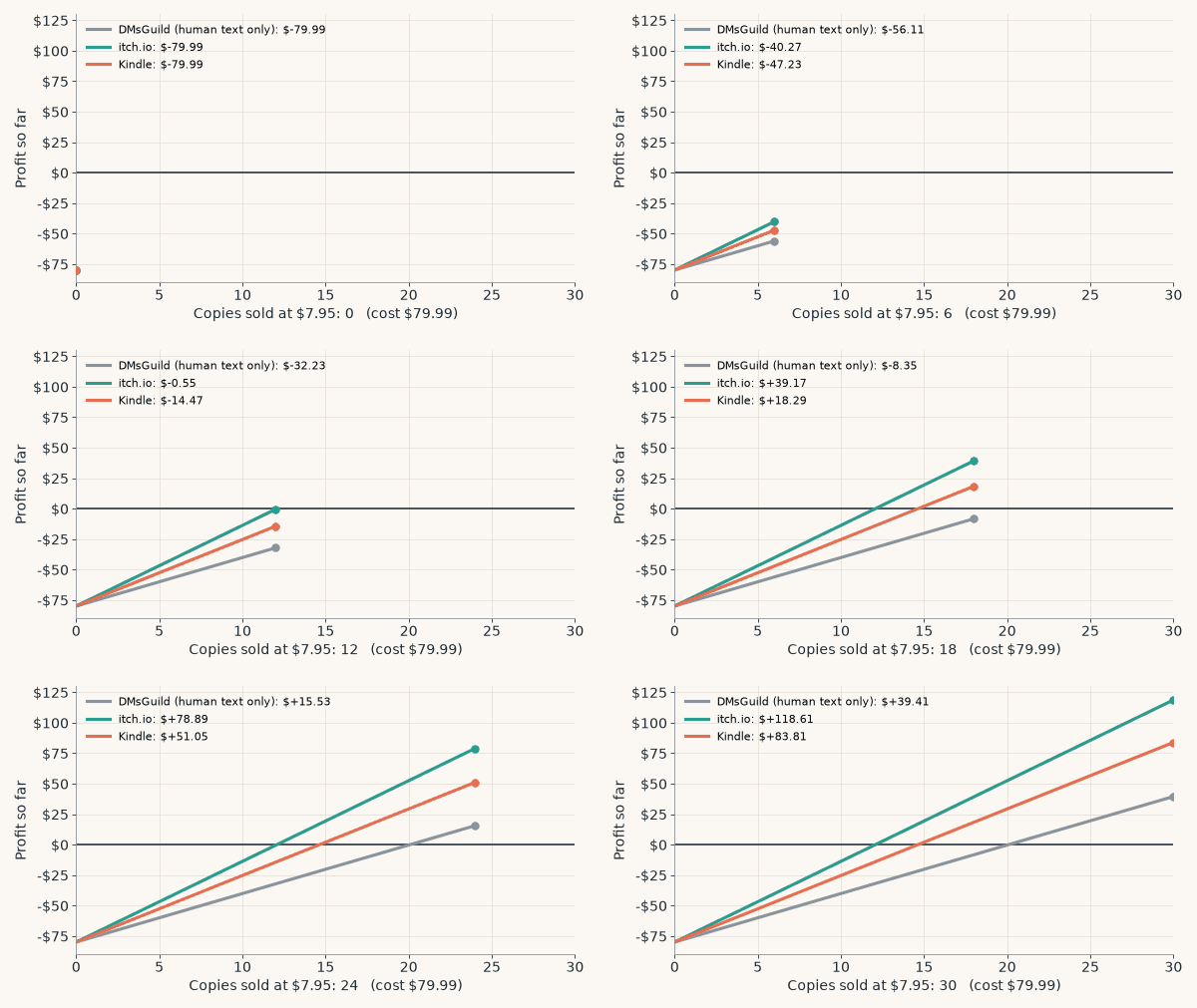
A DM can sell an AI-drafted adventure, just not on DMs Guild. On itch.io a $7.95 copy nets $6.62 and pays back a $79.99 project in 13 sales.
