

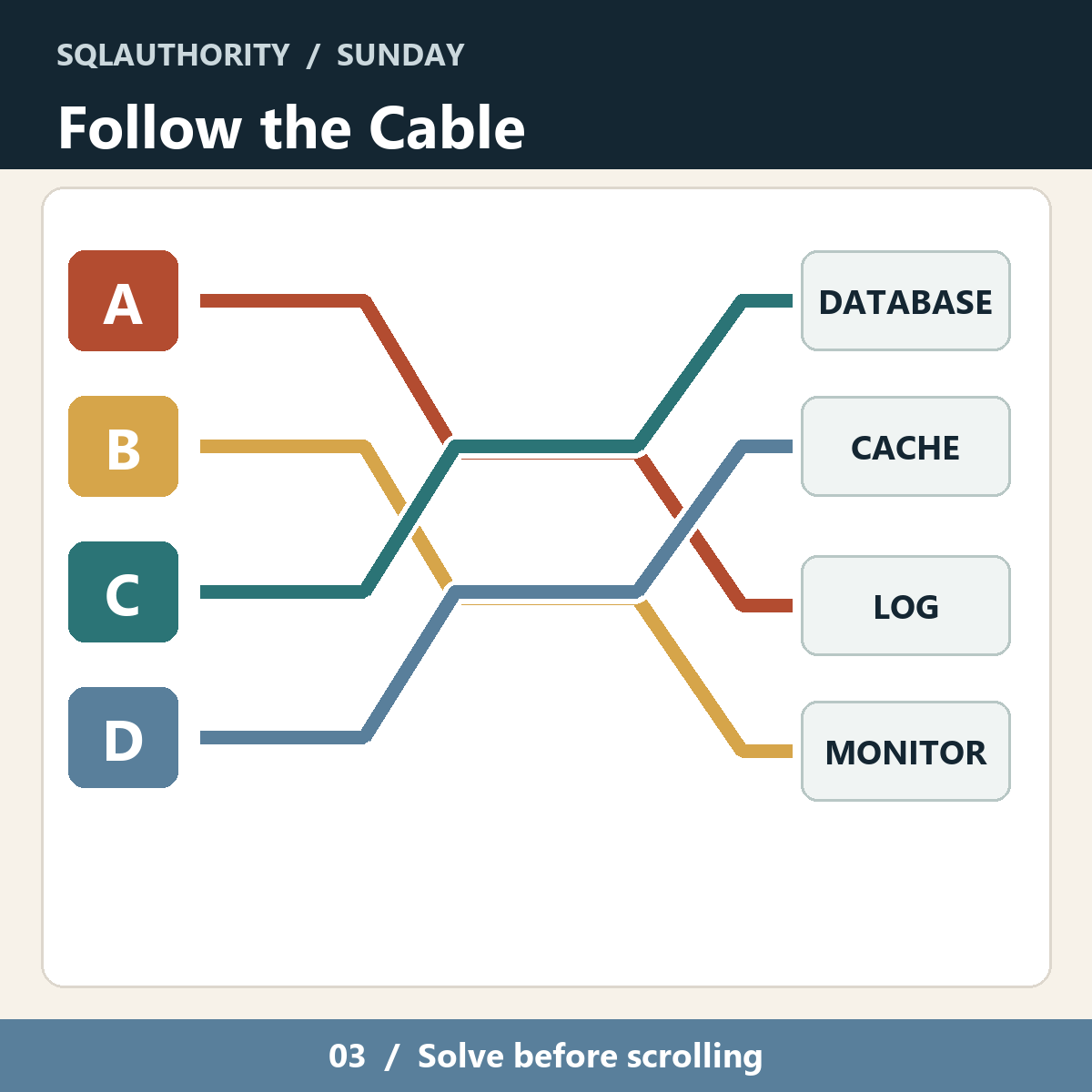
Four cables cross behind a rack. Which cable reaches the database? Follow it without lifting your finger.
There is a moment in every troubleshooting call when someone says, ‘The application talks straight to the database.’ Sometimes that is true. Sometimes there is a cache, a proxy or a service in the middle, and the sentence skipped the interesting part.
Today’s picture is a small path-finding game. Four cables leave the boxes marked A, B, C and D. On the right are DATABASE, CACHE, LOG and MONITOR. A crossing is not a junction. Keep following the same coloured cable through the crossing and name the letter that reaches DATABASE. If you are viewing this on a phone, turn it sideways if you prefer. The lines are thick on purpose.
Do not guess from where a cable begins. The paths bend. I would trace one at a time, starting at the label on the left, and stop when it reaches a box on the right. You can check your answer in the next section.
Which Cable Reaches the Database: The Answer
C reaches DATABASE. A goes to LOG, B goes to MONITOR, and D goes to CACHE. The coloured paths cross, but none splits or merges. That is why following the cable is different from looking at the most direct line across the page.
If you traced A and then jumped to C at the central crossing, you found the intended trap. It is easy to treat two touching marks as a connection. In the finished diagram each cable has its own continuous colour and a white edge at crossings so that the path can be checked rather than guessed.
Real systems have more than four tidy cables, but the habit still holds. When a request is slow, draw or verify the path it actually takes. Where does the application send the call? What sits between it and SQL Server? Is the delay on the network, in a service, or in the query itself?
The point is not to blame the network. The point is to find the right path before choosing a fix. For today, the reward is smaller: you can tell the database cable from the monitoring cable without crawling under anyone’s desk.
Published by Pinal Dave on SQLAuthority. More of my work at pinaldave.com.
Discover more from SQL Authority with Pinal Dave
Subscribe to get the latest posts sent to your email.
