
Part one of ten. Most AI interview questions start here, even for senior roles. Someone asks you to explain a large language model in plain words, and your answer tells them more than your resume does.
1. What is the difference between AI, machine learning, deep learning and generative AI?
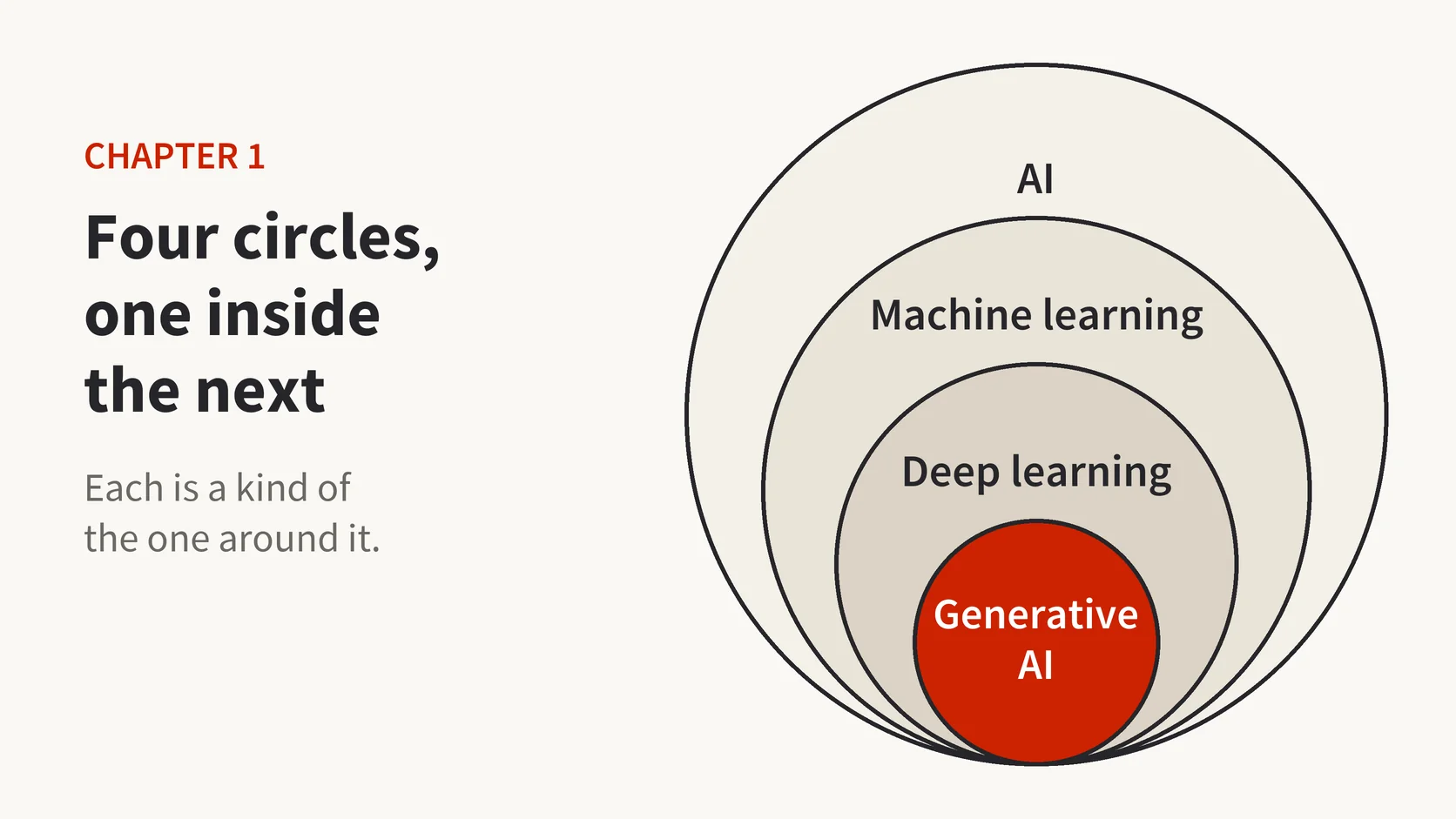
Think of four circles, one inside the next. AI is the widest: any system that does work we’d call judgment. Machine learning sits inside it and learns patterns from data instead of hand-written rules. Deep learning uses many-layered neural networks, and everyday generative AI uses them to create something new.
Why it matters. All four can show up in one data platform. A fraud score trained on last year’s transactions is machine learning. The assistant that drafts your query is generative AI.
What the interviewer wants. Nested circles, not four rival products. One real example in each circle beats a memorised definition.
2. What is a large language model?
A model trained on huge amounts of text to predict what comes next. Give it the start of a sentence, and it picks a likely next piece of text, then the next. Everything it writes, from an email to a SQL query, is built that way.
Why it matters. It explains both the strengths and the mistakes. A model writes fluent SQL because it has seen a lot of SQL. It has never seen your database, so it can write a confident query against a column you don’t have.
Watch out. Don’t say it stores the internet. It learned patterns from its training text and keeps no searchable copy.
3. What is the difference between training and inference?
Training is when a model learns. Inference is when you use the finished model: you send a prompt, and it produces an answer.
Why it matters. Training is a big upfront cost, and inference adds cost every time the model runs. Most cost and speed questions a data team faces are inference questions. That’s where the monthly bill comes from.
Watch out. Using a model doesn’t train it. Your prompt goes through inference, and the parameters stay exactly as they were.
4. What is a knowledge cutoff?
The date the model’s training data ends. Ask about something newer, and it either admits it doesn’t know or guesses. Newer facts need a document you supply or a tool, such as web search.
Why it matters. In data work it shows up as old advice: a deprecated feature, a missing new function, or no knowledge of your database’s latest version. The answer still sounds current, because the model has no sense of today’s date.
The follow-up. “How do you find a model’s cutoff?” The vendor publishes it. Asking the model isn’t reliable, because it can be unsure of its own.
5. Does a model learn from my conversation while I use it?
Not while you’re chatting. The parameters don’t change during a conversation. Some products add a memory feature that saves notes and feeds them back later, and that’s the app storing text, not the model learning.
Why it matters. This is the real question behind “can I paste customer data into this?” The live model won’t learn it. The vendor can still keep it, log it or train a future model on it, depending on the settings and the terms.
What the interviewer wants. Three separate things: the live model, the app’s memory feature and the vendor’s data policy. Weak answers blur them into one.
Five minutes, any AI assistant
Find where its knowledge stops. Turn web search off if the tool lets you, then ask two questions in a fresh chat:
What is your knowledge cutoff?
What is the newest version of [your database product], and what changed in it?
Compare both answers with the vendor’s own website. Did it name an old version as the newest? Did it hedge, or did it state the wrong thing plainly?
That second answer is the knowledge cutoff biting, and now you have a story about it rather than a definition.
Why this is worth a book
Chapter 1 has ten of these, and it’s the vocabulary the other nine chapters stand on. It also covers transformers in plain words, reasoning models, open-weight against closed models, and the difference between a chat assistant and a coding assistant.
100 AI Interview Questions and Answers for Data Professionals has a hundred questions across ten chapters, each marked Starter, Working or Senior. It’s in Kindle (also on Amazon.in), paperback and audiobook.
Part two is about tokens, and why the model can’t count the letters in strawberry.
Generative AI is not the whole of AI, it is the smallest of four circles.
Published by Pinal Dave on SQLAuthority. More of my work at pinaldave.com.
