

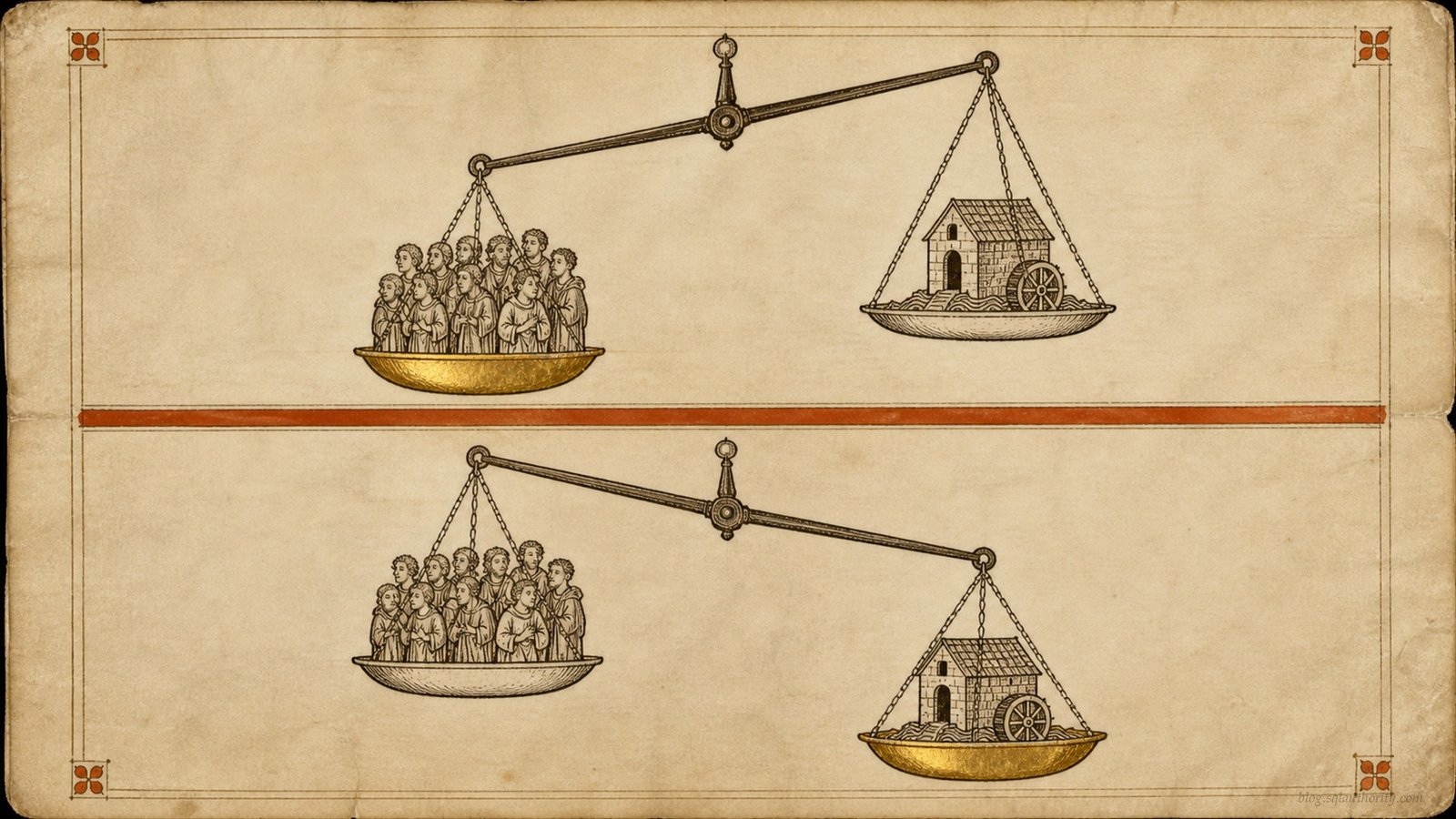
Your second skill was never a parachute, and the proof is six hundred years old. In 1349, with the Black Death tearing through England, the king’s council passed an emergency law to freeze wages, then spent the next forty years trying to outlaw basic supply and demand. Understanding why that effort failed is the clearest way to understand what is happening to our own careers today.
The same balance, drawn twice. Labour outweighs capital above. Below, it does not.
The Black Death reached England in 1348 and killed somewhere between a third and a half of the population within roughly two years. For the survivors the consequence was immediate. Land was suddenly abundant and people were suddenly scarce. Labourers, and especially the unfree tenants who had held the least room to bargain, discovered they could walk to the next county and be paid more for the same work.
The landowning class responded the way landowning classes do. Parliament could not even sit that year, so the king’s council issued the Ordinance of Labourers in June 1349, and Parliament followed with the Statute of Labourers once it reconvened in 1351. Both tried to freeze wages at their 1346 levels and compel every able-bodied person under sixty, women included, to accept work at those rates.
What often gets forgotten is that the law actually worked at first. Prosecutions through the 1350s were vigorous and reasonably effective, and real wages did not jump immediately after the plague, despite the shortage. The law genuinely held the line.
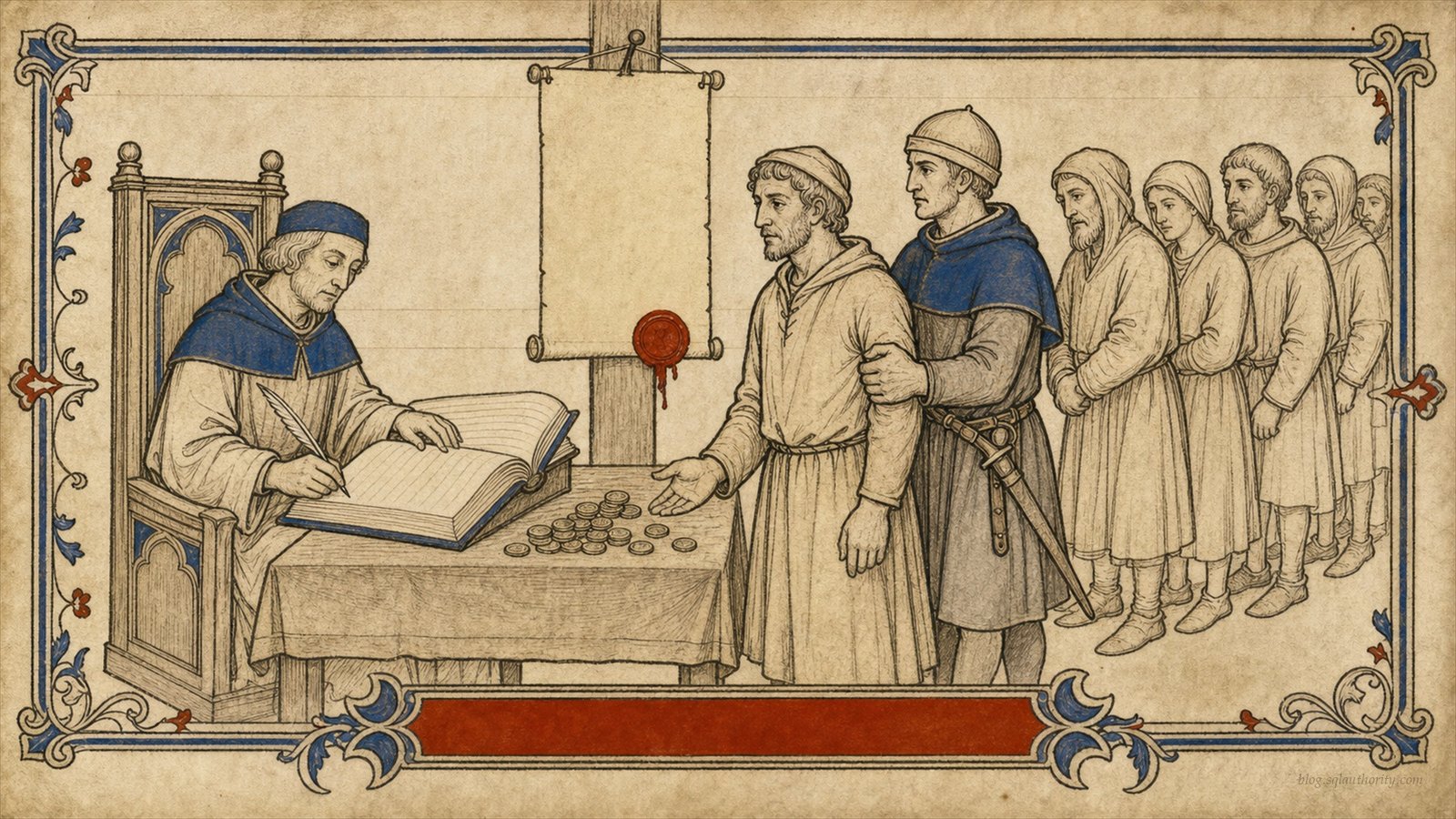
Enforcement was patient, administrative and effective. It held the line for about forty years.
Eventually, market reality caught up. The wage caps became one of the standing grievances behind the revolt of 1381. By 1388 the state conceded, passing new statutes with legal maximums set well above pre-plague levels. Real wages climbed across the following century and serfdom eroded. England had legislated against arithmetic and bought itself about forty years.
Everything that enriched that peasant came down to a single ratio, and it balances like a scale: how much labour was available, set against how much capital needed it. The plague made working humans scarce, and scarcity did the rest.
Artificial intelligence is the first shift since the fourteenth century capable of moving that same ratio at comparable speed. This time the arrow points the other way.
What flowed toward the peasant in 1360 flows back the other way now. And it will be just as difficult to legislate against, for the same reason.
The Two Clocks
Economists love to reassure working professionals that technology has never destroyed jobs in aggregate. Historically, they are right. But telling that to someone whose industry is shrinking is like telling a drowning swimmer that the ocean is calm on average.
Technology doesn’t instantly erase work; it reprices it. And that repricing runs on two completely unsynchronised clocks: capital captures the cost savings in a few quarters, while labour takes nearly a generation to reallocate.
Everything painful lives in the distance between those two clocks. Government agencies measure what they can reach. The Bureau of Labor Statistics has tracked displaced workers and re-employment rates for decades. But no statistical series captures the private erosion of a household, or the quiet second-order losses that nobody ever attributes to technology. Those losses happen one family at a time, and the gap between those two clocks is never listed as a line item on any budget.
AI will create jobs. I have no argument with that. My question is who pays the interest while we wait.
The Fifty-Year Footnote
David Ricardo spent most of his career arguing that machinery served everybody. Then, in 1821, he added a chapter called “On Machinery” to the third edition of his Principles of Political Economy and Taxation, and publicly reversed himself. The substitution of machinery for human labour, he now concluded, is often very injurious to the class of labourers.
He was the most respected economist of his age, and he changed his mind while staring at the same figures everybody else was busy celebrating.
What he was staring at is now called Engels’ Pause. Across roughly the first half century of British industrialisation, output per worker climbed steadily and real wages did not. Profits rose. Living standards for working people flattened, and by several measures got worse, for decades.
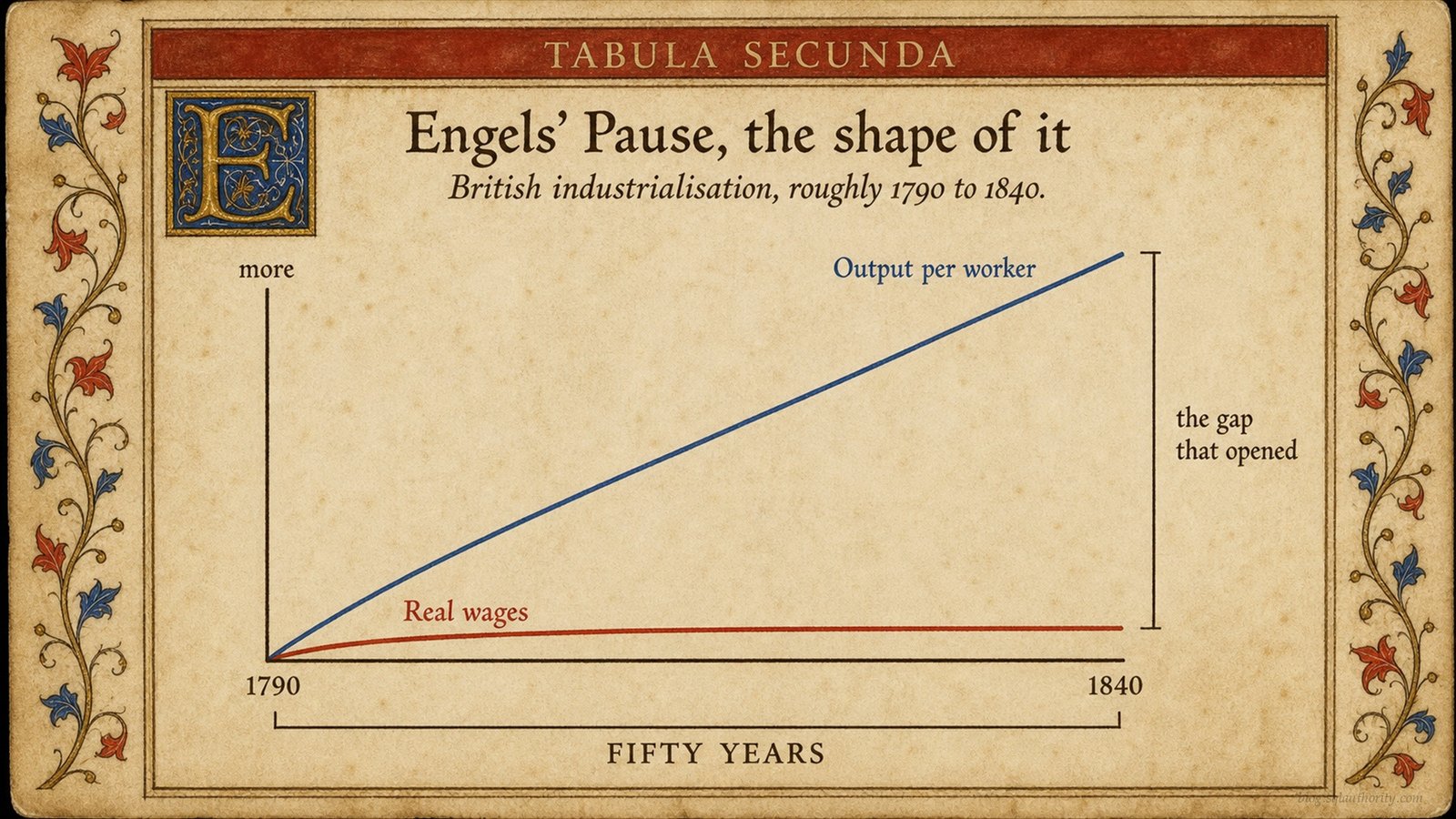
Output climbed. Wages did not. The vertical axis carries no scale on purpose, because this is the shape of a documented finding rather than a plotted series.
Two generations lived inside that clause. Their grandchildren inherited the prosperity, which is the part the optimists quote, and it was no comfort whatsoever to a man who was thirty-eight in 1815.
The Luddites belong here, because almost everything popularly believed about them is wrong. They were not a mob, they were not unskilled, and they were not frightened of machinery. They were among the best paid working men in England: framework knitters, croppers and weavers, all of whom had served long apprenticeships, spread across Nottingham, Yorkshire and Lancashire from 1811.
The machines that arrived were cheaper rather than better. Wide frames and gig mills let workers who had served no apprenticeship turn out goods of visibly lower quality at a fraction of the cost. A cropper in 1812 was as good at his trade as any cropper before him, and worth a fraction of the wage. That is the entire Luddite grievance, and it is the same sentence as this essay.
They organised, signed their letters as General Ludd, a man who never existed, and broke the frames. Parliament answered with the Frame Breaking Act in 1812, making the destruction of a stocking frame a capital offence, and Byron gave his maiden speech in the House of Lords against that bill and lost.
A special commission sat at York in January 1813: sixty-four men tried, seventeen hanged, twenty-five transported to Australia.
They were right on the economics. They were hanged anyway.
Four transitions, laid out side by side.
| Episode | Period | The gain, and how fast it landed | The adjustment, and how long it took |
|---|---|---|---|
| Mechanised textiles, Britain | c. 1790 to 1840 | Output per worker and the profit share rose from the outset | Real wages flat for about fifty years |
| American agriculture | 1900 to 2000 | Yield per acre and per worker rose continuously | Farm share of the workforce fell from roughly 40 percent to under 2 percent, across four generations |
| Automatic telephone switching | 1950 to 1984 | Cost per call fell as switching automated, network scale exploded | Switchboard operators went from roughly 342,000 to about 40,000, and the steepest losses came decades after the technology existed |
| Detroit motor manufacturing | 1950 to 2013 | Productivity and profit followed the industry wherever it moved | City population fell from about 1.85 million to roughly a third of that, ending in municipal bankruptcy |
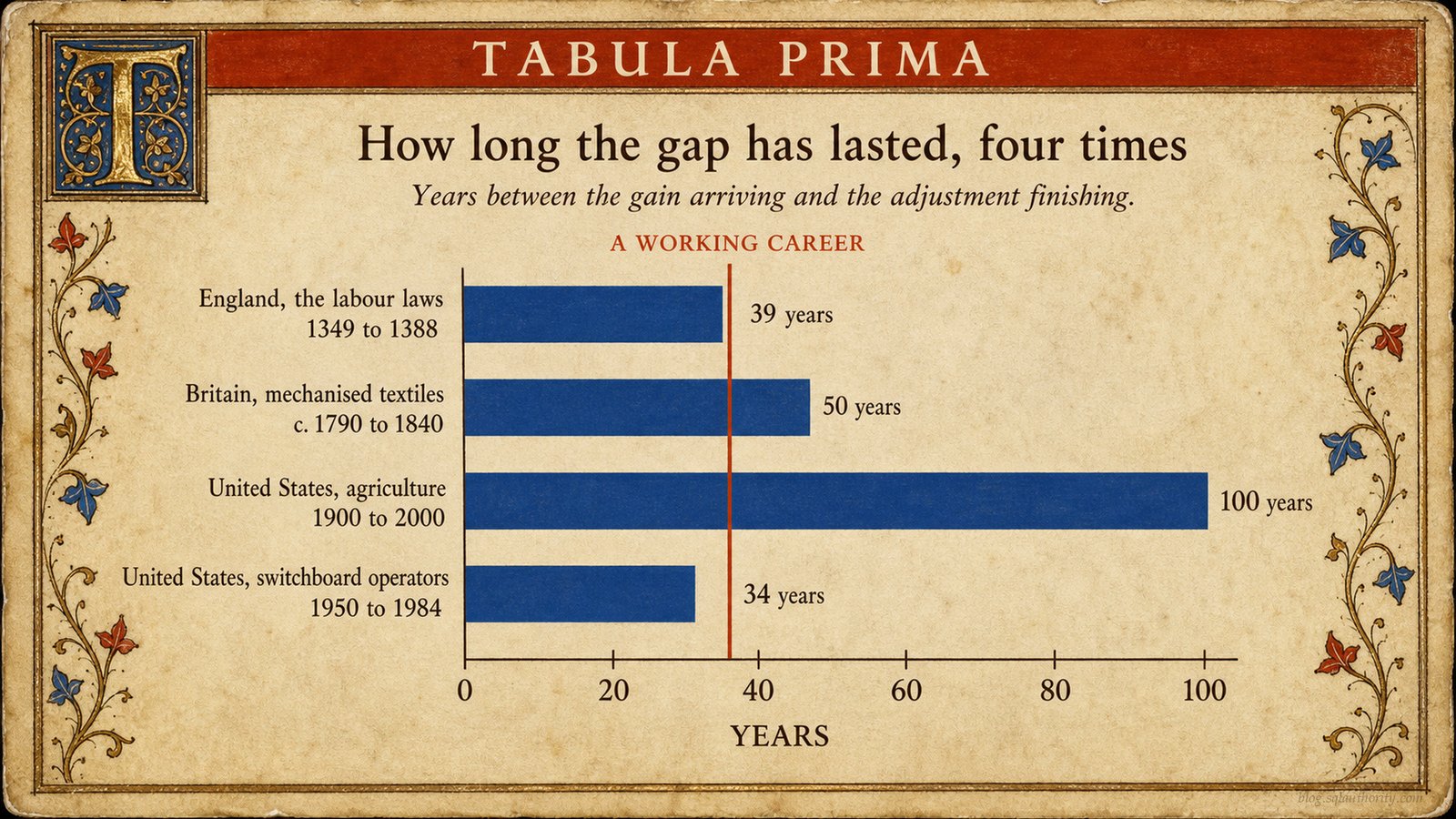
Four adjustments, measured. The vermilion line is a forty-year career. Two of them outlast it.
Read the four together and one thing stands out. The most recent, running from 1950 to 1984, took thirty-four years. The oldest, running from 1349 to 1388, took thirty-nine. Six centuries of progress bought five years.
Detroit is the loosest of the four, and it belongs here with a caveat. Relocation, foreign competition, suburbanisation and a long fiscal collapse all pulled alongside automation, so it is evidence about what happens to a concentrated economy, not a clean parable about machines.
The gains from every one of those transitions are still with us. Not one of them arrived in time for the people who were standing in it.
Your Second Skill Was Never a Parachute
Ask any senior professional what they would do if their primary role vanished, and they almost always have a ready answer: they will teach, they will consult, they will join a smaller firm, or they will fall back on whatever technical work they did before they specialized.
A lot of professionals sleep well at night relying on that fallback plan. Unfortunately, it fails on three practical counts:
The fallback sits one rung lower. Almost by definition, the skill you retreat to is less complex than what you do now. Less complex means more routine, better documented, and easier to automate. You are effectively cutting an escape hatch into the part of the hull that is already below the waterline.
A fallback only works if you are the only one falling. These plans quietly assume an open market and a short line. But when a transition hits, thousands of displaced peers from your exact industry arrive in the same quarter with the identical secondary skill.
You are a specific factor. Economists have understood this dynamic for a century: mobile inputs pivot between sectors effortlessly, while specialized inputs absorb the full shock. Twenty-two years of hard-won domain expertise on one platform in one industry is the textbook definition of a specific factor. Everything that made your judgment valuable was built to be non-transferable.
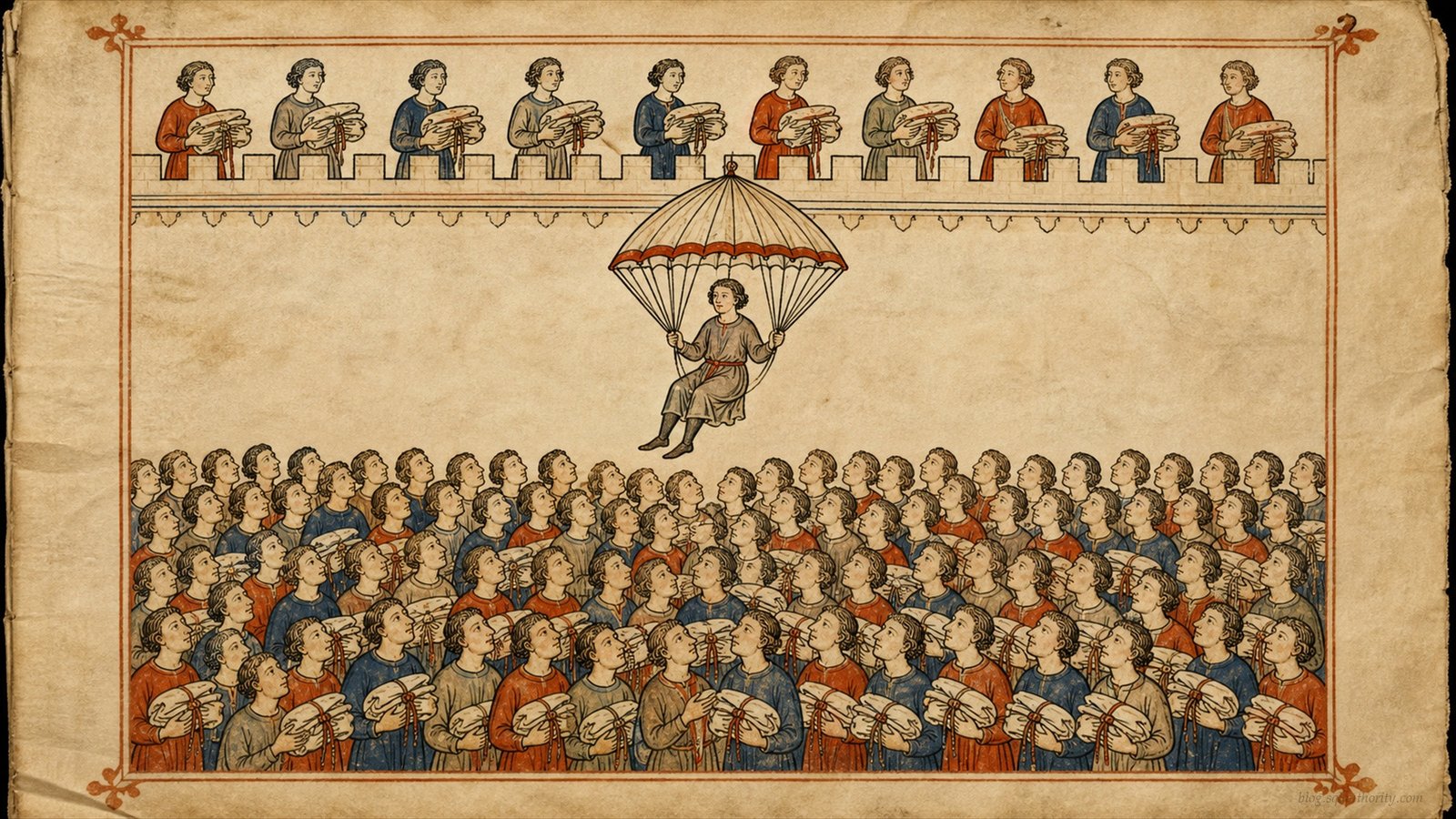
Everyone on the wall brought the same plan, and the ground below is already occupied.
When you break down the most common backup plans, the structural flaws become obvious:
| The plan | The assumption hidden inside it | Why the assumption breaks |
|---|---|---|
| “I will teach.” | Teaching demand is stable and entry is open | Training budgets are the first line cut in any downturn, and every displaced senior in your field arrives with the identical plan in the identical quarter |
| “I will consult.” | Your network will buy your judgment | Your network is your sector, and your sector is cutting this exact line of spend for the same reason you are available |
| “I will join a smaller firm.” | Small firms are insulated from all this | They adopt more slowly, which is real, but they also carry far less slack. Census figures put AI use among the largest employers at roughly double the rate of the smallest, and the small firm’s budget is the first thing cut when its larger customers start economising |
| “I will go back to hands-on work.” | The lower rung is still there | The lower rung is better documented, easier to specify, and automated before the rung you are standing on |
And then there is the resale problem.
A displaced machine retains salvage value. It can be sold, exported to a lower cost market, or stripped for parts. Deep human expertise has no salvage market at all. There is no exchange on which a career can be sold, no buyer of last resort, and no scrap price.
You spent two decades building an asset, and it depreciated without ever appearing in a single set of accounts.
The labour literature calls what follows hysteresis. Long spells out of work do more than postpone income. They reduce the probability of ever returning to prior earnings, because skills decay, networks thin, and employers read the gap as information. A gap on its own is survivable. What does the damage is that the gap starts feeding on itself.
The Ladder That Lost Its Bottom Rungs
Firms automate entry-level work first, and not out of malice. They do it because junior tasks are documented, routine, and easy to specify.
But you cannot hire a seasoned senior out of thin air. Deep expertise is grown slowly, and the soil it grows in is junior work. If you saw off the bottom three rungs, the ladder doesn’t get shorter. It just means that in ten years, there is nobody left to promote, and nobody notices until the day they go looking.
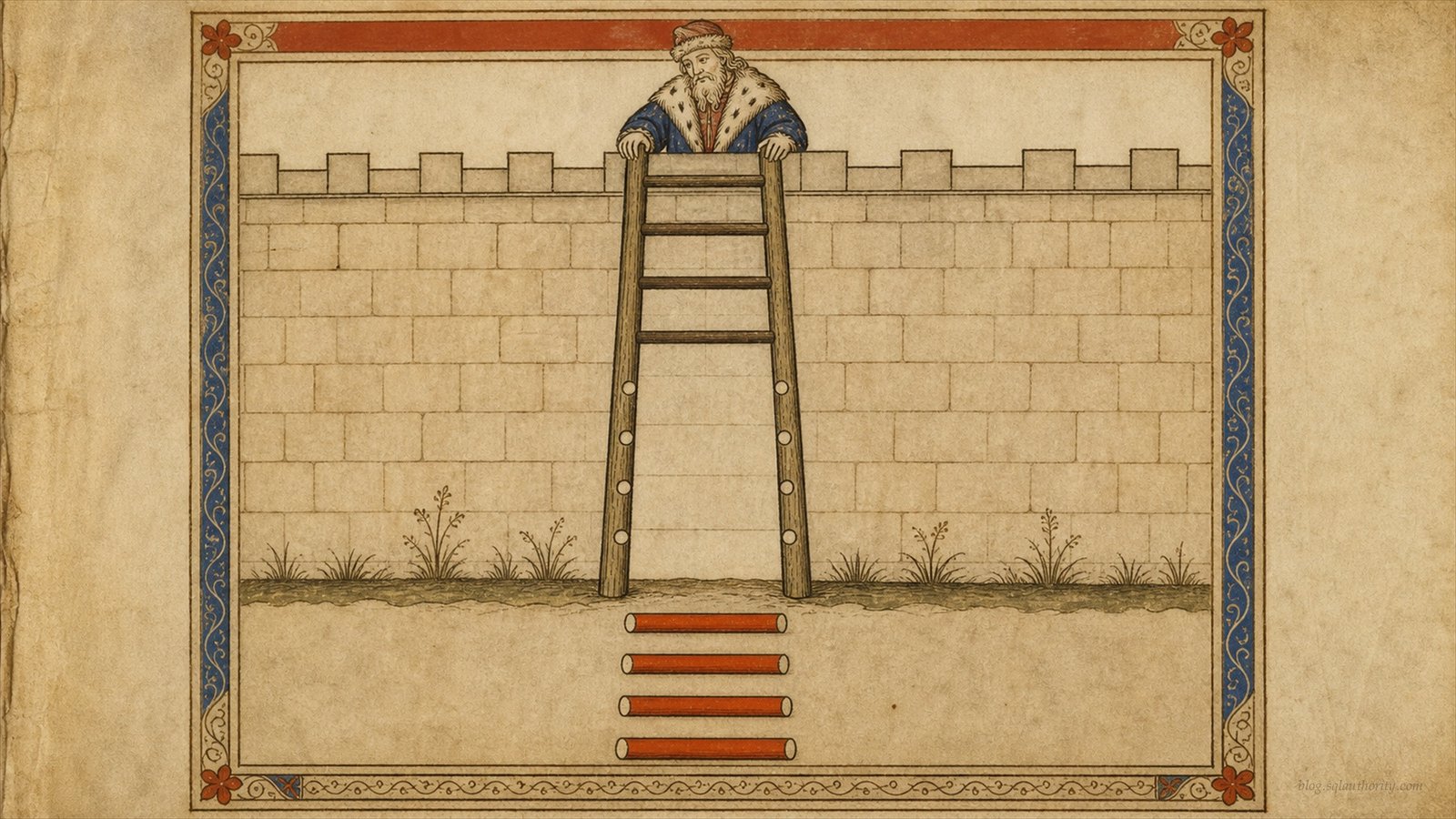
The cut rungs are still lying at the foot of the wall. The man at the top has nobody coming up behind him.
Keep an eye on job vacancies and unemployment numbers together over the coming years. The Beveridge curve plots one against the other. When both run high at the same time, weak demand is no longer the issue. The jobs on offer and the people available have stopped being the same shape.
A labour market can starve and drown at the same time, and ours is quietly arranging to do both.
The Layoff That Is Never Announced
Most professionals affected by this transition will never receive a pink slip. They will simply stop being scarce.
Salaries track scarcity. When the supply of adequate substitutes surges, wages rarely drop on paper because cutting nominal pay destroys morale. Instead, pay freezes in place, and inflation quietly performs the pay cut that management didn’t want to announce.
You don’t need a predictive model to see how this plays out. Take a salary that is never officially cut and never raised, and watch what inflation alone does to real purchasing power:
| If inflation runs at | Real income after 5 years | After 10 years |
|---|---|---|
| 3 percent | down about 14 percent | down about 26 percent |
| 4 percent | down about 18 percent | down about 32 percent |
| 5 percent | down about 22 percent | down about 39 percent |

The same coin, the same purse, the same payslip. Only the loaf changed size.
A third of a career’s earning power removed with no meeting, no severance, no consultation period, and no entry in any layoff tracker anywhere. The employee is still employed. The payslip still says the same number, which is why nobody protests.
There is no press release for a denominator.
The Tea Stall Was Never in the Tech Sector
Economists divide local economies into tradable and non-tradable sectors. Tradable output is sold globally; non-tradable services are consumed where they are made. High-paying tradable jobs create a powerful local multiplier, sustaining several service workers around every single engineer.
What people overlook is that local economic multipliers run in reverse just as quickly.
Three thousand engineers on one campus don’t just fill an office building. They feed an entire neighbourhood. Outside a tech campus in Hyderabad that means the tea stall and the auto stand. Outside one in Austin or Seattle it means the coffee cart and the daycare. None of them appear in technology sector headcount, but every single one of them is funded by technology payroll:
- the tiffin service and the lunch cart
- the cab drivers and the auto stand outside the gate
- the salon, the tailor and the dry cleaner
- the crèche that exists because two salaries in one household require it
- the security guards, the housekeeping staff, the canteen contractor
- the man who repairs phone screens on the corner
- the landlord of every flat within a twenty-minute commute
Not one of those people works in technology. Every one of them is technology funded.
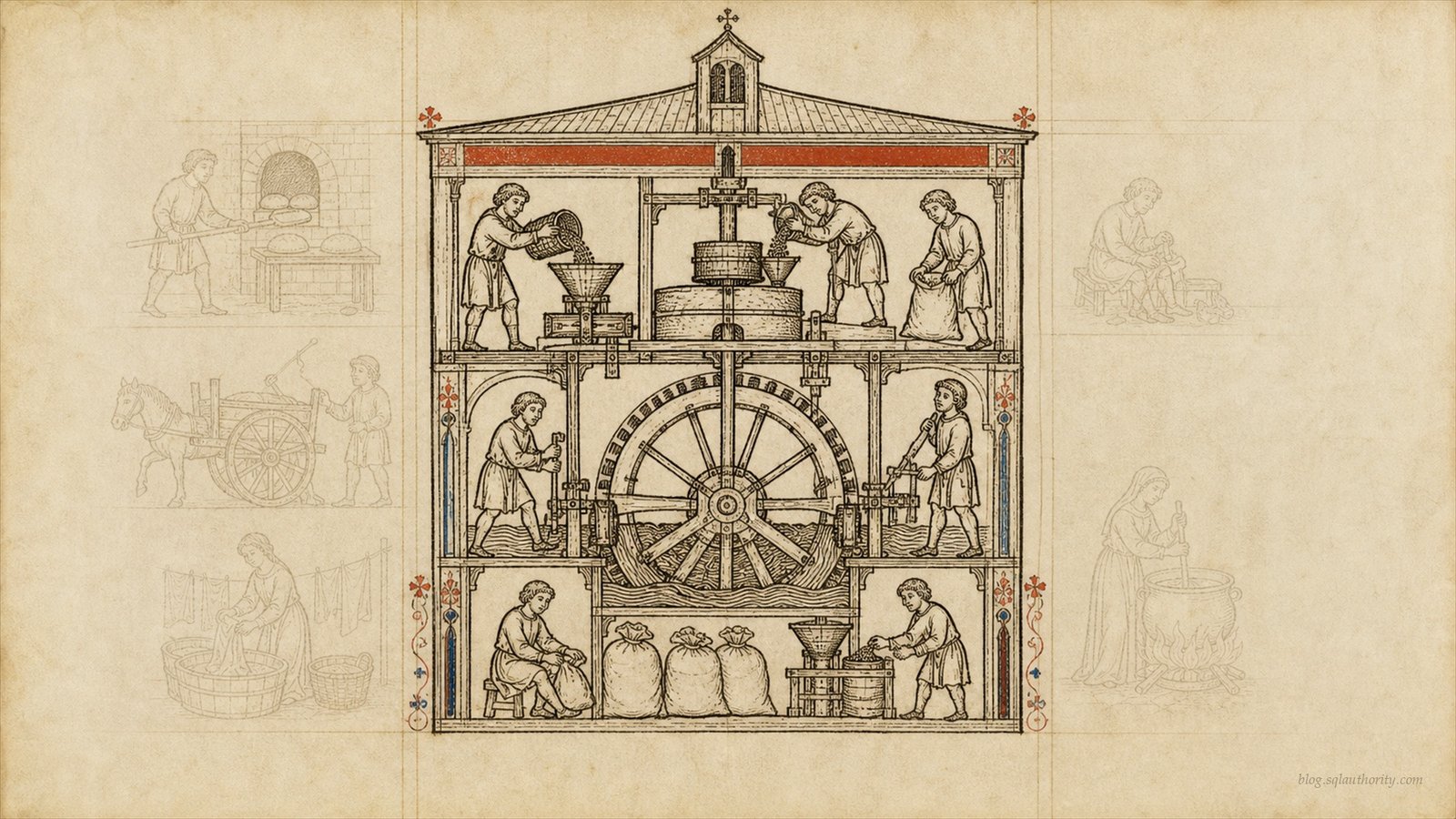
The mill is fully inked. The trades around it fade off the edge of the page, which is where they sit in the statistics.
When corporate headcount is cut, the engineer receives a severance package, outplacement support, and a data point in national employment statistics. The tea stall receives nothing, and whatever economic pain eventually reaches it will never be linked to a technology shift in an industry it was never part of.
The engineer is measured. The people who lived off the engineer are not.
The Restaurant Knows Before the Payroll Does
Friedman’s permanent income hypothesis says households do not spend according to this month’s income. They spend according to their expectation of lifetime income.
Which flips most of the commentary on its head. Discretionary spending does not wait for income to fall. It responds to the moment people stop believing in next year, and that arrives months earlier, while the salary is still landing on time.
So the mall empties before the redundancies are announced. The second car is deferred. The gym membership lapses. The holiday shrinks into a long weekend, and the long weekend shrinks into a day trip. The restaurant sees it first, and it sees it in a customer who is still fully employed.
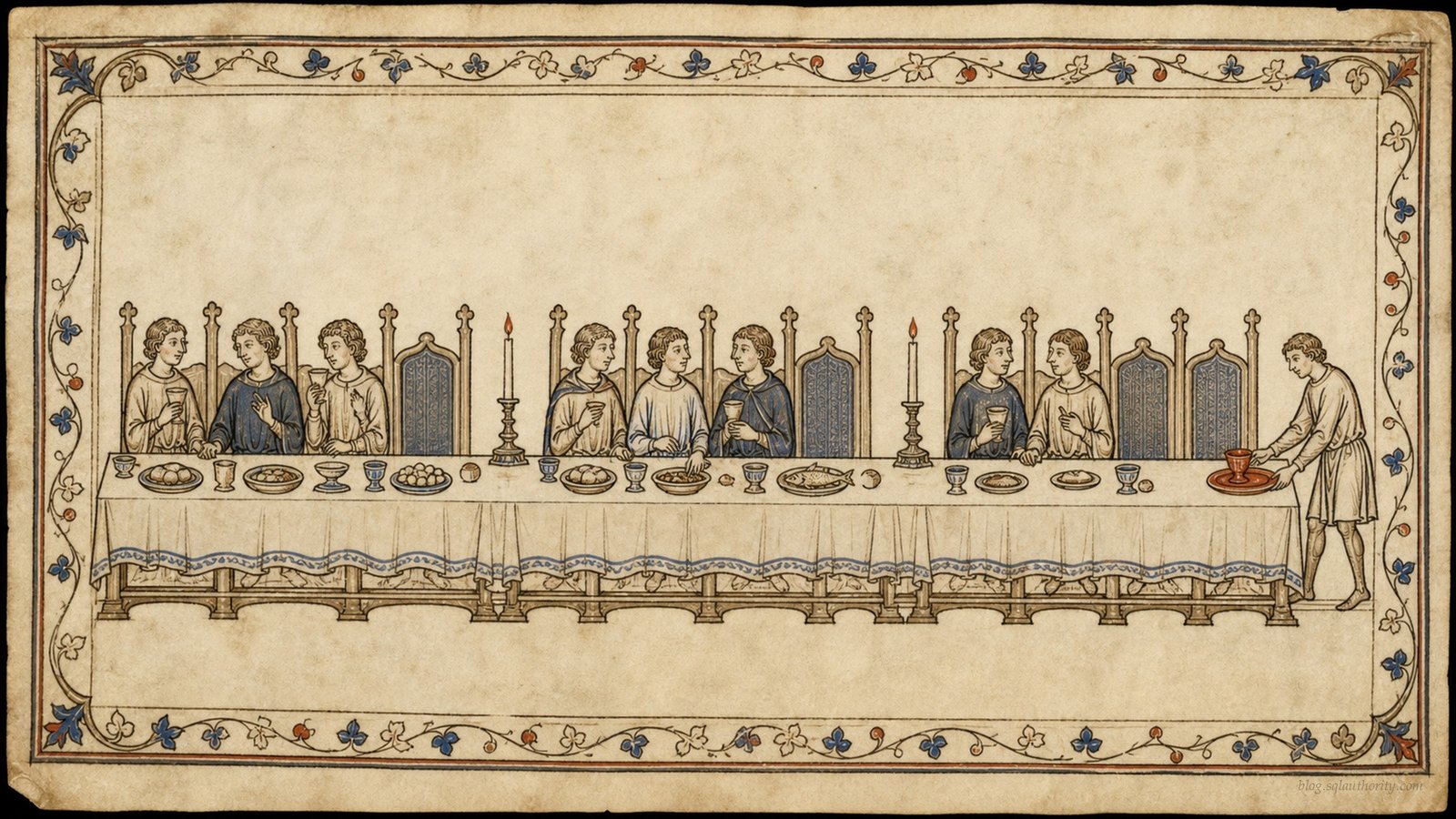
Three seats already empty, a fourth setting going quietly. Nobody at the table has looked up.
All of this gets filed as lagging consumer sentiment. It is the earliest honest data anyone has, collected from people with no incentive to dissemble and no press office to manage the message.
The luxury economy is a confidence instrument wearing a retail costume, and it reprices before anything else does.
The sequencing is cruel. Malls, restaurants, aspirational retail and discretionary travel are among the largest employers of the people with the least capacity to retrain into anything. They lose their jobs to an automation wave that never touched their industry, and they lose them before the wave has formally arrived.
The order rarely varies. Almost nobody reads it in sequence:
| What happens | Who absorbs it | |
|---|---|---|
| 1 | Discretionary spending stops | Shop and restaurant staff. Every customer still employed. |
| 2 | Local services contract behind it | The tea stall, the salon, the cab driver. Nobody in tech. |
| 3 | Gig rates soften as the displaced arrive | Gig workers already there, doing fine. |
| 4 | Hiring freezes replace firing | Anyone trying to move. Everyone trying to enter. |
| 5 | Real wages erode under frozen pay | Tech workers who kept their jobs and never noticed. |
| 6 | Junior recruitment stops | Graduates now. The industry in ten years. |
| 7 | Single-sector property reprices | Anyone who owns near the corridor, tech or not. |
| 8 | Municipal tax receipts fall | Nobody yet. A line in a budget. |
| 9 | Public services degrade | Everyone, including people who never worked. Long after the private pain. |
Steps one through three are visible today in most technology corridors on earth. They are being read as consumer softness.
Now read the right hand column downward. The sequence begins outside the industry and ends outside the workforce, and technology itself does not appear until the fourth line.
You Did Not Build a Portfolio, You Built One Position Four Times
Millions have done everything they were told. Saved diligently, bought the apartment, held the employer stock. They believe they are diversified. Examine what those holdings actually are:
- The salary comes from the sector.
- The employer equity is the sector.
- The apartment is priced by the salaries of other people in the sector.
- The city those salaries are paid in exists because of the sector.
Several holdings. One risk factor.
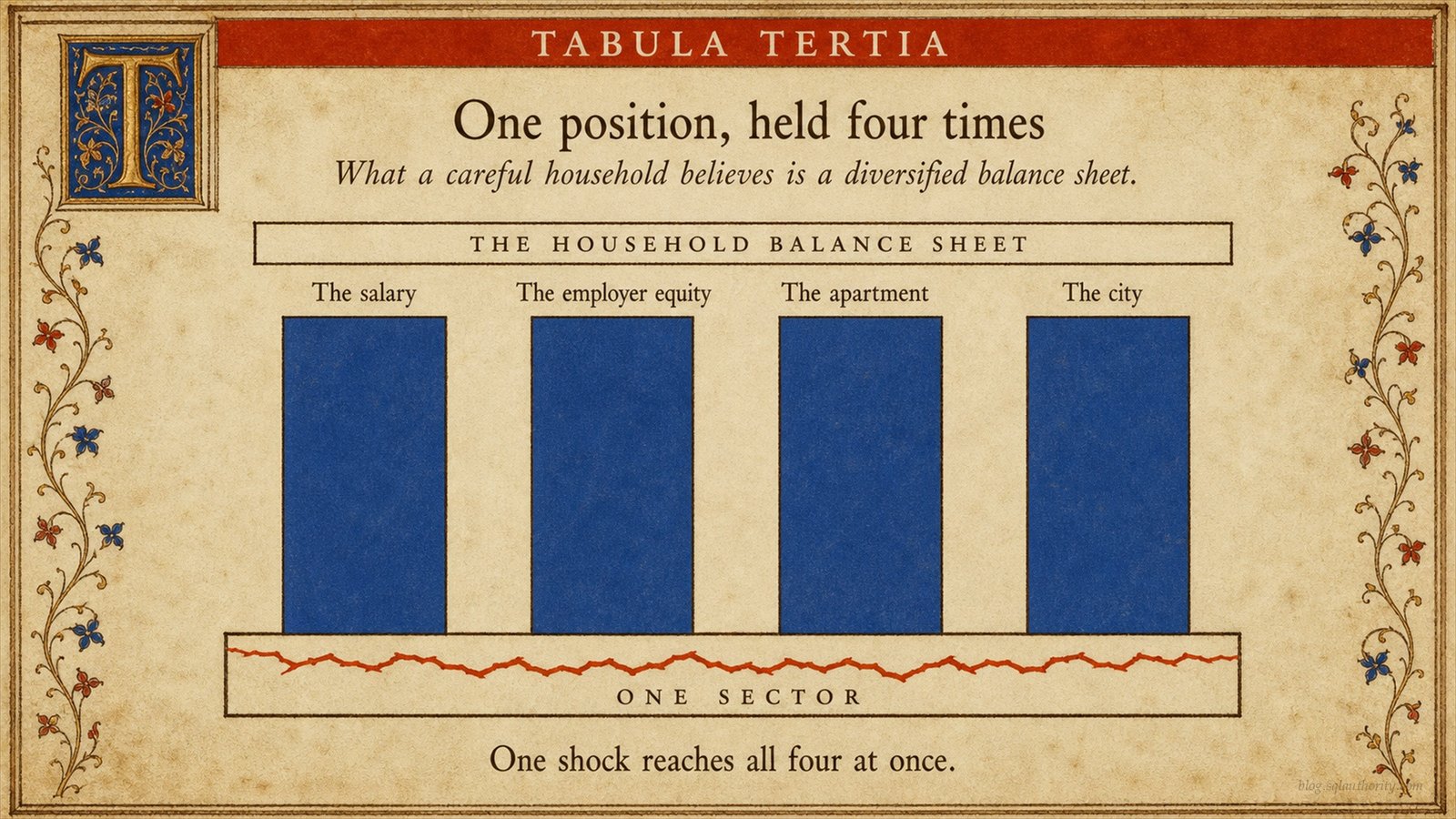
Four names on four statements. One plinth underneath all of them.
In portfolio terms this is a leveraged single position, with the concentration hidden behind instruments that carry different names on different statements. No competent fund manager would be permitted to hold it. Most households hold it without ever having decided to.
Then the aggregate problem, which is older and worse. Keynes described the paradox of thrift: when everyone economises at once, aggregate demand contracts, manufacturing the very downturn the saving was meant to survive.
Prudence is virtuous individually and deflationary collectively. Your caution is somebody else’s redundancy.
The savings were also sized for the wrong shape of event. They were calculated as a bridge, priced against an assumption of resumed income growth on the far bank.
If the far bank turns out to be a permanently lower plateau, the arithmetic stops describing a difficult year and starts describing a smaller life. Very few households have run that version of the spreadsheet, and the ones who have tend not to discuss it at dinner.
The Cushion That Charges Rent
Gig platforms will absorb the displaced, but that creates its own failure mode.
Gig platforms do not turn people away at the door the way traditional employers do. They ration quietly from the inside: how much work the algorithm offers you, what your rating qualifies you for, or whether your account stays active.
When supply surges, the adjustment never arrives as a rejection letter. It shows up as thinner work and lower earnings spread across everyone, including the workers who were already there and managing fine.
Very few labour markets pass the cost of an industry downturn quite so directly onto the people already working inside them.
The driver who was managing fine becomes poorer because someone else lost their job, and no mechanism anywhere sends anyone the bill for it.
One-Industry Towns Do Not Decline Gently
When the American Civil War cut off the supply of raw cotton, the Lancashire mill towns collapsed within months. The Cotton Famine of 1861 to 1865 put an entire regional economy on relief. Lancashire had done nothing wrong. Lancashire had done one thing exclusively, which turned out to amount to the same.
Detroit is the version everybody knows. Population of about 1.85 million in 1950, roughly a third of that today, and the largest municipal bankruptcy in American history in 2013. Neither region adjusted smoothly, because concentrated economies do not adjust. They fail, and then re-form around something else decades later, usually staffed by different people.
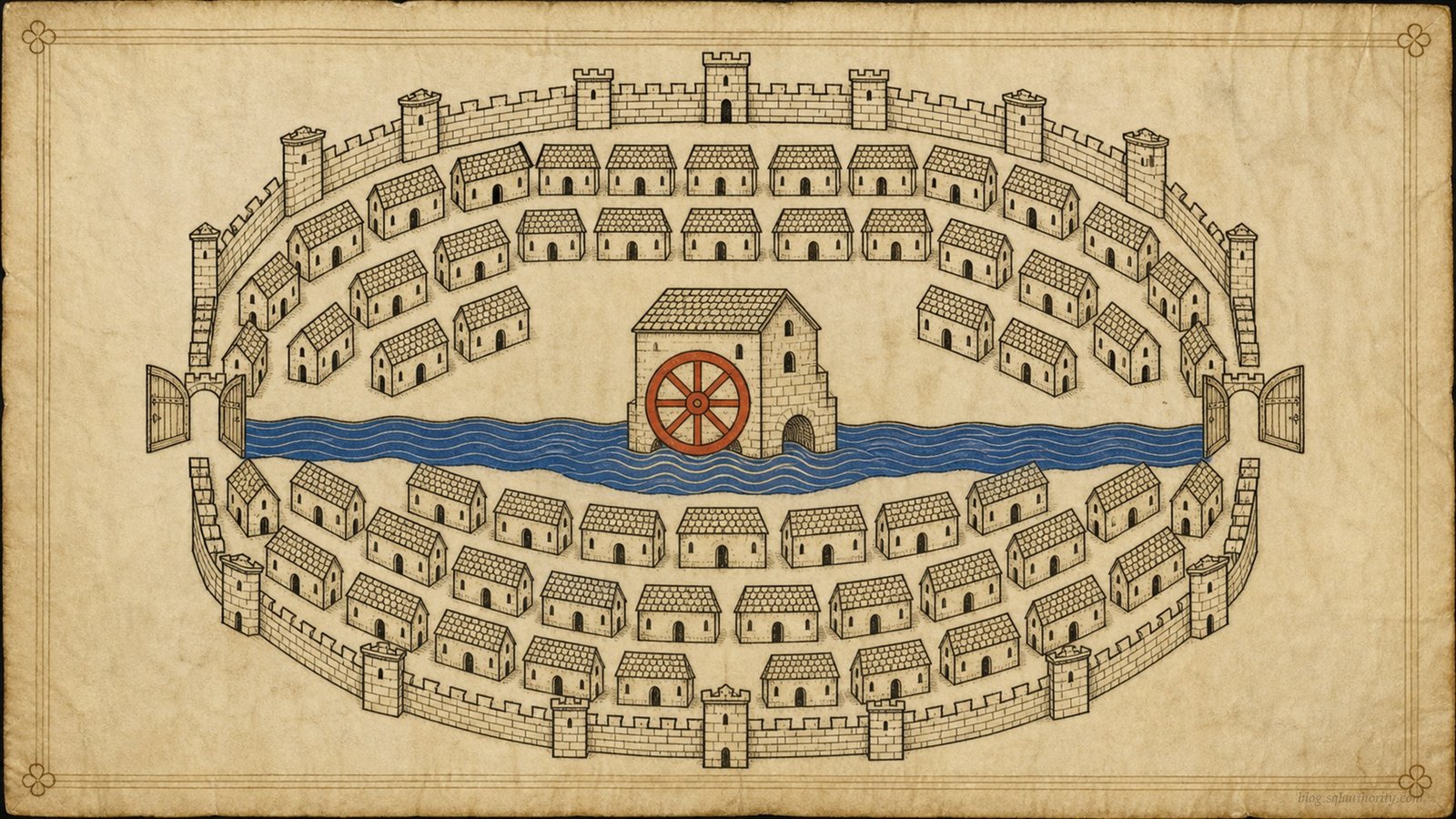
Every house is the same house, and all of them face one wheel. The wheel has stopped. The river has not, which is the hard part. Nothing that made this town possible has gone away, and the water is still running past the door. The town simply never found a second use for it.
Every major technology corridor on the planet is a monoculture. Increasingly, so is the household inside it. Families used to carry an implicit hedge in the form of two earners in two unrelated sectors. Now both partners are frequently in the same industry, often among the same handful of employers, in the same city, servicing the same mortgage on the same street.
The last effect is public and arrives late. Municipal services run on some mix of property, sales and income taxes, transfers from higher levels of government, and fees, and that mix varies enormously from one city to the next. What most of those sources share is that they lag household distress by years.
So the schools, the roads, the transport and the clinics degrade well after the private pain, at the moment the town can least afford the repairs.
The bill always arrives late, and always at the address least able to settle it.
The Statistic Everyone Quotes for Comfort
In 1900, roughly forty percent of the American workforce was in agriculture. Today it is under two percent. Nobody regards this as a catastrophe. It is the most common example cited by people arguing that automation always works out, and it gets quoted constantly.
Look closely at what that transition actually took. It required a century, massive urbanization, two world wars, the mechanization of the entire rural economy, a depression that put a quarter of workers out of work at its peak, and an unprecedented postwar education investment paid for by the state. That is four generations. Nobody who lost a farm in 1930 got anything back because their great-grandchild would one day write software.
Every argument that this works out is an argument about your great grandchildren, delivered to you as though it were about you.
The Economy Will Be Fine. That Is the Problem.
Output will not shrink. It will very probably grow.
Jevons showed in 1865 that making a resource cheaper to use tends to increase the total amount consumed. The modern illustration is the cash machine. Economists expected it to eliminate the bank teller, and for a long stretch teller numbers rose instead, because branches became cheap enough to run that banks opened far more of them.
Cheap analysis will not mean less analysis. It will mean vastly more of it, in places that could never previously afford any, and that expansion will create work nobody today can name.
Schumpeter called this creative destruction, and people only ever quote the first word.
The destination was never in doubt. The journey is where this gets expensive, and Frank Knight’s 1921 distinction is the one that matters here.
Risk is measurable, and anything measurable can be priced, hedged and insured. Uncertainty cannot be measured, and so cannot be priced at all. Public conversation about AI and employment is conducted in the language of risk. What we actually have is uncertainty.
Products do exist for the measurable slice. Unemployment insurance covers a spell out of work, and private involuntary-unemployment cover will service a loan for a few months. Nothing insures the thing this essay is about, which is a competence losing its price permanently. Nothing will, because that is uninsurable by definition rather than by oversight.
The real debate isn’t whether productive work will exist in twenty years. It will. The issue is who captures the economic surplus during the crossing, how long the transition takes, and who funds the crossing while an entire generation retools. The surplus arrives on a corporate calendar measured in quarters; the human adjustment runs on a career calendar measured in decades. Nothing serious has been proposed for the years in between, and that gap is where the real damage happens.
Picture what is missing. A bridge half built out from a crowded bank, stopping in the air above the water. On the far side, green and nearly empty, a small group already standing there, and behind them, pulled up on the shore, the boat they came in.
Boats are privately owned. Bridges are not.
A bridge only exists if enough people agree to pay for it before a single one of them can use it. A boat needs no such agreement. Nobody is building the bridge, and the people who already crossed have stopped asking when it will be done.
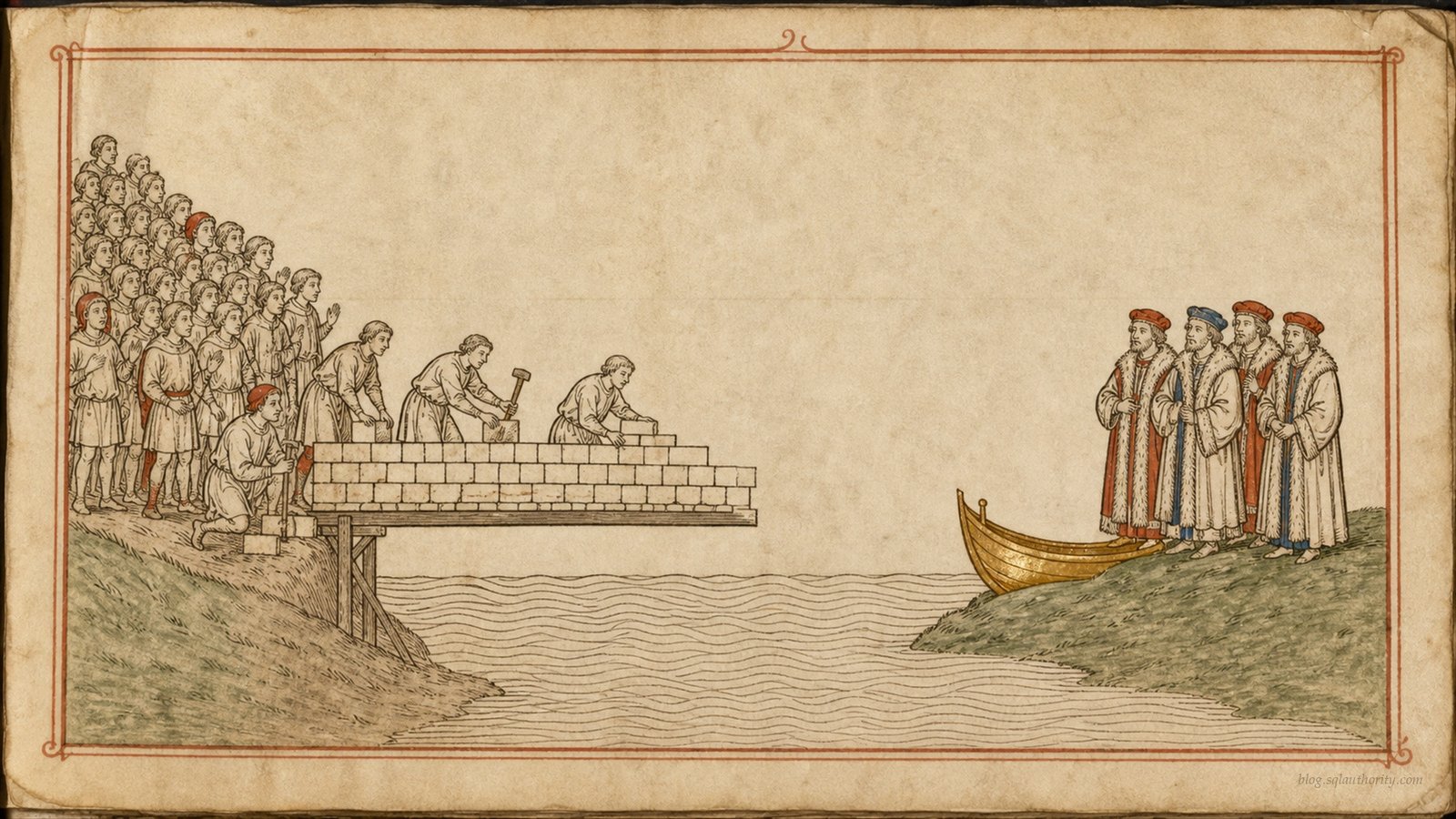
Half a bridge is not half a crossing. It is no crossing at all.
Thirty essays circling this from the human side are in my book AI: Nobody’s in There. But we’re still in here. The paperback is on Amazon. Every essay in it is also free to read at pinaldave.com and always will be, so buy the paperback if you would rather hold one. This one is the balance sheet version of the same worry.
In 1349 the men who wrote the law were the men the ratio was moving against. They had the courts, the bailiffs and the fines, they used all three seriously, and it bought them about forty years before the state conceded in writing. They lost in the end because arithmetic does not answer a summons.
This time the ratio is moving the other way, toward the people who write the laws rather than away from them. There is no powerful constituency that needs it stopped, and nobody is going to spend forty years fighting this one.
The machines are the least of it.
The gains arrive in quarters. The costs arrive in careers. And nobody has started building the bridge.
Reference: Pinal Dave (https://blog.sqlauthority.com/), AI and the Economics of Job Loss, X
