

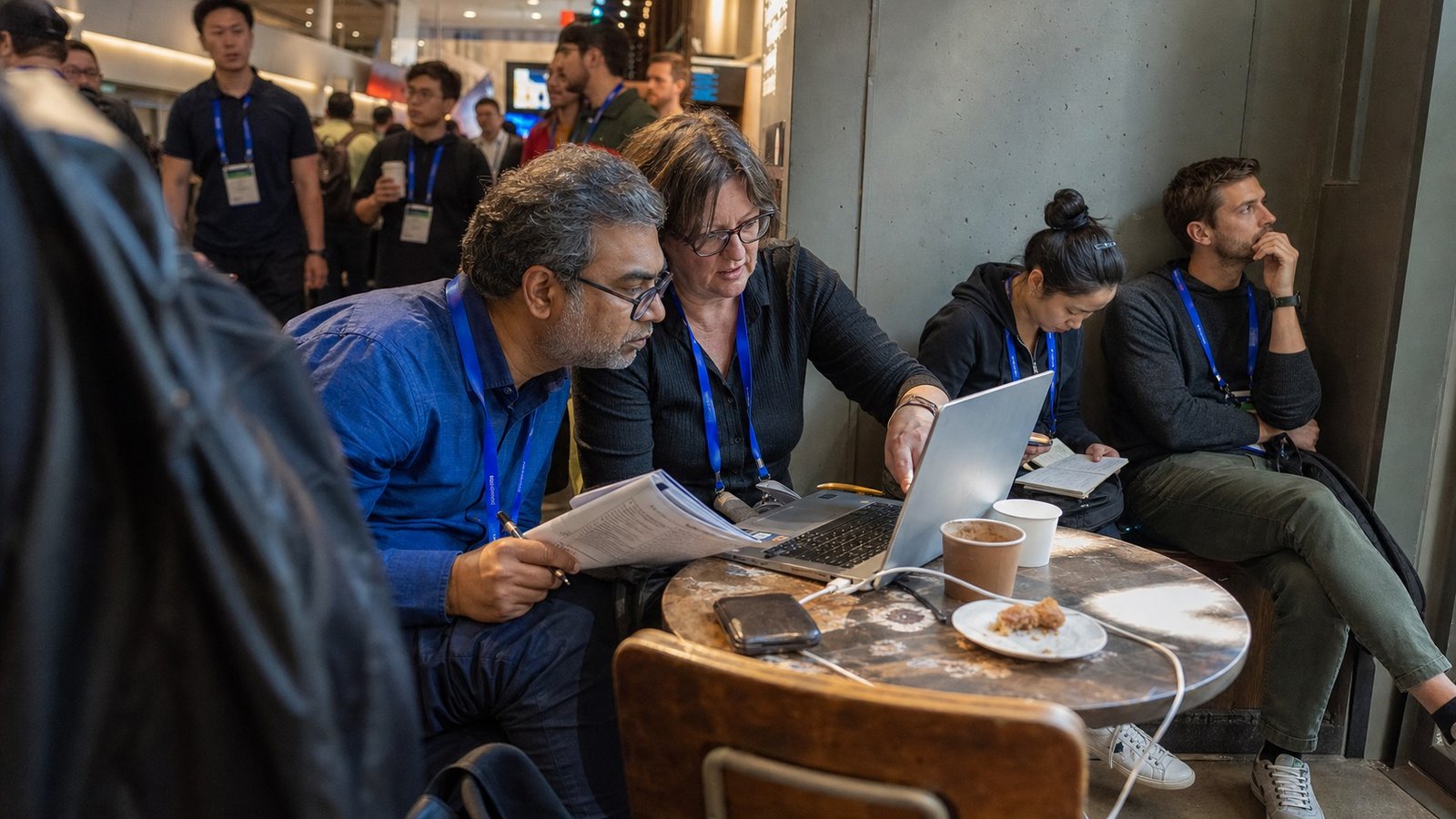
Tech conferences are worth every hour I have ever given them. The sessions are not. So instead of spending a thousand words proving that first, here is the program for a conference that does not exist.
One note before I start. None of this is about any particular event, any particular organizer, or anybody I have worked with. There is no conference I have in mind and no person I am describing. It is all a composite, drawn from twenty years and a lot of countries, and every criticism is aimed at the format rather than at the people who run it. If something here sounds like your event, that is because it is common everywhere, not because it is you. I owe tech conferences my entire career, and I would like them to still be here in twenty years. That is the only reason any of this got written down.
The Program
- 08:00 Registration. Your badge says what you are stuck on, not where you work.
- 08:45 The follow-up keynote. Last year’s speaker returns and reports what actually happened.
- 09:30 Twelve minutes, then forty-eight. Every talk capped at twelve. The rest of the hour belongs to the room.
- 10:30 Coffee. No microphone anywhere, so nobody says “more of a comment really.”
- 11:30 Bring your own problem. No call for papers. The agenda was built from what attendees submitted.
- 12:30 Lunch is assigned. You are seated by the problem printed on your badge.
- 14:00 The clinic. Bring your worst thing. Public triage on a big screen.
- 15:00 Office hours. No talks at all. Bookable appointments with the experts.
- 16:00 The autopsy. Cameras off. One failed project, in detail, including what it cost.
- 17:00 The transparency hour. Rates, salaries, real numbers. Moderated and anonymous.
- 18:00 The reverse expo. The attendees get the booths. The vendors walk the floor.
Day two is deliberately boring. A ten year room, where nothing on stage has been in production for less than a decade. A sunset track about deprecating and deleting. A rule that no number leaves the stage without a source. Certification you earn by doing the task in front of a human being.
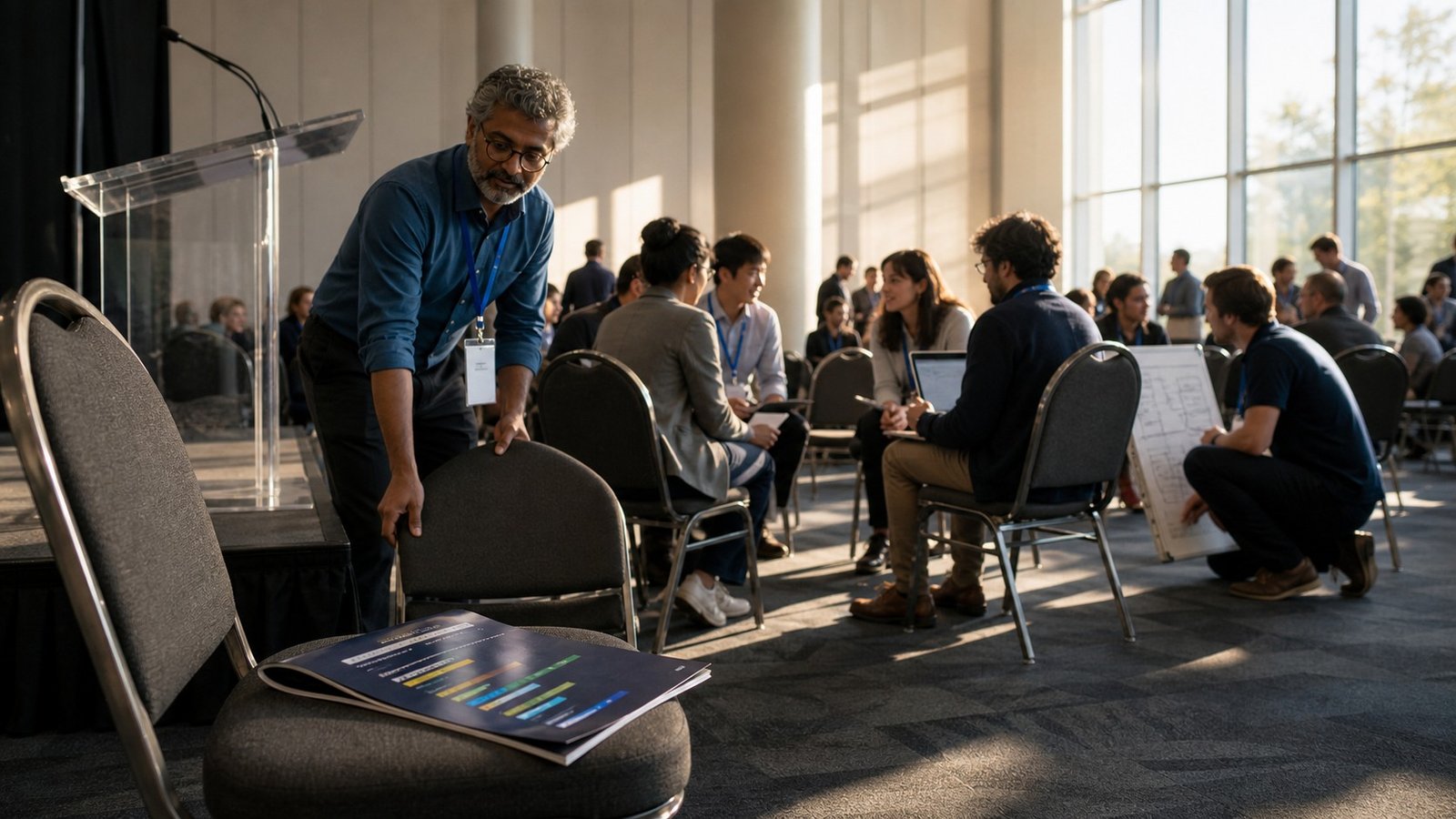
I’d pay for that.
Some of This Exists. Almost None of It Is the Main Event.
Most conference criticism ends up recommending an unconference, a hallway track, or a birds-of-a-feather session. I have sat through all three and they all help, and every single time they get put in a side room near the toilets while the main hall carries on exactly as before.
Several of the things below already run somewhere, as an add-on, a lounge, or an experiment on the third floor. I have never seen one of them put at the center of an event and made the reason people came.

That program is me being polite. Here is what I would do, and some of it would cost me personally.
Delete the sessions. All of them. No stage, no deck, nothing to sit through. Three days of appointments instead. Fifteen minutes with the person you flew there to meet, booked like seeing a doctor.
I’ve made a living on those stages for twenty years and I’m telling you to switch mine off. In twenty years, not one person has ever come up to me afterward to talk about slide fourteen.
Nobody has ever gone home and said the best part was the slides.
If that is too far, cap every talk at twelve minutes. You’ve sat through the other version. Agenda slide. Definition slide. A brief history of the problem. A diagram with too many arrows. Then the demo you flew in for, arriving with six minutes left while somebody at the back holds up a card that says five.
The good part never ran longer than ten minutes. We have been renting ballrooms by the hour to protect the other fifty.
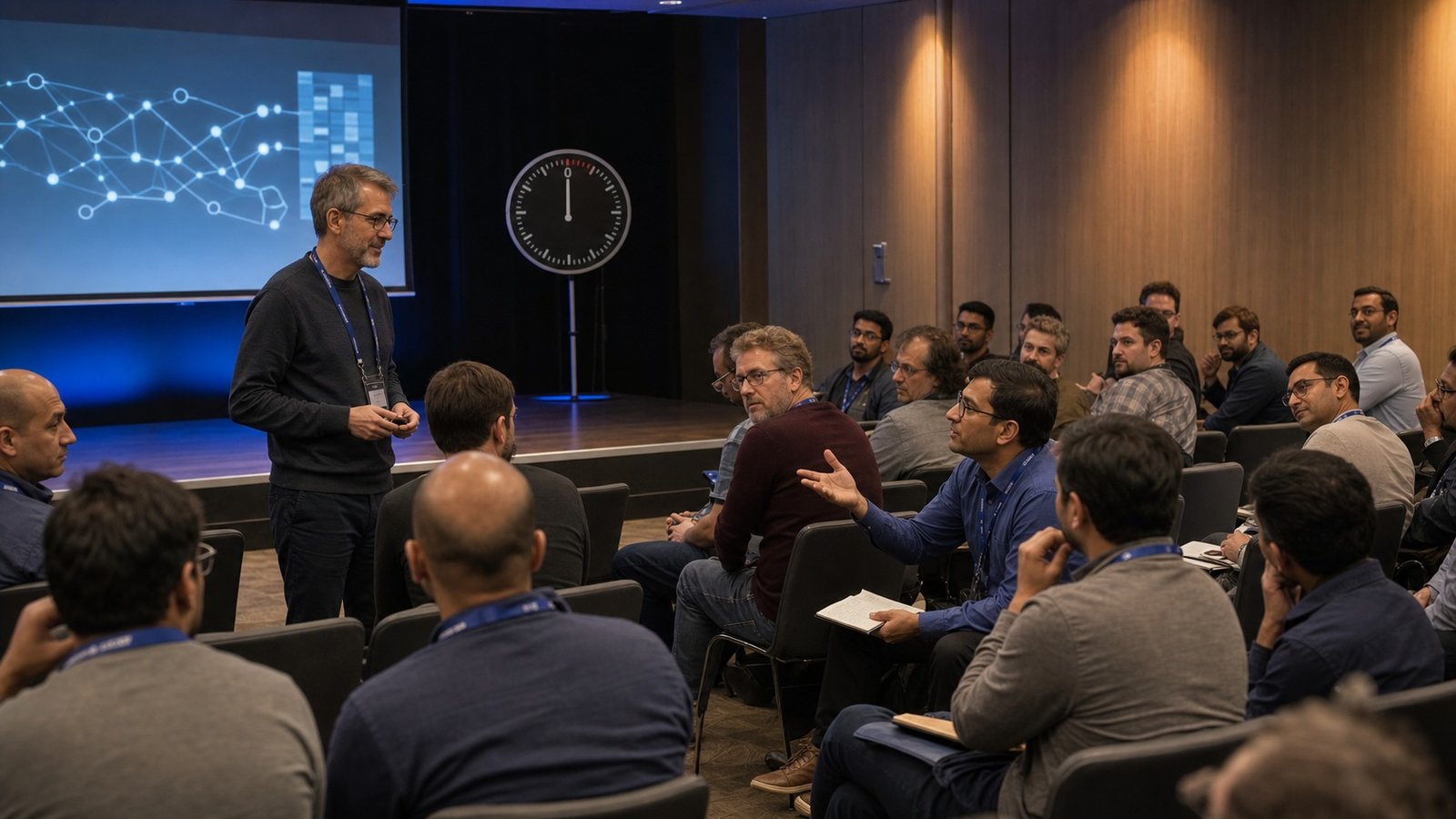
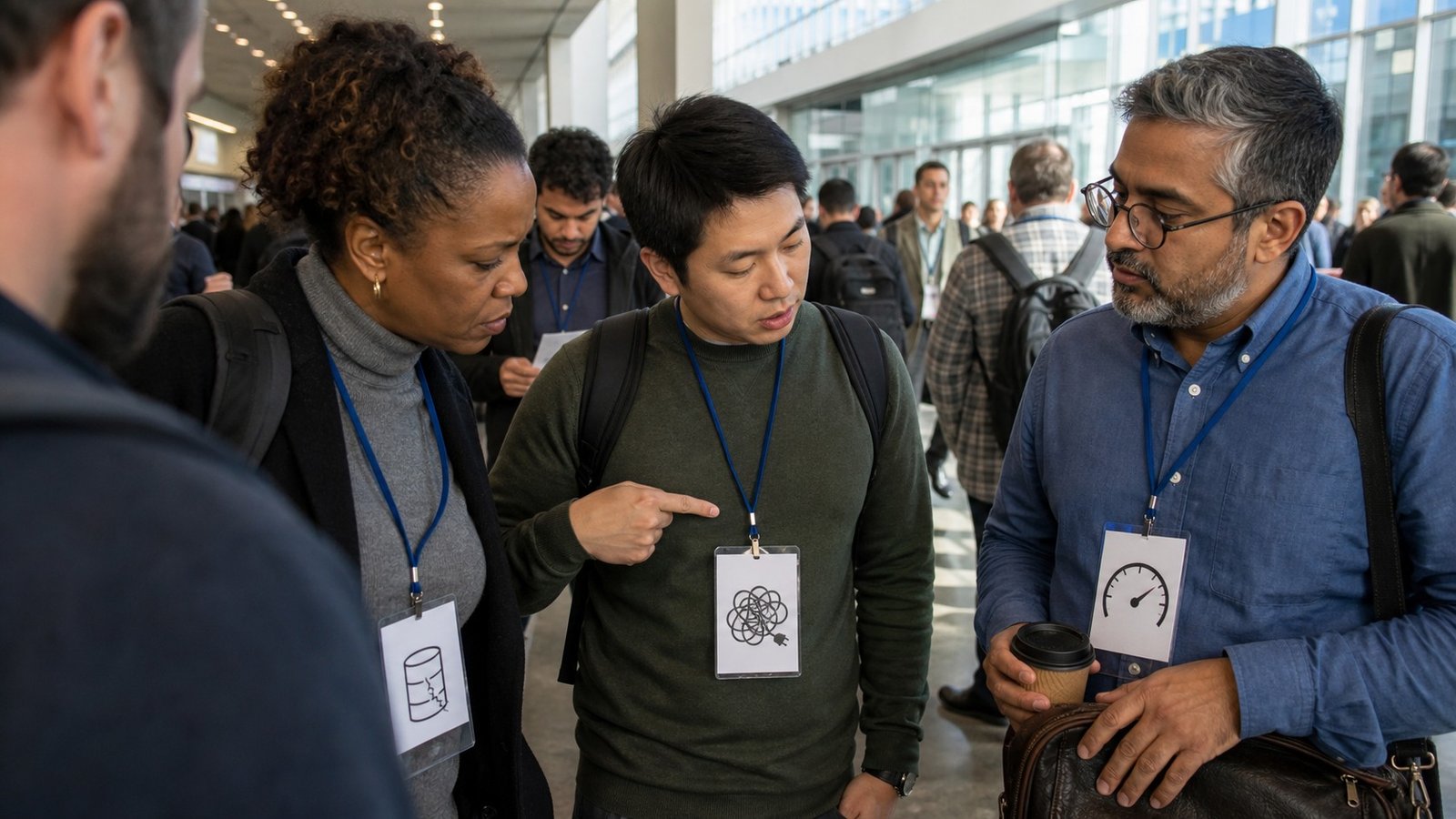
Print the badges wrong on purpose. Take the job title off. Put what is grinding them down.
“Moving forty terabytes off a database nobody wants to touch.”
“Cannot get anybody to care about our test suite.”
Notice how fast you picked which one to walk up to. You may already know the answer.
That is one column in a spreadsheet, and it does more work than the job title ever managed. Nobody in the history of conferences has crossed a room because a badge said Senior Manager.
Assign the lunch. Ninety minutes, already paid for, currently handed to whoever was standing near you when the room emptied.
Think about the one conversation that changed how you work. Somebody put you next to the right person by accident. Stop leaving your best introduction to luck.

Schedule nothing. On purpose. Ninety minutes in the middle of the day with no rooms open, no track, and nowhere to be.
Every organizer fills that gap, because an empty box on a printed grid looks like a mistake. That empty box holds the story you will still be telling in five years. Guard it the way you guard the keynote.
Nobody speaks alone. Every talk pits two people who genuinely disagree against each other, with nobody there to smooth it over.
Think about how much of a talk stays with you when you agreed with all of it. Now think about the last time you watched two people properly disagree in public. You can probably still name who you thought won.
The retraction track. Speakers come back and publicly retire the advice they no longer believe.
I’d go first, and I wouldn’t enjoy it. I have said things from a stage that I wouldn’t say today, and some of you went home and built on them. I’ve never apologized for that. Nobody does. We just quietly stop mentioning it and hope the search results move on.
We give people a stage to make a promise, and then never ask them back to keep it.
Mail the promise back in ninety days. On the last afternoon everybody writes one sentence about the thing they are going to change. The organizer posts it back three months later.
Picture that envelope landing on an ordinary Tuesday, in your own handwriting, long after you stopped thinking about it.
Price the corridor higher than the sessions. Two tickets. One gets you whatever talks survive. The other gets you the matching, the lunch, the appointments and the room with the cameras off, and it costs twice as much.
If I am right, that is the one that sells out. If I am wrong, one event finds out cheaply, I look silly, and at my age that is a fair trade.
Put a refund on it. Leave unable to name one thing you will do differently, and get your money back.
Almost nobody would ask, because we all want to believe we learned something. A refund clause is a promise that we did.
Other Industries Solved This Forty Years Ago
I stole the thinking below. Every field that has ever needed people to talk properly got there before us. Medicine, manufacturing, teaching hospitals, courtrooms, design schools. They worked it out decades ago and wrote it down.
We are the industry that automates everything, and our answer is still a person, a projector, and hope.
Room size changes how people behave. We have exactly one setting. Here are nine that cost almost nothing.
| Room | What you run | Why it works |
|---|---|---|
| Three or four | The silent seat. One person lays out a problem, then never speaks again while the other two discuss it in front of them. | You hear people think instead of perform. |
| Three or four | Write the ending first. Two sentences each on how it already failed. Past tense. Read them aloud. | People write down what they would never put in a status report. |
| A dozen | Let the table write the menu. Everyone lists what they want to discuss, the table picks three, each runs until the energy goes. | No speaker, no preparation, no call for papers. |
| A dozen | Double it. Pairs agree on one sentence, then fours, then eights, then the table. | Every merge costs somebody a sentence. Nobody hides and nobody dominates. |
| Hundreds | Give the problems an address. One problem per table on a standing card, one person holds the thread, everybody else roams. | Everybody can see where the problem they care about is sitting. |
| Hundreds | The question wall. One real question per person on arrival, posted by the door for the whole event to read. | Whatever turns up most often becomes the closing hour. |
| Any | Go and look. An afternoon on a coach to a genuine operations floor. | Teaches more than a week of slides. |
| Any | Measure one thing. Before and after, and publish both. | If we ask a speaker for a citation, we can manage one ourselves. |
| Any | Organizers go first. On the last afternoon they say what did not work this year, before anybody else can. | Every team reviews itself every two weeks. A conference could manage it once a year. |
The first one is the one to try tonight. It’s horrible for about a minute, and then somebody leans forward and argues with somebody else about your situation, and you realize nobody in the room is defending anything.
The card tables are the one I am least sure about. Half of them might sit empty all afternoon, and that would be a very public kind of failure.
We have spent thirty years automating everything except the one hour where people are actually in the same room.
And this is the moment for it. Travel is expensive, attention is cheap, and a machine will summarize any talk you can name before you reach the car park.
A screen can now copy nearly everything we used to get on a plane for. It still cannot do very much with forty people standing in the same room, which is the only advantage we have left.
Now Name Three Sessions
Think about the last conference you actually attended. Name three sessions.
You have one. Maybe two, and you are not confident about the second because it might have been a webinar.
The speakers weren’t the problem. They worked hard, and I know how hard, because I have been the one rewriting a demo at eleven at night on terrible hotel wifi with a laptop balanced on an ironing board.
Now go back to that same conference and name three conversations instead.
You did that faster, didn’t you.
I have forgotten every slide I have ever seen. I have not forgotten a single hallway.

The Bill, and Who Pays It
For thirty years the old shape worked, because there was no other way to reach knowledge that scarce. Content is now free, infinite and searchable, and it is not going back up.
The introduction, the argument over dinner, the person who says I have seen this before and here is what actually happened, turns out to be the only part nobody can download.
We are charging for the free half and giving away the priceless half as a bonus.
Sponsors fund the event. Sponsors are buying attention. Attention is now cheaper to buy somewhere else. So the funding leaves.
Ignore the attendance number on the closing slide, that is marketing. Go and count the booths instead, and count how many of them are a table, a pull-up banner, and one person whose budget got cut in half back in March.
I own a drawer of conference socks. I have never once bought the software.
No sponsors at all. Attendees pay real money, speakers get paid, no vendor keynote and no gold tier. A smaller event, where every slot on the agenda earned its place on merit.
Publish the speaker terms. State what is covered before the call opens. Flights, nights, fee, or nothing at all.
Speaker pay is easy to rage about and easy to get wrong, so slow down here. There is no single arrangement. There are four or five, and they all sit side by side at events of roughly the same size and reputation. The exchange runs both ways too. A well known speaker fills rooms and shifts tickets, and in return picks up an audience and a few consulting leads. I have turned down paid slots at the wrong event and paid my own way to the right one, and there was nothing noble in that. I did the sums and the right room was worth more to me than the fee.
Two speakers on the same stage can be on entirely different terms, and neither of them knows.
I don’t think any of that is unfair. I think it just never gets said out loud, which is a far smaller problem, and one that costs an organizer nothing to solve.
While we are being honest about evidence, I should admit that there is not one sourced figure in this entire post. By my own rule you should discount all of it accordingly.
The Volunteers Are Running Out
The big commercial events will be fine. They have staff and a finance team. I’m worried about the volunteers.
Somebody held every event you have loved together on their own vacation days, working harder than they do at their real job. They chased the catering. They printed the badges at home the night before, the printer jammed at eleven, and they fixed it. They stood at registration at seven in the morning with a real smile on four hours of sleep.
Nobody paid them. Nobody thanked most of them.

I’ve never done that job. I’ve only ever benefited from it.
Every good thing in this industry was built by somebody who was tired.
They are running out, and not because they stopped believing in it. There is only so much of this a person can do on top of a full time job. When they stop, nothing collapses loudly enough for anybody to notice. It just does not happen next year, and everybody assumes somebody else made that call.
That’s the loss I actually worry about, far more than a thinning expo hall. One person with a laminated schedule, and nobody behind them.
My Badge Would Say
My first talk drew about eleven people, and four of them were waiting for the next session.
My hands shook. I read half of it off the slides. I finished early, so I stood there offering to answer questions nobody had asked.
Somebody stayed behind anyway. We talked for twenty minutes. I’ve known that person ever since.
That’s the entire business model of my life, and it happened in a corridor.
So scratch the nostalgia label off this. Conferences are not dying, whatever the posts say. They are being asked what they are actually for, probably for the first time in thirty years.
You fly home full of intentions, and eleven days later you couldn’t name one thing you were going to change. The notebook is in a drawer with four pages used. Call it the eleven day rule. Every idea above exists to beat it.
I do not want the conference back. I want what the conference was for.
That question, what is still worth paying for once the information itself is free, is the one running underneath all thirty essays in my book AI: Nobody’s in There. But we’re still in here. Every essay is free to read in the complete online collection, and there is a paperback on Amazon if you would rather hold something real.
And if somebody printed my badge the way I described at the top, mine would not say author, or consultant, or speaker.
It would say: still hoping somebody stays behind after the talk.
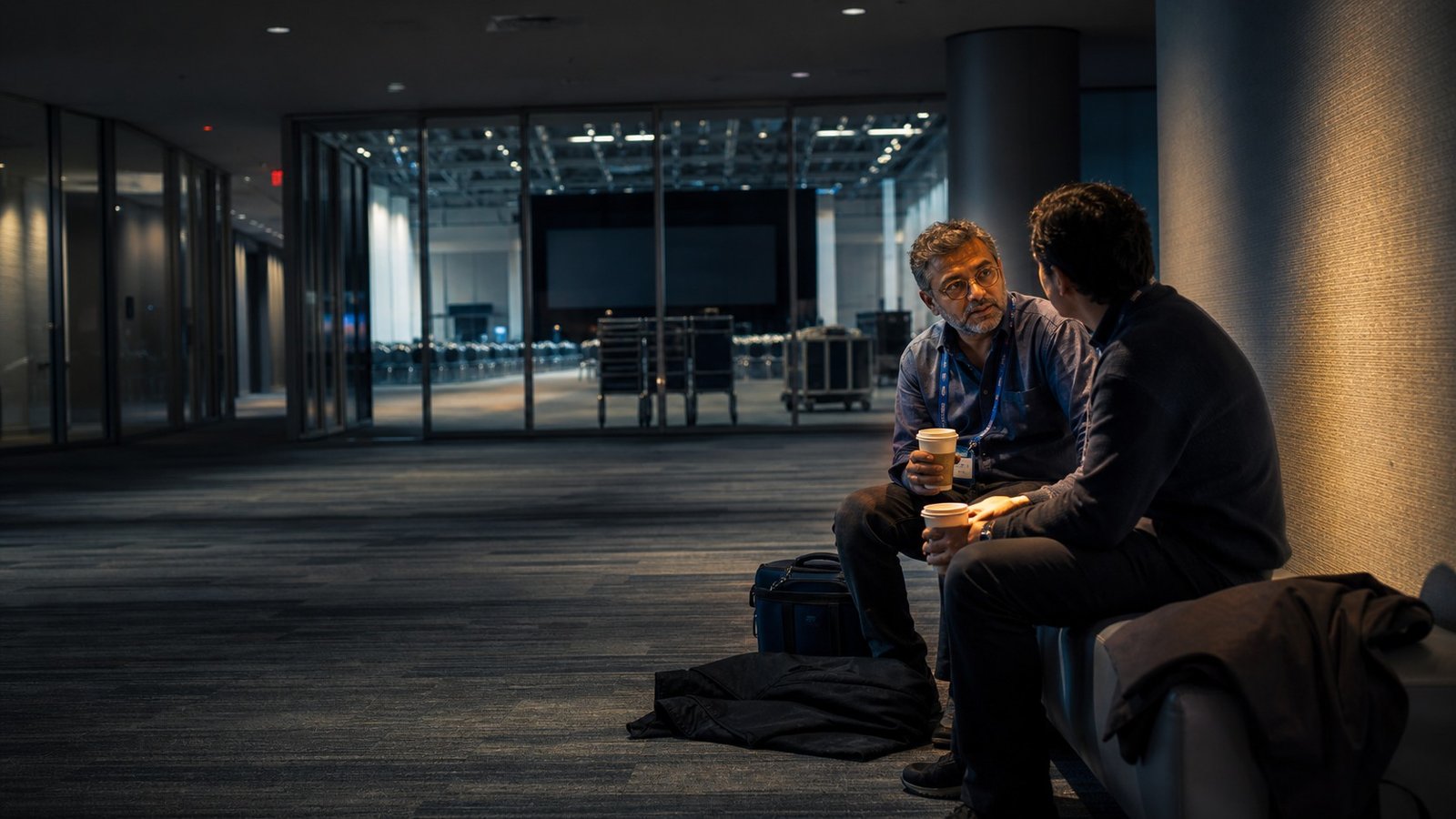
Thank you for the twenty years. Now let us go and ruin the agenda.
This is not a story about fixing tech conferences, it is a story about finally charging for the part that was always worth the trip.
Reference: Pinal Dave (https://blog.sqlauthority.com/), Tech Conferences, X
