

TL;DR — Key Takeaways
- Anaconda’s acquisition of Kilo Code moves the company beyond Python tooling and into the AI coding-agent layer. Kilo gives Anaconda direct access to the developer interface where models are selected, agents are directed and organizational data is routed.
- The deal forms part of a broader platform strategy. Anaconda’s package and environment management, Outerbounds’ workflow orchestration and Kilo’s agentic development tools could become an end-to-end enterprise AI development platform.
- The opportunity is significant, but integration and developer trust will be critical. Anaconda must provide enterprise governance, security and visibility without undermining Kilo’s open-source flexibility, model neutrality or developer experience.
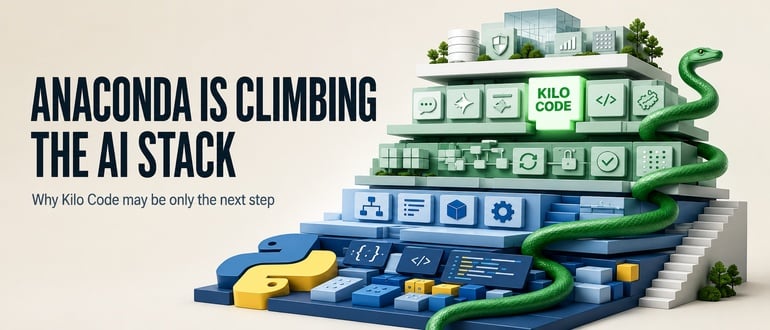
The Kilo Code acquisition complements Anaconda’s Python roots, but it also reveals a larger ambition: Moving up the AI stack before the value—and the developer relationship—moves beyond it.
Anaconda announced this week that it is acquiring Kilo Code, and the announcement arrived wrapped in enough AI marketing language to fill several context windows.
There is a “tokenpocalypse.” Enterprises are “token-maxxing.” CIOs are being asked whether they know where their data is. Anaconda and Kilo, meanwhile, are promising “AI on your own terms.”
Let’s strip all of that away. The deal is important enough without the promotional wrapping.
Kilo Code is an open-source, model-agnostic coding agent used by more than 3 million developers. According to the companies, it orchestrates nearly 10 trillion tokens per month and can route work across more than 500 models. It operates inside VS Code, JetBrains and the command line, placing it directly where developers and AI agents increasingly perform their work.
That makes Kilo a significant addition to Anaconda. But the more interesting question is what the acquisition says about Anaconda itself.
Most of us still think of Anaconda as the company behind the Anaconda Python distribution. That identity has served it well. Python became the lingua franca of data science, machine learning and much of artificial intelligence, while Anaconda made the language and its sprawling package ecosystem manageable for millions of developers and thousands of enterprises.
Now, Anaconda appears determined not to remain merely the Python company.
More Than a Python Distribution
The easy explanation is that Kilo complements Anaconda’s existing business. That is true, but it does not fully capture what is happening.
Anaconda’s value was never limited to packaging Python and making it easier to install. It provided environments, dependency management, curated packages, reproducibility and a level of security and governance around an open source ecosystem that could otherwise become difficult for enterprises to manage.
Anaconda did not create Python, nor did it own all the software its customers used. It made that software consumable and trustworthy. It became an important layer between a sprawling open source ecosystem and organizations that needed some assurance about what their developers and data scientists were actually running.
That same problem is reappearing at a much larger scale with AI.
Developers are no longer choosing only packages and libraries. They are selecting models, connecting agents to internal systems, passing organizational data through external services and allowing software to take actions on their behalf. One developer may use a frontier model for a complex reasoning task, an open-weight model for routine coding and a locally hosted model for work involving sensitive data. Agents may install packages, call MCP servers, access databases and generate code that eventually reaches production.
The Python environment remains important, but it is no longer the entire environment that needs to be managed.
Kilo gives Anaconda a position in this expanded development surface. It moves the company from managing what sits underneath the developer to participating in the interface directly in front of the developer.
That is complementary, but it is also transformational.
The Risk of Remaining Indispensable
Anaconda could have chosen to remain focused on its traditional position. Python is not disappearing. Neither is the need for secure packages, reproducible environments and dependency management. If anything, AI-generated software makes those capabilities more important.
But importance does not necessarily translate into control of the customer relationship or capture of the economic value.
If developers increasingly begin their work inside an AI coding agent, the agent provider can become the primary interface. That provider may decide which models are presented, which tools are connected, how context is assembled and where workloads run. The package and environment layer underneath it can remain essential while becoming less visible and more interchangeable.
This is a version of what I call The Indispensability Trap: Foundational technology can remain necessary even as value moves farther up the stack. The companies providing the foundation do the hard work of keeping everything running, while someone operating closer to the user captures the relationship, differentiation and margin.
Anaconda appears to understand the danger.
Python gave it an extraordinary position at the beginning of the data science and AI development process. Kilo is an attempt to follow that process upward as the starting point moves from opening a Python environment to instructing an agent.
The Pieces of a Larger Platform
Kilo makes even more sense when viewed alongside Anaconda’s acquisition of Outerbounds in April.
Outerbounds is the company behind Metaflow, the open-source framework originally developed at Netflix for building and operating data science and machine learning workflows. The acquisition gave Anaconda additional capabilities around compute, workflow orchestration and moving AI applications from development into production.
The pieces now form a recognizable architecture.
Traditional Anaconda supplies trusted packages, environments, models, dependency management and software supply chain governance. Outerbounds and Metaflow extend that foundation into workflow orchestration, compute and production. Kilo adds the agentic engineering layer where developers choose models, direct coding agents, connect tools and produce software.
Anaconda is assembling the ingredients for an end-to-end AI development platform.
That does not mean the company has already created one. Acquiring a collection of complementary technologies is easier than integrating them into a coherent experience. Packages, environments, model catalogs, production workflows, coding agents, model routing, policy enforcement and usage analytics may line up nicely on a presentation slide. Making them operate as one platform without adding friction for developers is considerably harder.
Still, the direction is becoming difficult to miss.
David DeSanto and I discussed Anaconda’s evolution during an interview at AWS re:Invent in 2025. The conversation was already about Anaconda’s AI platform, open source growth and the future of secure software. It was not simply a discussion about improving Python distribution.
More recently, we spoke about OpenAI’s acquisition of Astral, the company behind the increasingly popular Python tools uv, Ruff and Pyright. We discussed what that acquisition could mean for Python, open source and trust in AI development.
Viewed together, the Astral and Kilo acquisitions create an interesting strategic mirror.
OpenAI, a frontier model company, moved down the stack into Python tooling. Anaconda, a trusted Python and package company, is moving up the stack into coding agents, model routing and the developer interface.
The model providers are moving toward Anaconda’s traditional territory. Anaconda is moving toward theirs without attempting to build a frontier model of its own.
The GitLab Connection
There is also a human connection behind this deal that should not be overlooked.
Kilo co-founder Sid Sijbrandij is best known as the co-founder and executive chair of GitLab. DeSanto spent six years at GitLab and became its longest-serving chief product officer, leading the product organization as GitLab expanded into an integrated, AI-enabled DevSecOps platform.
That history matters.
DeSanto and Sijbrandij did not need to begin this conversation by explaining their respective views of developers, open source or integrated platforms. They had already worked together while GitLab expanded from a company known primarily for source-code management into a much broader platform spanning the software development lifecycle. DeSanto played an important role in that transformation, including the addition of security and compliance capabilities.
We do not know who placed the first call or exactly how the Kilo transaction came together. Unless one of the participants tells us, it would be irresponsible to claim that the prior relationship produced the deal.
It would be equally naïve to pretend the relationship was irrelevant.
Acquisitions involve more than comparing product features. The buyer is betting on the people, culture, community and technology it is absorbing. The seller is deciding whether the buyer can be trusted with what it built. A long working relationship between Anaconda’s CEO and one of Kilo’s founders would give both sides knowledge that does not appear in a standard due-diligence report.
Sijbrandij’s prominent role in the acquisition announcement reinforces the connection. He described Kilo and Anaconda as a rare fit with “almost no overlap,” saying that what one lacked, the other already possessed. That is more than the customary congratulatory quote from a financial backer. It is the assessment of a Kilo co-founder who already knows DeSanto and has previously worked with him while building a developer platform.
The relationship also provides another clue about DeSanto’s ambitions for Anaconda.
At GitLab, DeSanto participated in the company’s evolution from a product associated with a particular part of the development process into a platform intended to manage much more of the software lifecycle. At Anaconda, he appears to be applying a related playbook: Start with a powerful open source foundation and a large developer community, then add adjacent capabilities until the original product becomes the center of a broader platform.
The comparison should not be pushed too far. Anaconda is not GitLab, and AI development is not simply the next version of DevSecOps. But DeSanto has seen this type of platform expansion before. More importantly, he has worked with Sijbrandij while doing it.
Kilo may therefore represent more than a complementary acquisition. It may also be a reunion of people who share a view of how developer platforms are built.
Custody of the Developer—and the Data
The strategic prize is not simply ownership of another AI coding assistant.
Kilo supports hundreds of models rather than requiring developers to commit to one provider. That potentially gives Anaconda a place between enterprises and the model companies competing for their workloads. Anaconda can offer access to frontier models for complex work, open-weight models for lower-cost tasks, local models for sensitive use cases and air-gapped deployments where data cannot leave the organization.
The value lies in governing those choices.
Which models are approved? What data is being sent to them? Which agents can access a source-code repository, database or production system? How much is the company spending across different tools and accounts? Which packages did an agent introduce? Can an organization reconstruct how a piece of AI-generated software was produced?
These are not theoretical questions. They are becoming part of everyday software development, often before enterprise governance systems are ready to answer them.
“The contest in enterprise AI development is quickly shifting to the interface where developers direct agents, choose models, and route organizational data. Anaconda’s Kilo acquisition positions it with a trust layer to govern that surface. Buyers are locking in agentic architecture before governance can answer which models agents use, what data they send, and which systems they touch. Coding agent selection is now a control-plane decision that cannot be deferred until adoption hardens”, Mitch Ashley, VP and practice lead, CIO tech buyer and software lifecycle engineering at The Futurum Group.
Model providers want to own that relationship. So do cloud providers, IDE vendors and agent platforms. Each wants to become the place where enterprises choose models, route workloads and apply policy.
Anaconda enters that contest with two advantages: trust and distribution. It already claims more than 52 million users and a presence inside 95% of the Fortune 500. Kilo gives it a way to extend those relationships into the agentic development experience.
The company is trying to move from being the environment developers rely upon to becoming the control plane enterprises use to manage AI development.
Developer Freedom Meets Enterprise Control
There is an obvious tension in this strategy.
Kilo grew because developers found it useful, open and flexible. It is model-agnostic and available across the tools developers already use. Its open source foundation gives users a degree of visibility and control that proprietary coding assistants do not always provide.
Anaconda is buying Kilo partly because of those qualities. It could also damage them.
If Kilo becomes a funnel into a heavy enterprise platform, developers may look elsewhere. If governance translates into restrictions, delays and corporate approval gates, the product will lose some of the freedom that drove its adoption. If model neutrality quietly becomes a preferred set of commercial relationships, the anti-lock-in position will be harder to defend.
Anaconda’s opportunity is to make enterprise control operate around the developer rather than against the developer. Policies should determine which models and resources are available without requiring a developer to submit a ticket each time an agent needs to perform useful work. Security should be embedded in the environment. Governance should provide visibility without turning AI development into a checkpoint marathon.
That is the promise. The acquisition does not prove that Anaconda can deliver it.
Kilo May Not Be the Last Deal
DeSanto and Anaconda have shown they are not shy about using acquisitions to accelerate the company’s evolution.
Outerbounds and Kilo arrived within a few months of each other. That looks less like opportunistic dealmaking than a deliberate effort to assemble a platform while the AI development market is still taking shape.
There are pieces Anaconda could still add.
AI evaluation and observability would give enterprises better ways to measure the quality, cost and reliability of agent behavior. Model and data lineage could provide a verifiable record of the prompts, packages, datasets and models involved in producing an application or decision. Agent identity and authorization would help control which resources autonomous software can access and which actions it may perform.
Security is another logical area. Prompt-injection defenses, model scanning, secrets management for agents and runtime protection could all complement Anaconda’s software supply chain position. Agent deployment, monitoring and rollback remain immature enough that a focused company in production agent management could fill a gap between Kilo’s development experience and Outerbounds’ orchestration capabilities.
This does not mean Anaconda will buy a company in each category. Nor should we turn the exercise into a fantasy shopping list filled with multibillion-dollar companies Anaconda is unlikely to acquire. The more plausible targets would be focused developer-tool startups and open source projects that provide important technology, community adoption and talent.
The larger point is that Anaconda may not believe its platform is finished.
DeSanto is not learning the platform-consolidation playbook on the job. He helped execute one at GitLab. Now he has acquired a company co-founded by the person with whom he helped build that platform.
Is DeSanto attempting to build the GitLab of enterprise AI development, with Python rather than source-code management as the original beachhead?
It is too early to make that declaration. But it is no longer too early to ask the question.
Anaconda is not abandoning Python. It is using Python as its beachhead, its source of credibility and the foundation beneath a larger platform. Outerbounds extended that foundation toward production. Kilo brings Anaconda into the agentic workspace. Future acquisitions may add more of the control, security and visibility required to connect the two.
Python gave Anaconda its position in the AI stack. DeSanto is now trying to climb that stack before the value and the developer relationship climbs away without it.
The question is no longer whether Anaconda wants to be more than the Python company.
It is how much of the AI development stack DeSanto ultimately intends to own.
Frequently Asked Questions
What is Kilo Code?
Kilo Code is an open-source, model-agnostic AI coding agent that works inside VS Code, JetBrains IDEs and the command line. It allows developers to route tasks across hundreds of AI models rather than being locked into a single model provider.
Why did Anaconda acquire Kilo Code?
The acquisition gives Anaconda a position closer to the developer’s daily workflow. Instead of managing only Python packages, dependencies and environments, Anaconda can now participate in model selection, agent activity, tool connections and AI-generated software development.
Is Anaconda trying to become an enterprise AI platform?
The acquisition suggests that direction. Anaconda now has capabilities spanning trusted packages and environments, workflow orchestration, production infrastructure and AI coding agents. However, turning these technologies into a unified platform will require successful integration, strong governance and a smooth developer experience.
