

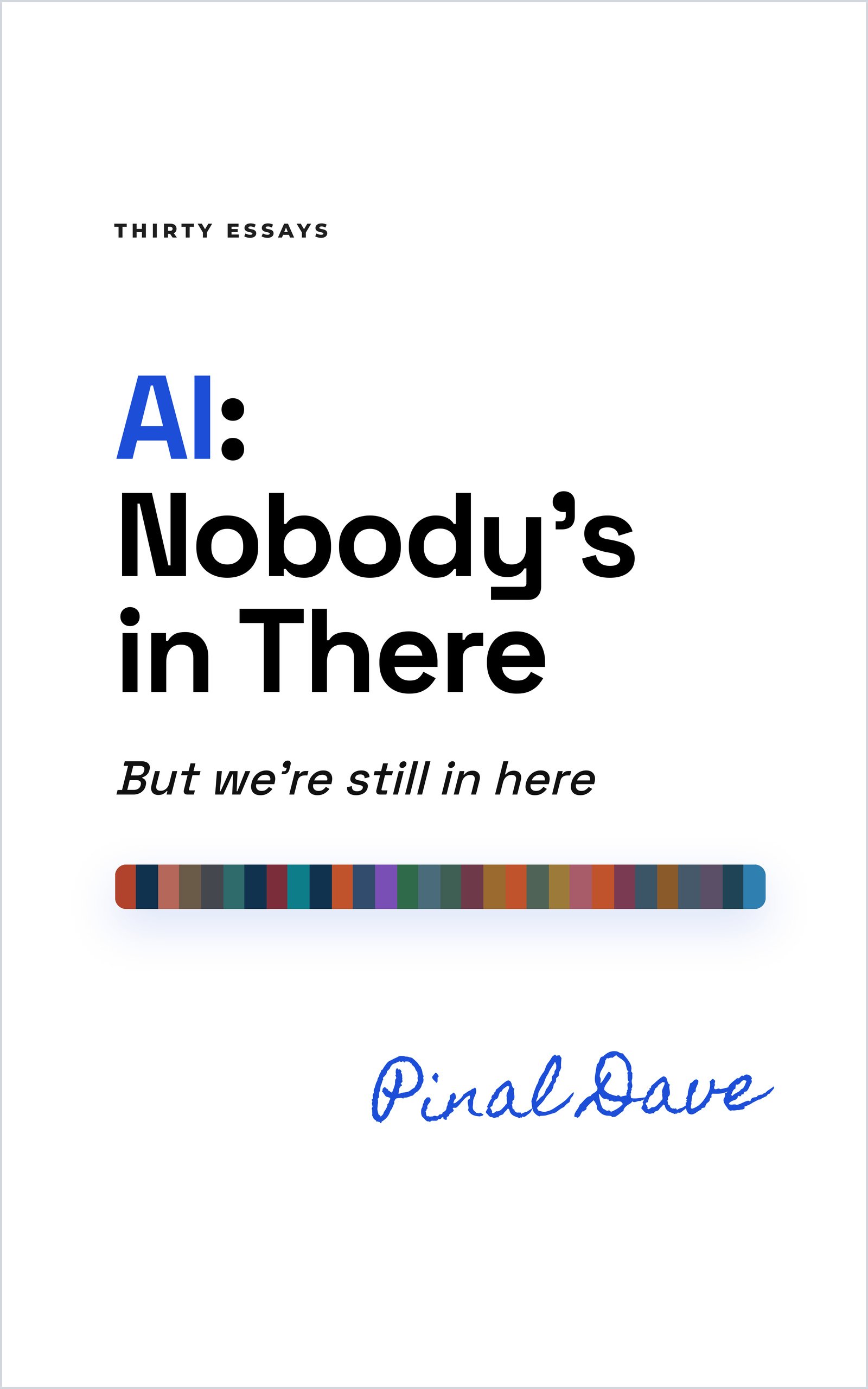
I almost did not publish this book.
Not because I doubted the ideas. Because I was not ready for anyone to see how much of it was about me. And, I suspect, about you.
For twenty-five years my job was to make slow things fast. Queries, indexes, servers. I was good at it, and I built a quiet pride on being good at it. I never imagined that a fast thing would be the one to break my heart a little.
I have written more than five thousand articles. Not one of them ever kept me awake at night. This one did, for months.
It started with a small grief
One ordinary afternoon, I watched a machine do in four seconds something that used to take me half a day. Something that, if I am honest, I used to look forward to all morning.
I waited to feel amazed. Everyone told me I was supposed to feel amazed.
Instead, something in my chest went very quiet.
It was grief. The small, embarrassing kind you feel watching someone do, without effort, the thing you loved doing slowly. And then I understood what I was actually mourning. It was not the task. It was the part of me that the task used to need.
I did not even have a word for it. So I started writing, just to find one.
Thirty essays later, I found it. The word was caring.
The machine can answer. It cannot care. It can write the sentence. It cannot want to. That part never left you, and it was never going to.
The sentence I was most afraid to write
Somewhere in the middle of the book, I typed one line, and then I had to push my chair back from the desk and just sit there for a while.
This is hard. And without the hard part, nothing works.
It is the thing none of us wants to say out loud, because it sounds ungrateful in a world this fast. But it is true. The struggle was never standing in the way of the learning. The struggle was where the learning was quietly being built, the whole time. And every time we hand the hard part to a machine because it is faster, we save an hour and give away a small piece of who we were becoming.
I was afraid of that sentence because, for one honest moment, I was not sure I still believed it. I do now. Writing this book is what gave it back to me.
Then I gave it to people I love
I sent the early pages to a few friends. Engineers, leaders, teachers. I told them I wanted feedback. The truth was smaller, and more frightening than that. I wanted to know if I was the only one who felt this way.
One of them called me and did not say hello. He was quiet for a long moment. Then, almost in a whisper, he said, “How did you know? This is exactly what I have been carrying and could never put into words.”
Another wrote back one line that I still cannot read in a steady voice. “I did not expect a book about AI to make me cry.”
That was the moment the fear left me. Because it was never only my feeling. It was ours. It is yours too. You simply have not had anyone say it back to you yet.
What is actually inside
This is not a book about prompts. It is not about tools, or tricks, or being ten percent faster. There are a thousand books for that, and most of them will be out of date by spring.
It is thirty short essays, and they ask the questions I could not stop asking in the quiet. What is your expertise worth when the answer arrives in seconds? What happens to the young ones who never get to struggle, the way struggling once shaped us? Why does easier work leave us feeling emptier instead of lighter? When everyone can make something polished, what suddenly becomes rare? And when the machine can fill the page in a blink, who is left to decide whether the page deserved to exist at all?
Each one is short enough to read between two meetings. None of them are disposable. They are about the things that do not expire. Judgment. Taste. Verification. Responsibility. The quiet pride you spent years building around being good at something hard, and are secretly afraid of losing.
That is the whole reason this book exists. Not to teach you another tool. To sit down beside you and remind you why you started.
Nobody’s in there. But we’re still in here.
If you have felt it too
If you have ever looked at a flawless answer on your screen and felt impressed and strangely hollow in the same breath. If your days have grown faster and somehow smaller. If some stubborn part of you misses the struggle you used to complain about. Then please hear this clearly.
You are not behind. You are not too sentimental. You are not the only one.
I did not write this book about you. I wrote it for you. I wrote it because I needed to read it myself, on the nights I forgot.
And if you decide not to buy it at all? No worries, truly. Every one of those thirty essays is free to read right here on my blog. Go and read one tonight. It takes a few minutes. If a single line finds the place you keep quiet, the book will be here when you are ready for the rest.
I put my whole heart into this. It is the truest thing I have ever made. If you read only one page, I hope it is the page you did not know you needed.
You can find AI: Nobody’s in There. But we’re still in here. on Amazon now, as a Kindle ebook, an audiobook, and a paperback.
AI: Nobody’s in There.
But we’re still in here.
Reference: Pinal Dave (https://blog.sqlauthority.com/), X
