
GitHub’s AI assistant has been a fixture in developer IDEs for a few years now. But the company just made a significant move: It launched the GitHub Copilot app in technical preview, and this isn’t just another interface for writing code.
The app is a GitHub-native desktop experience designed for agentic development — letting developers start from the work already in front of them, keep it isolated, steer it as it progresses, and land the change through pull request review. The key difference is that it runs entirely outside the IDE.
A New Kind of Developer Workflow
For years, developers have toggled between terminals, editors, and browsers to keep a single task moving. The GitHub Copilot app is built around the idea that most of that context already lives in GitHub — so why not start there?
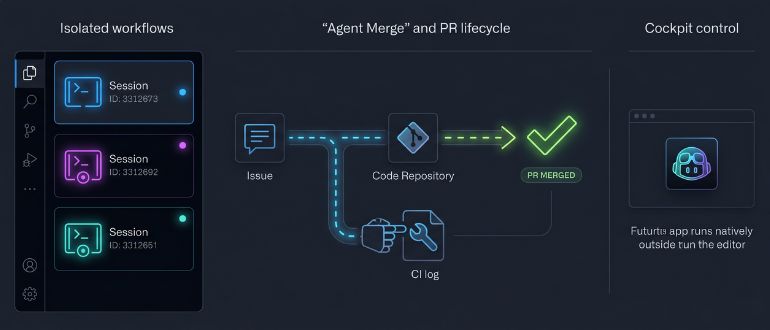
Work begins from the issues, pull requests, and prompts already in a repository. Each task runs in its own session, and developers get a single surface to steer, check, and ship the change. A cross-repository inbox surfaces issues and pull requests across every connected repository that need attention.
Each session has its own space: branch, files, conversation, and task state. Work stays separated even when you have more than one thing in motion. Sessions can also be paused and resumed exactly where they left off.
That last part matters. Context-switching is one of the biggest productivity drains in software development. The ability to pause an agent session and return to it — without losing the thread — is a practical improvement for anyone juggling multiple projects.
Agent Merge is the Feature to Watch
Agent Merge is arguably the most interesting new capability. It monitors CI checks, downloads failure logs, resolves merge conflicts, and automatically pushes fixes before merging. It handles CI failures, security alerts, and other common issues that surface during the PR lifecycle, without requiring manual intervention.
That’s a meaningful reduction in the kind of tedious back-and-forth that slows down pull requests. Anyone who has spent time chasing down a failing CI check only to discover it was a minor dependency conflict will appreciate what this automates.
The app also supports running multiple agent sessions across repos simultaneously, with each session isolated and tracked in real time. Recurring workflows can be automated, and agents can be extended with MCP servers and custom skills.
“The agent surface is moving from the browser tab to the desktop client. Agentic workflows need persistent local sessions, async execution, and cross-repo visibility that survives context switches. The Copilot app gives developers fewer interruptions per task and a cockpit outside the editor,” according to Mitch Ashley, VP and practice lead, software lifecycle engineering, The Futurum Group.
Ashley continues, “For GitHub, the app-based move puts them on a similar work surface with Cursor and Claude Code at the desktop tier. Agent Merge and session orchestration give them durable hooks into the developer workflow that desktop app competitors will need to compete for developer mindshare.”
Where it Fits in a Crowded Market
GitHub isn’t alone in this space. Anthropic’s redesigned Claude Code desktop client launched in April 2026 for Mac and Windows, built around parallel agent sessions, while Cursor 3 arrived with an Agents Window that runs many agents in parallel across local, worktree, cloud, and remote SSH environments.
But GitHub’s advantage is integration. Developers’ work already lives there. Issues, pull requests, branch protection rules, CI pipelines — all of it is already native to GitHub. The Copilot app doesn’t ask developers to bring their context to a new tool. It starts where the context already exists.
GitHub clears the Pro+, Business, and Enterprise plan tiers from the waitlist during the rollout week, making the new desktop surface available to paid Copilot seats. Pro subscribers can sign up for early access as the preview expands.
What it Means for DevOps Teams
The practical implications here go beyond individual developer productivity. When an agent can watch a CI pipeline, detect a failure, write a fix, and push it back through the pull request — all without a developer having to context-switch — that compresses cycle time in a meaningful way.
The broader trend is evident in GitHub’s recent updates: cloud agent sessions now launch directly from Visual Studio, a new Debugger agent validates fixes against live runtime behavior, and custom agents are gaining wider support.
The GitHub Copilot app is a direct expression of where this is all heading. The agent isn’t just a coding helper anymore. It’s becoming a collaborator that can take a task from open issue to merged pull request, with the developer in a review and steering role rather than doing the mechanical work.
That’s a different kind of development workflow than most teams are used to. Whether organizations embrace it — or approach it cautiously — probably depends less on the technology and more on how much trust they’re willing to place in an AI agent working within their codebase.
The app is available now in technical preview on Windows, macOS, and Linux for paid Copilot subscribers.
