

The AI coding agent market just got a new competitor. Elon Musk’s xAI is rolling out its first coding agent, called Grok Build, in a bid to challenge Anthropic’s Claude and other established tools in the developer workflow space. For DevOps teams already sorting through a crowded field of AI-assisted coding tools, the arrival of Grok Build adds another option — and a few fresh ideas worth paying attention to.
What Grok Build Is
The agent, currently in early testing and available only to paying subscribers, can complete complex coding tasks based on user commands. But the more interesting part isn’t what it does — it’s how it does it.
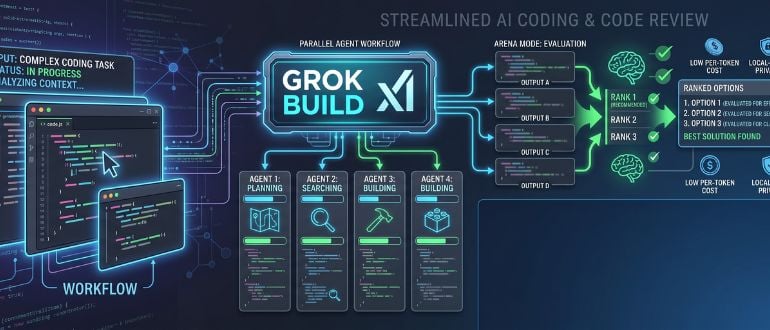
Grok Build runs up to eight parallel AI agents simultaneously, each working through a three-stage workflow: plan, search, and build. What sets it apart from other tools is Arena Mode, an automated evaluation layer that scores and ranks competing outputs before a developer ever reviews them. Instead of manually comparing multiple code solutions, developers see a ranked list of options. That’s a practical time-saver on complex tasks.
The tool is also local-first, meaning no source code is transmitted to xAI’s servers. For teams working with proprietary codebases or in regulated industries, that’s a meaningful design choice. Installation follows a standard npm workflow, and the CLI includes an optional web UI for visual monitoring.
The underlying model, grok-code-fast-1, was built from scratch — separate from the Grok 4 lineage — with a training corpus heavy on programming content and post-training focused on real-world pull requests and coding tasks. It scores 70.8% on SWE-Bench Verified and is priced at $0.20 per million input tokens. That’s a notably competitive price point compared to what developers are paying for Claude Code or Codex CLI today.
A Crowded and Competitive Market
The AI coding agent landscape in 2026 has become a three-way race between Anthropic’s Claude Code, OpenAI’s Codex CLI, and now xAI’s Grok Build. Both Claude Code and Codex CLI have significant head starts. Codex CLI surpassed one million developers in its first month, and Claude Code alone has reportedly driven Anthropic to $14 billion in annual recurring revenue, with coding agents identified as the company’s primary growth vector.
Grok Build has some catching up to do on the ecosystem side. Claude Code and Codex CLI have tighter IDE integrations, more third-party extensions, and longer production histories. And there’s the context window gap to consider: grok-code-fast-1’s 256K context window trails Claude Opus and GPT-5.4, both of which offer 1 million tokens or more — a meaningful difference for developers loading large codebases in a single pass.
According to Mitch Ashley, VP and practice lead, software lifecycle engineering, The Futurum Group, “Coding agents are becoming the procurement front where AI labs compete to own the developer workflow. Multi-agent parallelism with built-in evaluation, paired with local-first execution, reflects vendors racing to differentiate on orchestration architecture and execution environment guarantees.”
Ashley continues, “DevOps teams now weigh orchestration patterns, evaluation pipelines, and execution location alongside model performance and ecosystem maturity. Per-token economics and execution sovereignty become procurement criteria that compound at scale, and benchmark-leading models without credible answers on both will lose enterprise footholds.”
Why xAI Needs This to Work
Grok’s growth has slowed in both consumer and enterprise markets. Research from Enterprise Technology Research found that corporate use of Anthropic’s Claude and Google Gemini is climbing sharply this year, while Grok has struggled to keep pace.
While xAI’s Grok models briefly surpassed rivals on certain benchmarks last year, competitors’ newer updates have since reclaimed the lead. The company is particularly focused on improving its coding capabilities, where Grok currently trails some competing tools.
The backdrop makes the Grok Build launch feel less like a product announcement and more like a strategic statement. xAI needs a credible foothold in enterprise developer workflows, and coding agents are one of the clearest paths to get there. With 90% of developers now using at least one AI tool at work, according to a JetBrains survey from January 2026, xAI’s timing puts it squarely in the middle of a fierce land grab.
What DevOps Teams Should Watch
For now, Grok Build is still on a waitlist. Musk set a “next week” launch timeline in mid-April, but by late April the tool had not shipped. Bloomberg’s report confirms that early testing is now underway, suggesting broader availability may be imminent.
For DevOps teams evaluating options, the practical calculus is fairly straightforward. If you need a production-ready coding agent today, Claude Code and Codex CLI are the proven choices. But if Grok Build delivers on its multi-agent architecture — and its local-first privacy design — it could carve out a real niche, especially for teams doing high-volume agentic coding where per-token cost matters.
Arena Mode is the feature to watch most closely. The idea of having AI agents compete and self-rank before human review isn’t just a clever marketing hook. If it works consistently in practice, it could meaningfully reduce code review overhead. That’s the kind of workflow improvement DevOps teams are actually looking for.
The coding agent market is still being defined. xAI is late to it, but Grok Build brings a few genuinely interesting ideas to the table. Whether that’s enough to close the gap with Anthropic and OpenAI remains to be seen.
