

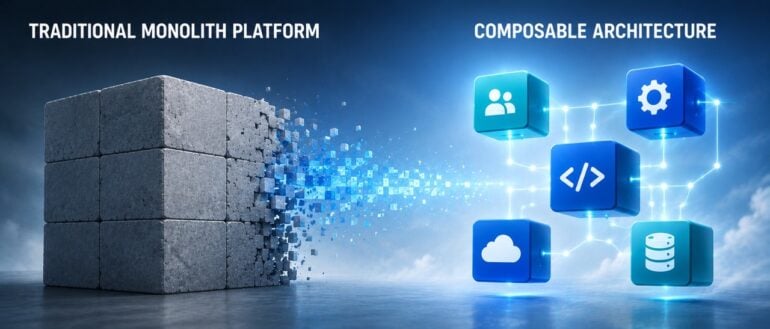
Traditional monolithic platforms have served their purpose. As technologies like artificial intelligence and quantum computing usher in a new digital age, flexible and modular architectures will take their place. Developers and cloud professionals should familiarize themselves with composable architecture’s principles, benefits and implementation best practices to remain competitive in an evolving technological landscape.
Composable Architectures Are Catching On
Composable architecture is not a niche concept. Market research shows it is a rapidly growing trend with significant projected growth. By 2028, its value will reach an estimated $11.8 billion, up from $5.2 billion in 2023. It will achieve a compound annual growth rate of 17.5% during the forecast period, demonstrating its rapid rise in popularity.
This expansion reflects increasing demand from organizations seeking greater flexibility and adaptability in their technology infrastructure, underscoring its importance to enterprise technology stacks.
Understanding Composable Architecture
In traditional monolithic architecture, an entire application is built, deployed and managed as a single inseparable codebase. Components remain tightly coupled despite being separate, creating dependencies that limit flexibility and slow development cycles.
The microservices architecture came next. It shortened development cycles to a mere few weeks by dividing applications into smaller, independently deployable units. Components scaled independently, services were communicated through well-defined APIs and containerization technologies simplified deployment.
While microservices are beneficial, they don’t live up to their promise of independence. If complexity is spread across systems and each deployment requires extensive coordination between teams, the architecture is still a traditional distributed monolith. It forces everything to scale, deploy and fail together.
Composable architecture is a modern software design philosophy that leverages smaller, API-first, modular components. This approach allows organizations to build applications from truly independent, interchangeable parts that communicate through well-defined interfaces.
Modularity, interoperability and reusability are fundamental. Developers achieve them with microservices, API-first, cloud-native and headless (MACH) principles. Professionals deploy and manage services separately.
The Business Benefits of Modularity
By enabling organizations to easily upgrade, swap or add individual functionalities, MACH principles can anchor IT execution to business objectives. This modularity delivers tangible advantages that extend beyond technical improvements.
Organizations can connect to different content repositories, modify individual components or introduce new capabilities without disrupting or overhauling the entire system. The primary benefits are agility, scalability and innovation.
With modular architectures, businesses can replace or update specific functionalities, such as payment gateways, search or content management systems. For instance, they can upgrade enterprise resource planning software by breaking down a monolithic system into flexible API-first modules.
By upgrading legacy systems, companies can benefit from enhanced performance, greater internal controls and decreased maintenance costs. In addition to delivering direct benefits, modularity mitigates opportunity costs by facilitating cloud functionality. These modern capabilities improve collaboration, reduce data loss and prevent technological obsolescence.
Greater resilience would be incredibly beneficial, as the average organization loses approximately $1.5 million to IT downtime each year. Unplanned downtime is even more expensive. With a cloud-native architecture, they can avoid the vast majority of these losses.
Guidance for Successful Adoption
Organizations must methodically implement a composable architecture. A successful transition involves careful strategic planning, a rigorous technology selection process and a culture of continuous improvement among teams.
Teams should choose a new architectural framework that offers an API-first conversion with a centralized hub for managing all component communications. This architectural foundation ensures seamless integration and reduces complexity as the system scales.
They should also fully replace their legacy technology stack with modular, cloud-native components to support this transition. Half-measures that retain monolithic components alongside new modular services create technical debt and limit the advantages of composability.
Preparing for the Next Technological Shift
Adopting composable architectures is a strategic imperative for future-proofing an organization. The adaptability of this approach provides significant cost-efficiency and makes it easier to expand and integrate future AI capabilities.
A modular API-first architecture is inherently better positioned to integrate emerging technologies like advanced AI and quantum computing. High throughput, reliable performance and greater customization are key to quickly adopting transformative technologies. Companies can future-proof their infrastructure to support emerging use cases.
This approach provides a level of adaptability that monolithic systems cannot match, as legacy platforms are having an increasingly difficult time maintaining compatibility with rapidly evolving technologies that are dynamic and data-intensive.
Composing Your Competitive Advantage
Organizations that embrace composable architectures position themselves to respond quickly to market changes, integrate emerging technologies and maintain operational efficiency. This transformative shift is a critical method for building a lasting competitive advantage in a dynamic digital world.
