
Red Hat today revealed it is extending the reach of its Ansible Automation Platform for IT operations to artificial intelligence (AI) agents, in addition to making it simpler to build AI agents using existing application development tools.
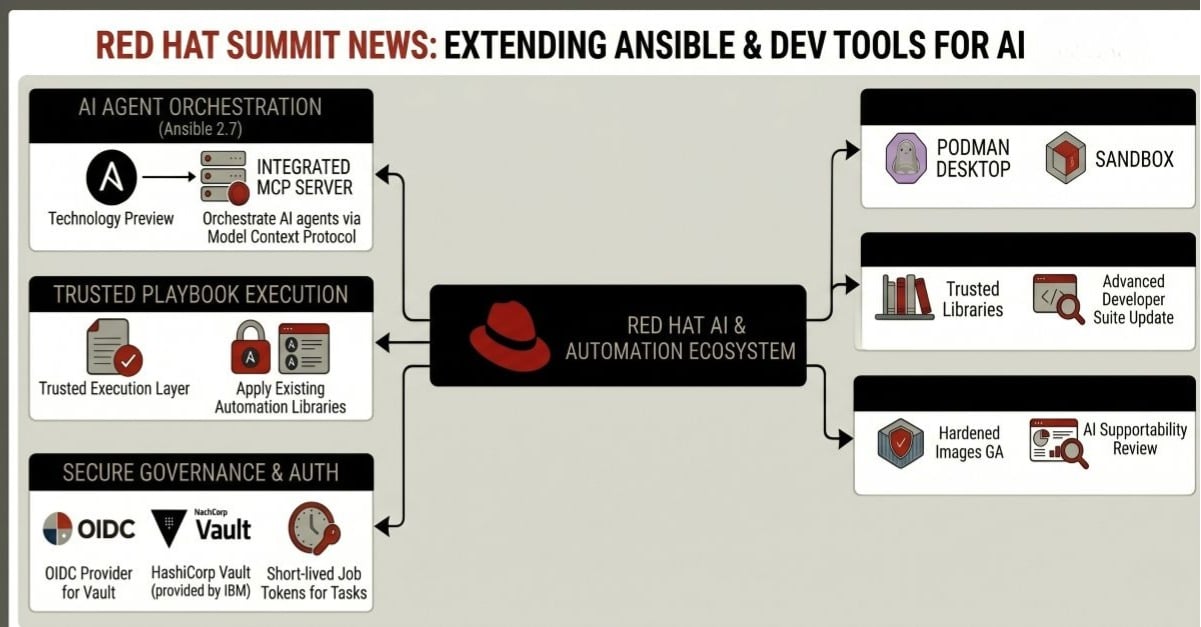
Announced at the Red Hat Summit conference, version 2.7 of the Ansible Automation Platform adds a technology preview of an orchestration engine for AI agents that are able to invoke capabilities via an integrated Model Context Protocol (MCP) server.
Sathish Balakrishnan, vice president and general manager for Ansible at Red Hat, said these capabilities provide AI agents with a trusted execution layer through which they can automate IT operations. The overall goal is to make new and existing libraries of automation playbooks available to AI agents in a way that can be governed using a set of policies enforced via the Red Hat Ansible Automation Platform, he added.
As part of that effort, the Red Hat Ansible Automation Platform can now serve as an OpenID Connect (OIDC) authentication provider for HashiCorp Vault, which is provided by Red Hat’s sister subsidiary of IBM. That capability makes it possible to issue short-lived, job-specific tokens for event-driven tasks to reduce potential risks.
At the same time, Red Hat announced that a version of its Red Hat Desktop tool for building applications now includes an instance of the Red Hat Podman tool for building and deploying containers that can be used to isolate AI agents in a sandbox environment.
Additionally, Red Hat has enhanced Red Hat Advanced Developer Suite to include a set of Red Hat Trusted Libraries and a set of AI tools to determine if known vulnerabilities in generated code are relevant to a specific application runtime.
Red Hat also announced the general availability of Red Hat Hardened Images to provide application developers with a set of more secure containers for building cloud-native applications, along with a Technical Supportability Review capability for Red Hat with AI that transforms manual environmental audits into a set of automated, self-service function that can validate more than 600 touchpoints.
Finally, Red Hat also announced it is making available a Red Hat Enterprise Linux Long-Life Add-On option for organizations that need support for longer than three years.
It’s not clear to what degree DevOps teams are adding AI agents to workflows, but it’s now more a question of what degree of trust they will place in them rather than if. The ultimate proof in the proverbial pudding will be determining to what degree AI agents will enable software engineers to reliably automate workflows at scale across increasingly complex application environments that have large numbers of interdependencies.
Ultimately, a small army of AI agents that are supervised by software engineers should enable organizations to deploy more applications than ever at higher levels of scale. The challenge, of course, will be ensuring that the AI agents confine their activities to the narrow set of tasks they have been assigned versus, for example, deleting a production database for one unexplained reason or another.
