

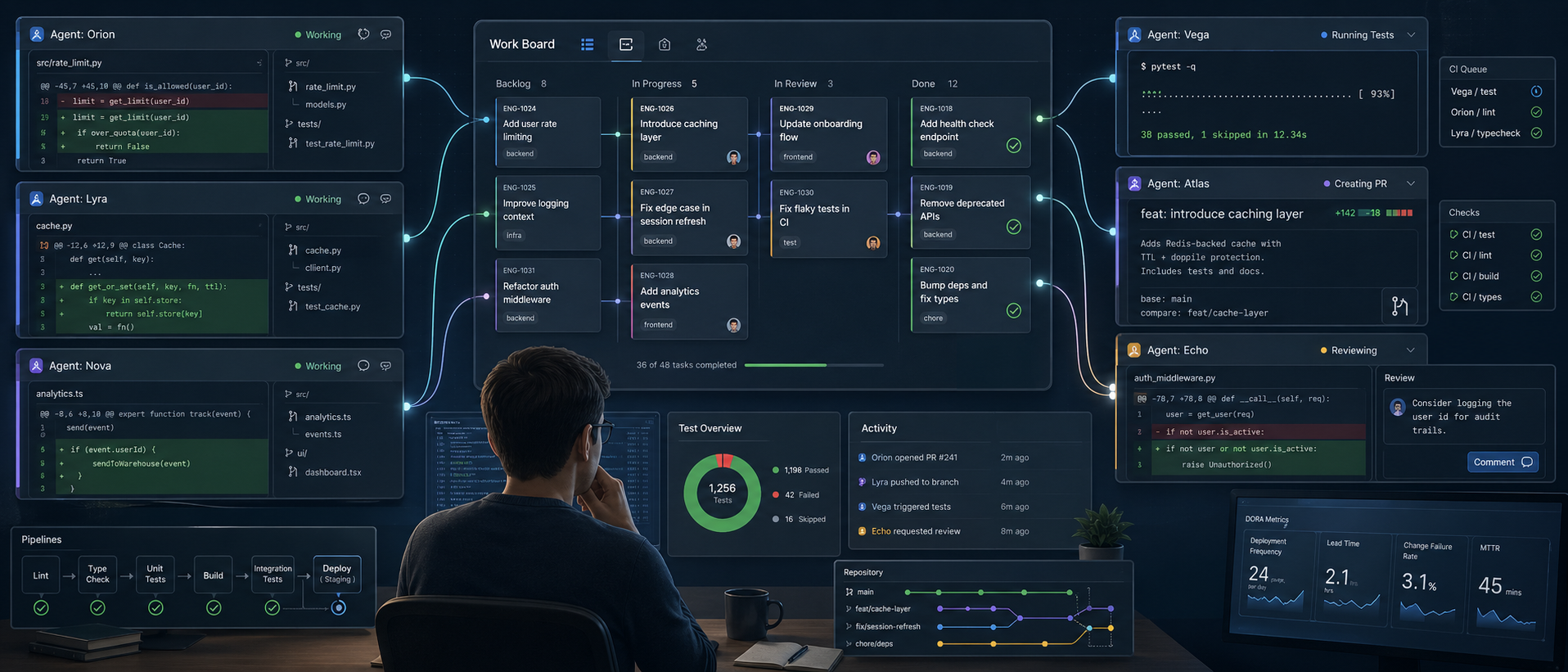

OpenAI has unveiled Symphony, an open-source specification that shifts how software development teams deploy AI in workflows, moving from interactive coding assistance toward continuous orchestration of autonomous agents.
Symphony reframes project management tools as operational hubs for AI-driven coding. Rather than prompting an assistant for individual tasks, developers assign work through issue trackers, allowing agents to execute tasks in parallel and deliver outputs for human review. The change reflects a trend in enterprise AI in which systems are increasingly embedded into production pipelines rather than used as standalone tools.
Symphony emerged from internal experimentation at OpenAI, where engineers attempted to scale the use of Codex across multiple concurrent sessions. While the agents proved capable, human operators became the limiting factor. Engineers found they could only manage a handful of sessions before coordination overhead offset productivity gains.
To address this constraint, OpenAI shifted its focus from managing sessions to managing work itself. Symphony connects coding agents directly to task boards such as Linear, assigning each open ticket to an autonomous agent running in its own workspace. These agents operate continuously, restarting if interrupted and advancing tasks until completion.
The system also integrates with existing development infrastructure, including version control and continuous integration pipelines. Agents generate code changes, monitor test results, and prepare artifacts like pull requests and validation reports. Engineers review the output rather than supervising execution in real time.
Claims Major Increase in Output
OpenAI claims that its own internal use produced a sharp increase in output, with some teams recording a fivefold rise in merged code contributions within weeks. The reported improvement stems not only from automation but from a change in how teams approach work. By reducing the human effort required to initiate and manage tasks, developers are more inclined to explore ideas and iterate quickly.
Symphony also allows non-engineering staff to participate more directly in development workflows. Product managers and designers can submit feature requests into the same system, receiving a response without needing to interact with code repositories or agent interfaces. This expands the range of contributors while maintaining a structured review process.
Rather than delivering a fully packaged product, OpenAI has released Symphony as a reference model that organizations can adapt. The core concept is defined in a simple document outlining how agents should interpret and execute tasks within a workflow. A reference implementation demonstrates how the model can be used, but the company does not plan to maintain it as a standalone offering.
This approach supports modular, open systems that integrate with existing tools. By using widely used project management platforms, Symphony lowers the barrier to experimentation while preserving familiar workflows.
Redefining Roles in Engineering Teams
Symphony, however, has its issues. Delegating tasks at a higher level reduces opportunities for real-time correction, boosting the likelihood of errors. OpenAI attempts to handle this by strengthening automated testing, and guardrails, allowing agents to self-correct over time. At this early stage it is unknown how effective these safeguards will be.
Also, not every task is suited for orchestration. Complex problems may still require direct human involvement or interactive AI use. In practice, OpenAI touts Symphony as a way to offload routine implementation work, enabling engineers to concentrate on higher-level challenges.
Symphony suggests a possible future for agentic AI. Rather than acting as mere assistants, agents are beginning to function as operational units within larger, structured systems. This shift will likely redefine roles within engineering teams, with greater emphasis on oversight and coordination.
