

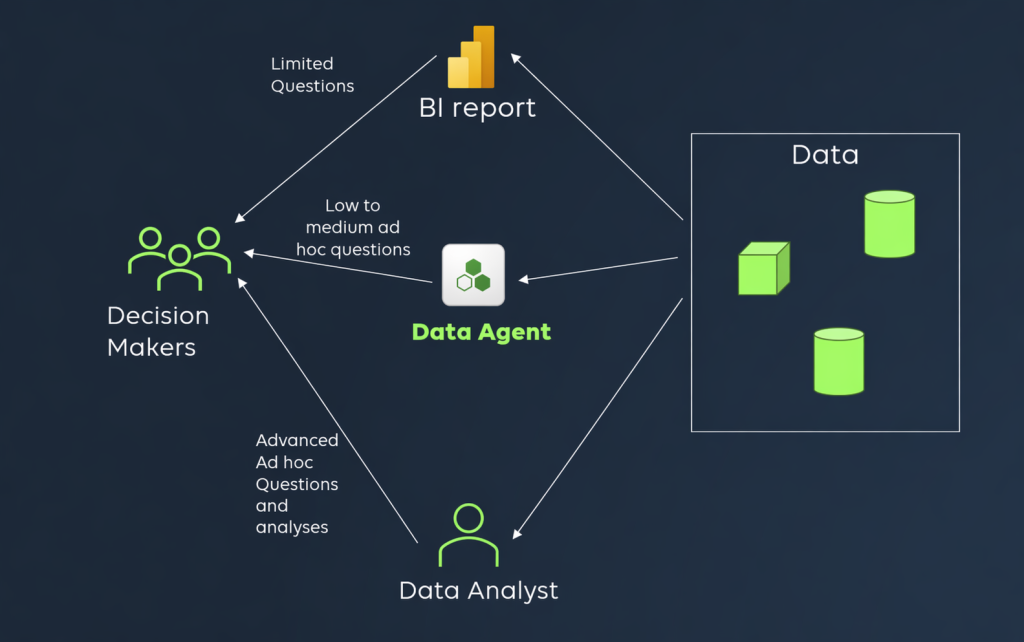
An agent without context is roughly as useful as asking a very fast junior analyst who has never seen your business. What makes an agent genuinely reliable and allows it to answer questions accurately rather than just plausibly is a well-structured semantic layer sitting between it and the raw data.
Think about what a good data analyst brings to the table: knowledge of the business domain, familiarity with where the data lives, an understanding of the relationships between tables, the logic behind calculated fields, the gap between what a column is called and what it actually means in practice. The semantic layer is the structured representation of that knowledge, and the richer it is, the more of that analyst-level context the agent can draw on when constructing an answer.
In a Microsoft environment, Power BI’s semantic model is the most natural starting point. It already encodes relationships, measures, and business logic that most organizations have invested significant time building, which means you’re working with a foundation that already exists rather than constructing one from scratch. Gartner called 2026 the year of context, and in our experience, organizations that had already invested in their semantic models had a meaningful head start when it came to getting agents to perform reliably.
What a semantic layer provides an agent
- Business definitions of metrics and dimensions, not just column names
- Relationships between data sources, pre-modelled and validated
- Calculated measures that encode business logic
- A shared vocabulary that maps user language to data structures
One thing that surprised us in practice: model size matters far less than the quality of context you provide. We’ve worked with models ranging from a handful of tables to well over 600, across industries from logistics to insurance to manufacturing, and the agent’s ability to perform doesn’t degrade with scale in the way people tend to assume.
