

Running multiple pen names on KDP sounds like diversification. Sweet romance under one name, steamy under another, dark romance under a third. Three brands, three audiences, three income streams.
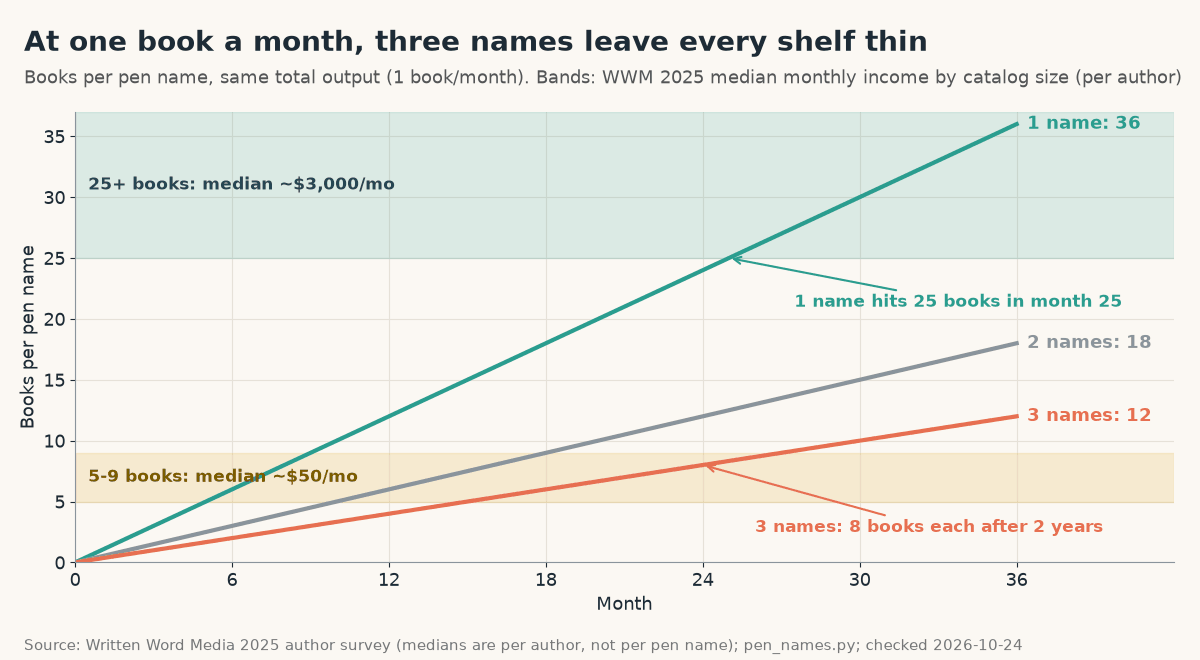
The catch is arithmetic. You still have one keyboard and one KDP account. At one book a month, a single pen name reaches 25 books in 25 months. Split the same output across three names and each one needs 75 months, more than six years, to get there.
That matters because 25 books is roughly where indie income stops being a hobby. In Written Word Media’s 2025 survey, authors with 25 or more books had a median income of about $3,000 a month. Authors with five to nine books had a median of about $50.
So should you use multiple pen names on KDP? Sometimes, yes. This post shows when the split pays, when it quietly starves every shelf, and the Python napkin math to check your own plan.
If more pen names means more books per month, the drafting step is where it breaks first. The tool I’d use for that is ImagineYourBook, an AI book-writing tool that turns a prompt or your notes into a complete draft (from a 10,000-word book up to a full novel) with a cover and Word/EPUB export. You set the heat level from sweet to steamy, and its Series Continuation compiles a story bible so Book Two starts from Book One’s canon. That keeps each pen name’s series consistent.
TL;DR
- KDP allows pen names with no stated cap, but the 2 new titles per format per week limit is per account, shared by every name.
- At 1 book a month, one name hits 25 books in 25 months; three names need 75 months each.
- Why 25 matters: WWM 2025 median income is ~$3,000/mo at 25+ books vs ~$50 at 5-9 (per author, self-reported).
- Read-through cost of splitting is small: 3.26 vs 3.46 books per new reader (−5.7%) in our napkin model.
- Split by audience (sweet vs steamy), not by subgenre, and give each name its own cadence.
What KDP actually allows (and what it doesn’t)
Pen names on KDP are normal and allowed. The rules are short, and most of them are about consistency.
- Pen names are fine. KDP’s Authors & Contributors page says you can use a pen name “as long as it is appropriate and stays consistent throughout all of your work.” Your real name goes in your account details for payments and tax forms, and it isn’t published on the site.
- Don’t mislead buyers. KDP’s metadata guidelines let you use a pen name “as long as it does not impair customers’ ability to make good buying decisions.” No borrowing a famous author’s name.
- The name is permanent per book. The author field “cannot be changed once your book is published.” KDP adds that Author Pages, Series Pages and format linking “rely on a consistent author name.”
- Pen names don’t add capacity. KDP’s Create a Book page limits new titles to 2 per format per week, for creating and for submitting. That’s a cap on your account, not on each name: 104 new ebooks a year, shared by every pen name you run.
- Author Central has slots. Author pages live in Author Central, not KDP. According to Book Bolt’s help center and Joe Trent, who both report checking with Amazon, you can add 3 author names yourself and ask support for up to 7 in total per Author Central account. That’s community-reported, not an official KDP help page, so check before you plan around it.
KDP’s help pages I read set no maximum number of pen names. The practical limit is your output, not Amazon.
The catalog-depth math: 25, 50 or 75 months
Here is the core trade-off in one function. Your total output is fixed. Every pen name you add divides it.
def months_to(books_per_name, names, books_per_month=1):
    """Months until EVERY pen name has `books_per_name` books, output split evenly."""
    return books_per_name * names / books_per_month

for n in (1, 2, 3):
    print(f"{n} name(s): {months_to(10, n):.0f} / {months_to(25, n):.0f} months")
# 1 name(s): 10 / 25 months
# 2 name(s): 20 / 50 months
# 3 name(s): 30 / 75 months
At one book a month (my assumption; plug in yours), one name gets to 10 books in 10 months and 25 books in 25 months. Two names take 20 and 50 months. Three names take 30 and 75.
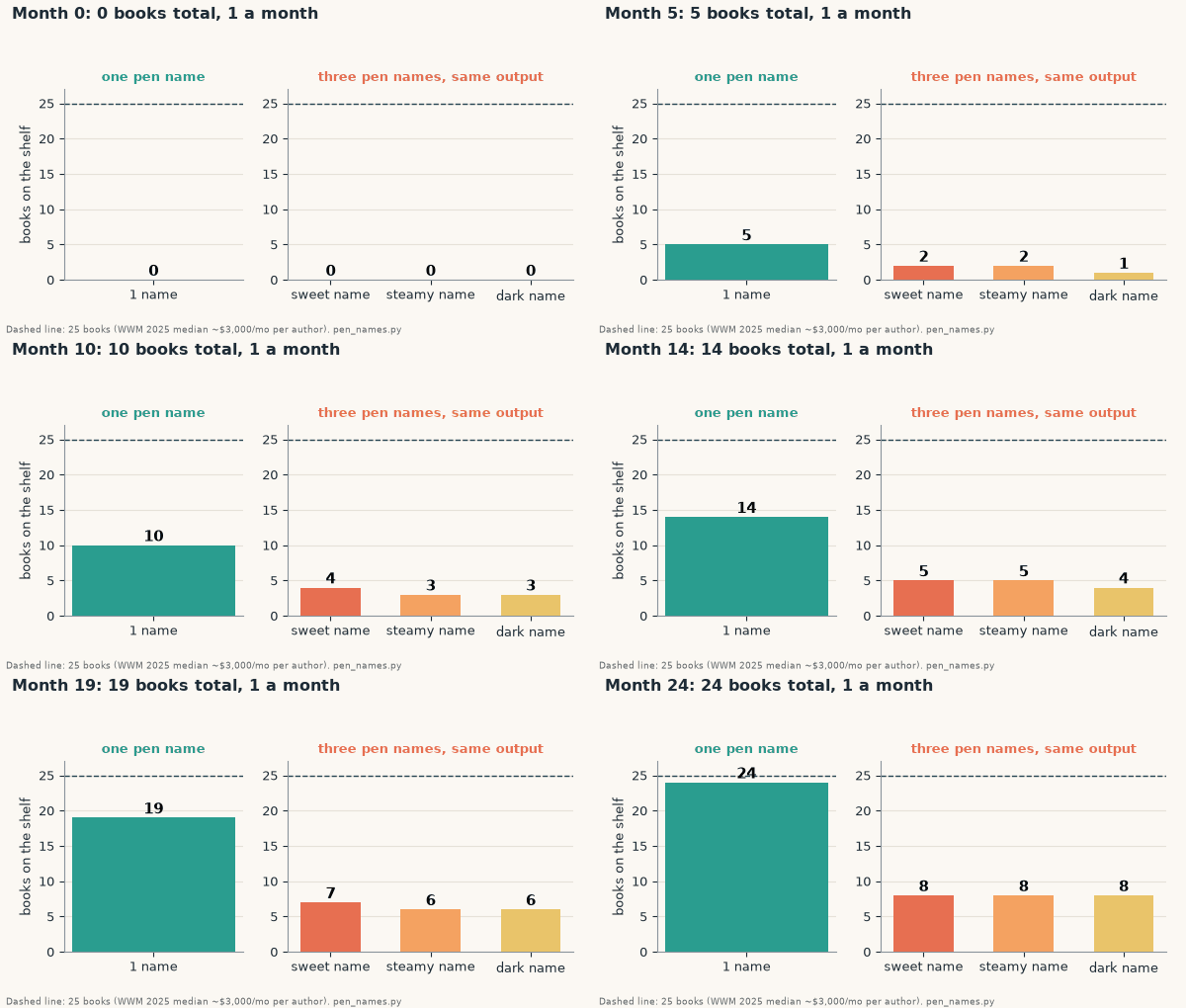
After two years, the single name has 24 books. Each of three names has 8.
Now overlay Written Word Media’s catalog buckets. Its 2025 author survey found median income around $50 a month at five to nine books, a ramp-up from 10 books, and around $3,000 a month at 25+ books, with more than 40% of that group earning over $5,000.
Two honest caveats. First, those medians are per author, not per pen name, and they’re self-reported. Second, correlation isn’t a promise: 25 weak books won’t earn like 25 good ones. But the direction is the point. Each pen name has to build its own followers, its own also-boughts and its own backlist. Eight books under each of three names is three shelves stuck in the five-to-nine zone.
Romance makes this sharper. In WWM’s 2023 survey, authors who mainly write romance had a median of 18 published titles and an average of 28. That’s the shelf depth your pen name competes with.
Watch the same 24 books land on one shelf versus three:
What splitting costs in read-through: less than you’d think
The other worry is lost read-through. If a reader finishes your sweet series, will they find your other sweet series if it’s under a different name? Let’s measure it.
Kindlepreneur’s read-through guide by Malorie Cooper gives an example 5-book series where, per 100 Book 1 sales, Books 2 to 5 sell 65, 50, 48 and 45 copies. The guide says many authors see 50-60% from Book 1 to Book 2, and in Kindle Unlimited it calls anything under 75% low for a book that has found its audience.
Take the first four books of that example as a 4-book series. One new Book 1 reader then reads 2.63 books on average. Then add one assumption: half of the readers who finish a series start another series under the same name (cross-start rate 50%). Readers can’t follow you to a name they don’t know exists.
"""Multiple pen names on KDP: napkin math for one catalog vs a split catalog.
Sourced inputs are marked SOURCE; everything else is an ASSUMPTION you should replace with your own numbers."""

# SOURCE: Kindlepreneur read-through example (share of Book-1 buyers who reach Book n), 4-book series
REACH = [1.00, 0.65, 0.50, 0.48]
# SOURCE: WWM KDP Global Fund tracker, Jan-Sep 2026 average $0.00474/KENP x ~211 KENP for 40k words
KU_PER_FULL_READ = 1.00
# SOURCE: KDP "Create a Book": up to 2 new titles per format per week, per account (not per pen name)
KDP_WEEKLY_CAP = 2

BOOKS_PER_MONTH = 1      # ASSUMPTION: your total output, across all pen names
CROSS_START = 0.5        # ASSUMPTION: share of series finishers who start another series under the SAME name

def months_to(books_per_name, names, books_per_month=BOOKS_PER_MONTH):
    """Months until EVERY pen name has `books_per_name` books, output split evenly."""
    return books_per_name * names / books_per_month

def books_per_name(month, names, books_per_month=BOOKS_PER_MONTH):
    return month * books_per_month / names

def reads_per_reader(series_under_name, cross=CROSS_START, reach=REACH):
    """Expected books read by one new Book-1 reader who can only follow series under one name.
    Read series 1; finishers (reach[-1]) start another unread series with probability `cross`."""
    per_series, q = sum(reach), reach[-1] * cross
    return per_series * sum(q ** k for k in range(series_under_name))

if __name__ == "__main__":
    print(f"Account-wide cap: {KDP_WEEKLY_CAP * 52} new ebooks/year, shared by all pen names")
    print("\nMonths until each pen name reaches 10 / 25 books at 1 book a month:")
    for n in (1, 2, 3):
        print(f"  {n} name(s): {months_to(10, n):>3.0f} / {months_to(25, n):>3.0f} months")
    print("\nAfter 24 months (24 books):", {n: books_per_name(24, n) for n in (1, 2, 3)})
    print(f"\nOne series = {sum(REACH):.2f} books per Book-1 reader (= ${sum(REACH) * KU_PER_FULL_READ:.2f} in KU reads)")
    for series in (6, 2):
        r = reads_per_reader(series)
        print(f"  {series} series under one name: {r:.2f} books per new reader (${r * KU_PER_FULL_READ:.2f})")
    loss = 1 - reads_per_reader(2) / reads_per_reader(6)
    print(f"Read-through cost of splitting 6 series into 3 names of 2: -{loss:.1%} per new reader")
    print("\nMonthly cadence on all 3 names = 3 novels/month =", 3 * 40_000, "words")
Output:
Account-wide cap: 104 new ebooks/year, shared by all pen names

Months until each pen name reaches 10 / 25 books at 1 book a month:
  1 name(s):  10 /  25 months
  2 name(s):  20 /  50 months
  3 name(s):  30 /  75 months

After 24 months (24 books): {1: 24.0, 2: 12.0, 3: 8.0}

One series = 2.63 books per Book-1 reader (= $2.63 in KU reads)
  6 series under one name: 3.46 books per new reader ($3.46)
  2 series under one name: 3.26 books per new reader ($3.26)
Read-through cost of splitting 6 series into 3 names of 2: -5.7% per new reader

Monthly cadence on all 3 names = 3 novels/month = 120000 words
Six series under one name gives 3.46 books per new reader. Two series under each of three names gives 3.26. That’s only 5.7% less.
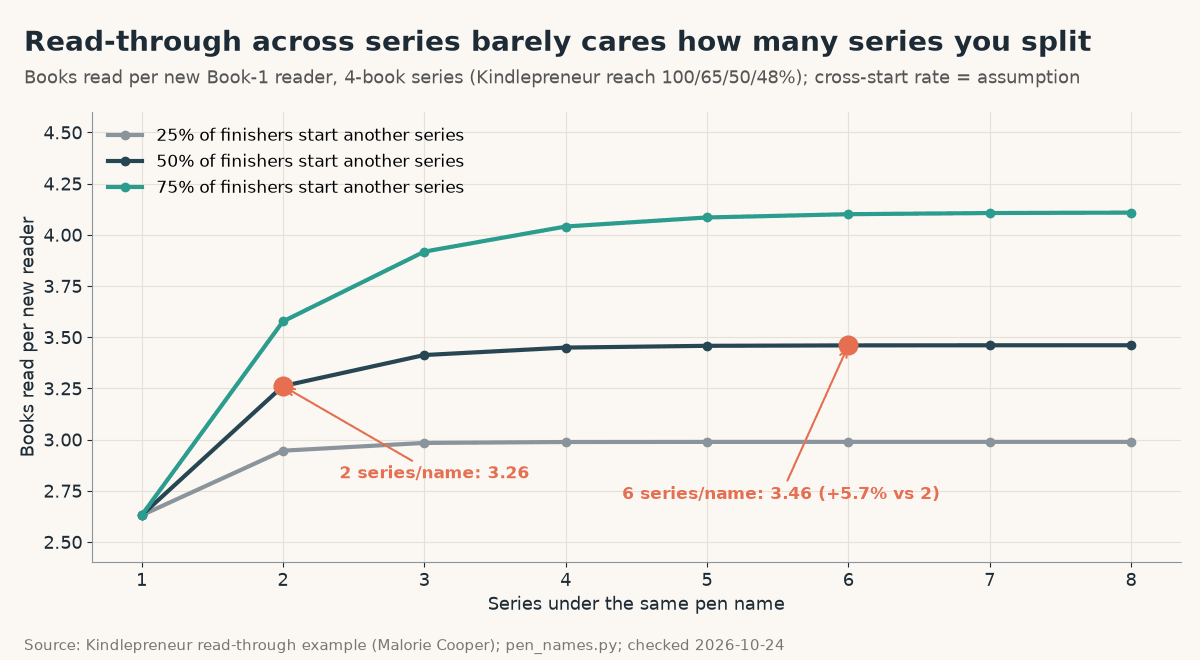
Why so small? Because only 48% of readers finish the series in this example, and only half of those (by assumption) start the next one. The compounding happens through new readers and new books, not through each reader’s chain. The curves flatten after 3-4 series per name even at a 75% cross-start rate.
So the read-through cost of splitting is real but modest. The big cost is time to depth, plus the duplicated marketing work below.
When a second pen name pays: steam, not subgenre
The best evidence for splitting comes from authors who tried both. On BookBub’s blog, romance author Ines Johnson, who says she now earns six figures, describes writing three romance subgenres under one name. Her readers didn’t cross over.
Her conclusion: “the level of steam matters most.” Readers who want the bedroom door wide open and readers who want it closed don’t mix. She split her books into three pen names grouped by audience, and kept paranormal romance and fairy-tale retellings together because those readers did overlap.
Read that carefully. She didn’t split by trope or by subgenre label. She split where the cross-start rate was already near zero. In my model, that’s the case where splitting costs nothing in read-through, because a sweet reader was never going to start your steamy series anyway. Johnson’s own words for the upside: separate names made readers “super happy and confident” about what they’d get when they opened a book.
Her other lessons point the same way. She doesn’t apply for a BookBub Featured Deal until a series has at least three books, and calls five the sweet spot. And she says irregular release schedules lost her readers, and that consistency matters more than speed. Both are harder to hit when one keyboard feeds three names.
| Situation | One name or split? | Why |
|---|---|---|
| Sweet and steamy (or closed-door and explicit) romance | Split | BookBub’s Ines Johnson: “the level of steam matters most”; readers didn’t cross over |
| Romance plus nonfiction, kids’ books or business titles | Split | Different buyers; KDP says a pen name must not impair buying decisions |
| Adjacent romance subgenres that share readers | One name | Johnson kept paranormal and fairy-tale retellings together because readers overlapped |
| Testing a new trope or subgenre | One name first | The author field can’t be changed after publishing; a new name starts at zero books |
| Privacy from your day job | One pen name | KDP keeps your real name off the site; one pen name is enough for privacy |
A three-name operation needs three cadences
If you do split, the honest way to avoid the 75-month problem is to multiply output, not divide it. A monthly release on each of three names is 3 novels a month, or about 120,000 words at 40,000 words per book.
That fits inside KDP’s account cap of 2 new titles per format per week, but it’s a lot of drafting for one person. It’s also roughly the capacity ImagineYourBook’s Publisher plan lists: about 120,000 words, or three 40,000-word novels, for $59.99 a month. Its Mogul plan, about 480,000 words for $179.99 a month, is literally labelled “for binge readers & pen names.”
Each name still needs its own:
- Author Central page (and one of your 3 to 7 slots, per the reports above).
- Cover style and series branding, so a sweet reader never lands on a steamy cover.
- Newsletter. Your list is the main way readers follow a name between releases.
- Release calendar you actually keep, per Johnson’s consistency lesson.
- Ads and promo budget, since reviews and followers don’t transfer across names.
The drafting can scale with AI. The list above mostly can’t. That’s why the practical rule is fewer names, deeper shelves.
| Question | One pen name | Three pen names (same output) |
|---|---|---|
| Months to 10 books per name (1 book/mo) | 10 | 30 |
| Months to 25 books per name | 25 | 75 |
| Books per name after 24 months | 24 | 8 |
| Books read per new reader (50% cross-start) | 3.46 | 3.26 |
| KDP new-title cap (per account) | 2 per format per week | 2 per format per week, shared |
| Author Central pages | 1 | 3 (of 3 self-serve slots; up to 7 via support, community-reported) |
| Newsletters, cover styles, ad budgets | 1 each | 3 each |
Limitations
- Assumptions: 1 book a month, 4-book series, the 50% cross-start rate, and the even split across names are my napkin inputs. Change them in
pen_names.py. - The read-through numbers are one illustrative example from Kindlepreneur, not an industry average. KU series often run higher.
- WWM medians describe authors, not pen names, and come from self-reported surveys.
- Revenue in KU reads ($1.00 per full 40,000-word read) uses the 2026 average per-page rate from our romance AI post. Rates change monthly.
The takeaway
Multiple pen names on KDP are a branding tool, not a growth strategy. Split when readers truly don’t overlap: sweet vs steamy, romance vs nonfiction. Then give every name its own cadence. Don’t split adjacent subgenres that share readers. At one book a month, three names turn a 25-month path to 25 books into 75 months, while saving you only about 6% in cross-series read-through.
If you’re going to run more than one name, the bottleneck is drafting enough books to keep every shelf growing. Try ImagineYourBook for your next series: the 7-day trial is $0 and includes one complete 10,000-word book. It needs a card, and the $29.99 Author plan starts after 7 days unless you cancel before day 8. As its own FAQ puts it, sales still depend on your editing, positioning and readers; they’re never guaranteed.
Related reading on Finxter: How many KDP books to make money, How often can you publish on KDP, Best AI for writing a book series, Top 10 AI dark romance book writers, and for the Python side, Python sum(), which the model above leans on.
Sources (checked October 24, 2026): KDP: Authors & Contributors (pen names) · KDP: Metadata Guidelines for Books · KDP: Create a Book (new title creation and submission limits) · Book Bolt Help: adding Author Central author pages · Joe Trent: 7 pen names per Author Central account (2023) · Written Word Media: 2025 Author Survey · WWM: 2023 State of Indie Authorship · Kindlepreneur: How to calculate series read-through (Malorie Cooper) · BookBub Partners Blog: How I Make Six Figures as a Self-Published Author (Ines Johnson) · ImagineYourBook pricing and FAQ. Script: pen_names.py (shown above). Related: Authors With an Email List Earn 20x More. Here’s the Catch (Medium) · ImagineYourBook is listed in the community-curated Awesome Generative AI list on GitHub.
