

How to get more Kindle Unlimited page reads? Most advice says “run more ads.” That’s one lever. It’s also the only one that costs money every month.
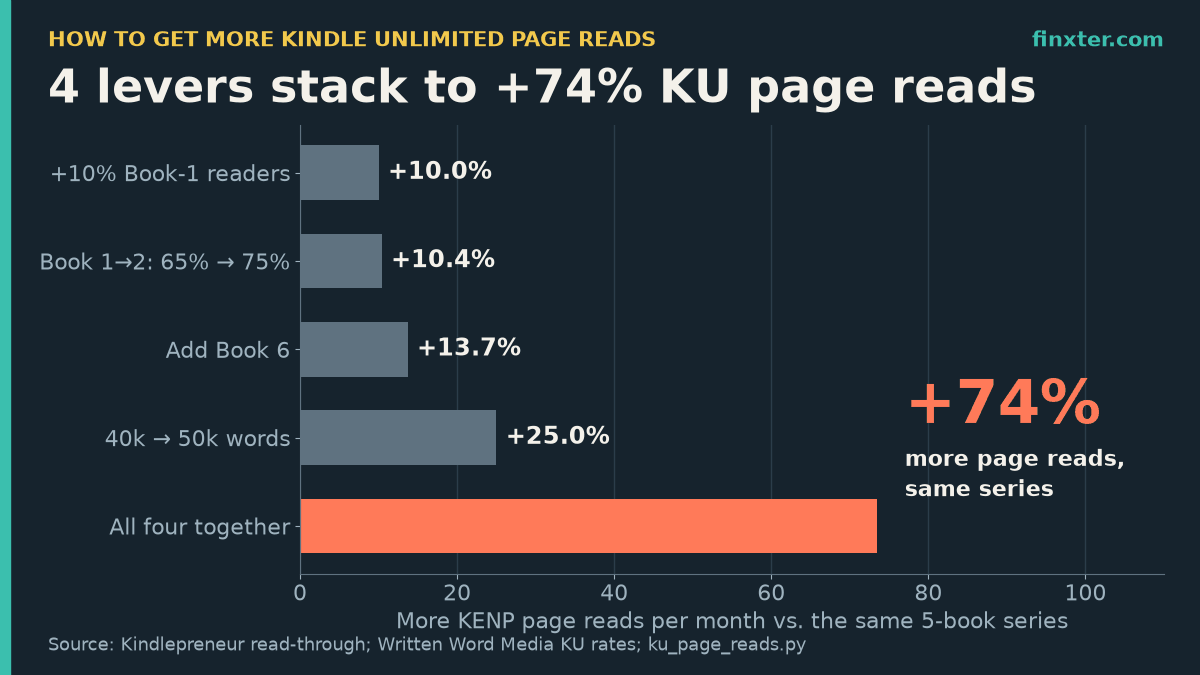
I modeled one five-book series with a published read-through curve and 2026 page-read rates. Four changes, each modest on its own, add +10% to +25% each. Stacked, they lift page reads by 74%, from 64,842 to 112,512 KENP a month, for the same series.
Only one of the four needs more traffic. The other three are about what’s inside your books, and that’s where an AI-assisted catalog has an edge.
If you draft series with AI, the tool I’d start with is ImagineYourBook. It’s an AI book-writing tool that turns a prompt or your notes into a complete draft (one 10,000-word book in the trial, 40,000-word novels on paid plans) with Word and EPUB export. Its series memory carries your characters and story into Book Two, and its Manuscript Rewrite can turn an existing manuscript into a longer edition. Two of the four levers below are exactly that: more books in the series, and longer books.
TL;DR
- Kindle Unlimited (now Kindle+ in KDP’s help pages) pays per first-time page read; the US rate averaged $0.00474 per page in Jan-Sep 2026.
- Raising Book 1 → Book 2 read-through from 65% to 75% adds +10.4% page reads, more than 10% more Book-1 readers (+10.0%).
- Adding Book 6 adds +13.7%; 50,000- instead of 40,000-word books add +25% (if readers finish).
- Stacked, the four levers lift one five-book series from 64,842 to 112,512 KENP a month: +74%.
- The per-page rate swung 31% since January 2025. You control pages, not the rate.
How Kindle Unlimited actually pays for pages
First, the rules, because they decide which levers work. KDP’s help pages now call the subscription Kindle+, and it covers audiobooks as well as eBooks enrolled in KDP Select (audiobooks in the US only).
From KDP’s Royalties in Kindle+ page and its KENP page:
- You’re paid from the monthly KDP Select Global Fund, by your share of all pages read or listened to.
- Pages are Kindle Edition Normalized Pages (KENP), counted from the start reading location (usually chapter 1) to the end of the book.
- You earn the first time a subscriber reads a page. Rereads don’t pay, and listening to a page already read counts as a reread.
- There’s a cap of 3,000 KENP per title per customer.
- The rate per page is the fund divided by total KENP read in that marketplace.
Amazon doesn’t publish the rate, but Written Word Media tracks it every month. The September 2026 fund was $65.9 million and the US rate $0.005365 per page. Across January to September 2026, it averaged $0.00474.
That rate moved 31% between its January 2025 low ($0.004091) and its September 2026 high. You can’t control it. (I skipped the tracker’s December 2024 value of $0.03228, which commenters on that page flag as a likely typo.) What you can control is the number of pages. At 190 words per KENP (the author-reported band is roughly 170 to 200, as in our best AI for writing romance novels breakdown), a 40,000-word novel is about 211 KENP, so one full read pays about $1.00.
The baseline: one five-book series
Kindlepreneur’s read-through guide shows an example month for a five-book series: 100 readers of Book 1, then 65, 50, 48 and 45 for Books 2 to 5. That’s 3.08 books read per Book-1 reader.
Assumptions, clearly mine: 100 Book-1 readers a month, 40,000-word books, everyone who starts a book finishes it, and the 2026 average rate. That gives 64,842 KENP, or about $307 a month, which is $3.07 per Book-1 reader.
Now change one thing at a time.
| Change (one at a time) | KENP / month | vs. base | At $0.00474/page |
|---|---|---|---|
| Base: 5 books, 65% to Book 2, 40k words | 64,842 | – | $307 |
| 10% more Book-1 readers | 71,326 | +10.0% | $338 |
| Book 1 → 2 read-through 65% → 75% | 71,579 | +10.4% | $339 |
| Add Book 6 (keeps 93.75%) | 73,724 | +13.7% | $349 |
| 40,000 → 50,000-word books | 81,053 | +25.0% | $384 |
| All four together | 112,512 | +73.5% | $533 |
The script below produces every number in this article. Change the constants to match your own KDP reports.
# ku_page_reads.py (excerpt); sources in the file header
FUNNEL = [100, 65, 50, 48, 45]   # Kindlepreneur example: readers of Books 1-5
WORDS, WPP = 40_000, 190         # ASSUMPTION: 40k words, ~190 words per KENP
RATE_2026 = 0.00474              # avg US $/page Jan-Sep 2026 (Written Word Media)

def funnel(b1_to_b2=None, books=5):
    s = [FUNNEL[i + 1] / FUNNEL[i] for i in range(4)]   # 0.65, 0.77, 0.96, 0.94
    if b1_to_b2 is not None: s[0] = b1_to_b2
    while len(s) < books - 1: s.append(s[-1])           # ASSUMPTION: Book 6+ keeps 93.75%
    out = [100.0]
    for r in s[:books - 1]: out.append(out[-1] * r)
    return out

def pages(readers=100, b1_to_b2=None, books=5, words=WORDS):
    return readers / 100 * sum(funnel(b1_to_b2, books)) * words / WPP

BASE = pages()
for name, p in {"+10% Book-1 readers": pages(readers=110),
                "Book 1->2 from 65% to 75%": pages(b1_to_b2=0.75),
                "Add Book 6": pages(books=6),
                "Books 40k -> 50k words": pages(words=50_000),
                "All four": pages(110, 0.75, 6, 50_000)}.items():
    print(f"{name:28s} {p:8,.0f} KENP  {p / BASE - 1:+.1%}  ${p * RATE_2026:,.2f}")
Full output:
Per-page rate Jan 2025-Sep 2026: low $0.004091 (Jan 2025), high $0.005365 (Sep 2026), 2026 avg $0.00474
Swing low->high: +31%  (not in your control)
40k-word book = 211 KENP; 3,000-KENP cap = 570,000 words per title per reader
Base funnel [100, 65, 50, 48, 45] -> 3.08 books per Book-1 reader
Base: 100 Book-1 readers -> 64,842 KENP -> $307.37 a month ($3.07 per reader)
  +10% Book-1 readers (ads, promos)     71,326 KENP  +10.0%  $ 338.10
  Book 1->2 from 65% to 75%             71,579 KENP  +10.4%  $ 339.30
  Add Book 6 to the series              73,724 KENP  +13.7%  $ 349.47
  Books 40k -> 50k words                81,053 KENP  +25.0%  $ 384.21
  All four together                    112,512 KENP  +73.5%  $ 533.33
Book 1->2 at 50.0%: 2.60 books per reader, $2.59 per Book-1 reader
Book 1->2 at 65.0%: 3.08 books per reader, $3.07 per Book-1 reader
Book 1->2 at 75.0%: 3.40 books per reader, $3.39 per Book-1 reader
Book 1->2 at 86.3%: 3.76 books per reader, $3.75 per Book-1 reader
Lever 1: fix Book 1 → Book 2 read-through first
Moving Book 1 → Book 2 read-through from 65% to 75% adds 10.4% to page reads. That’s slightly more than 10% more Book-1 readers, and it costs no ad money.
Kindlepreneur sets the bar higher for KU than for sales. A KU Book 1 → Book 2 read-through under 75% is low “for a KU book that has found its audience”, and its worked example lands at 86.3%. If yours is at 65%, you’re not unlucky. Something in Book 1 is losing readers, and Kindlepreneur’s advice is to read your 1- to 3-star reviews to find out what.
It also compounds down the series, because Book 3 readers come from Book 2 readers:
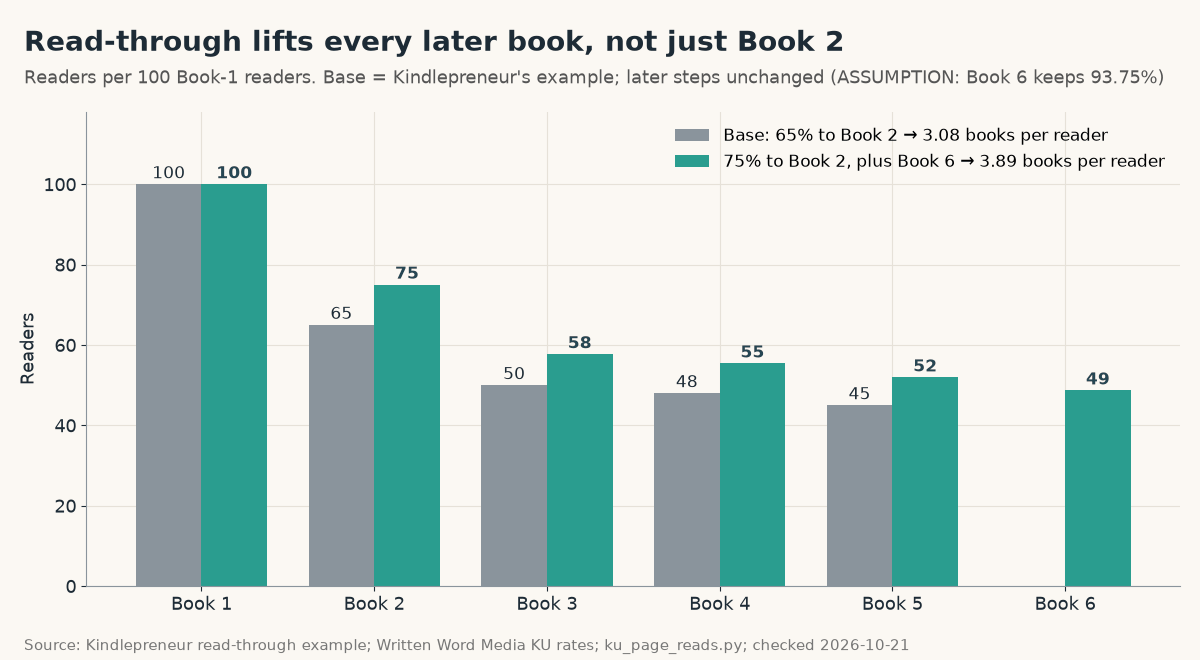
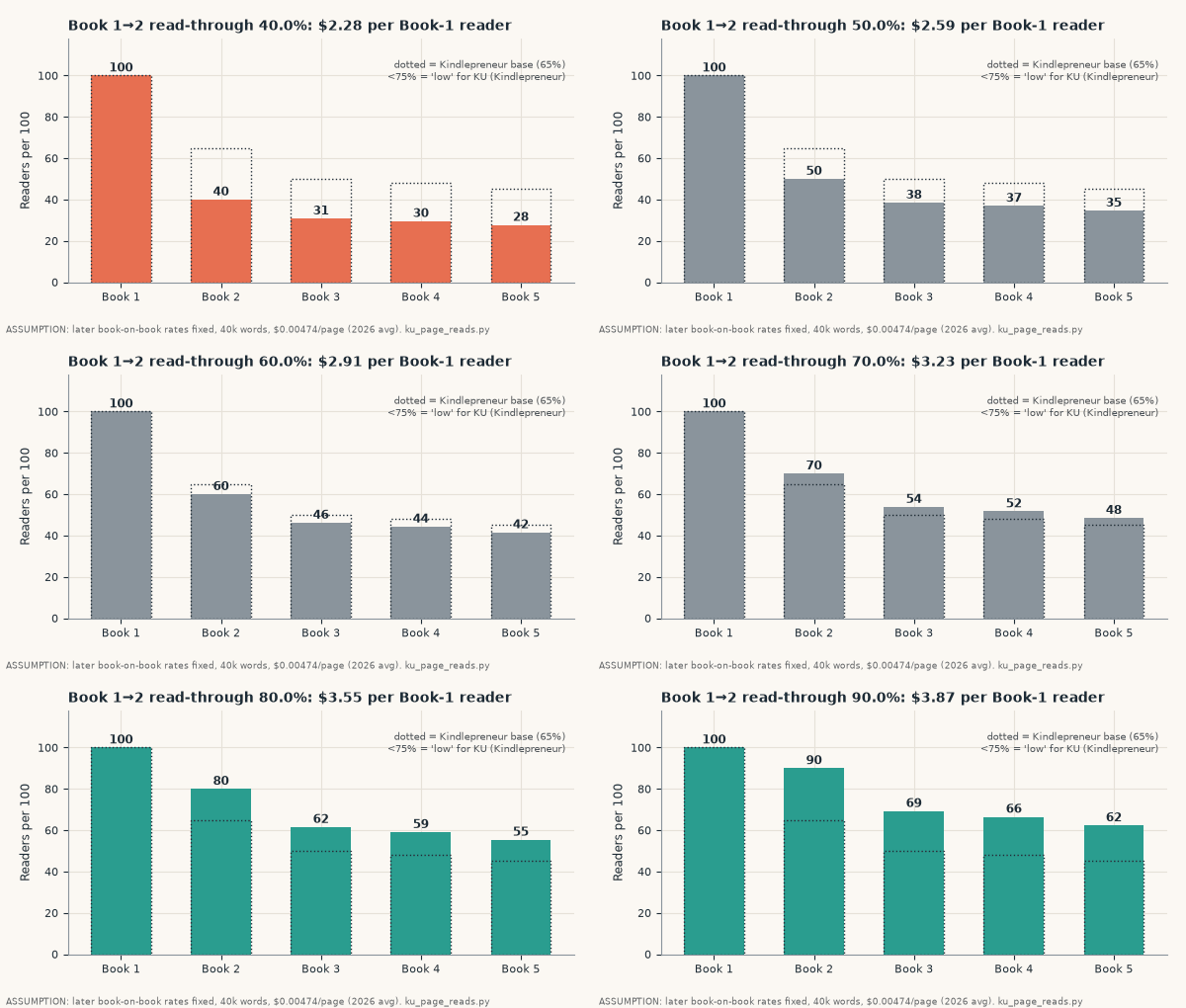
At 50% read-through, a Book-1 reader is worth $2.59. At 75% it’s $3.39, and at Kindlepreneur’s 86.3% it’s $3.75. Every reader you already have becomes worth more.
How to measure yours: divide each book’s KENP read by its KENPC (shown in the KDP Select info for each title) to get “full reads”, then divide Book 2’s full reads by Book 1’s. That’s Kindlepreneur’s method, and it works even though KU doesn’t tell you who finished.
Lever 2: add Book 6
Readers who reach Book 5 are your most loyal. In the example, 93.75% of Book 4 readers go on to Book 5. If Book 6 keeps that rate (my assumption), it adds 42 readers per 100 Book-1 readers, or +13.7% page reads.
That’s why rapid-release series authors keep writing sequels instead of starting over. A new Book 6 inherits an audience. A new Book 1 has to find one. Our How many KDP books to make money post shows the same effect at catalog scale: per book, bigger catalogs earn more.
Lever 3: write longer books (if readers finish them)
KENP is a page count, so a 50,000-word book has 25% more pages than a 40,000-word one. If completion holds, page reads grow 25%.
That “if” matters. My model assumes every reader finishes, and padding is the fastest way to break that. The 3,000-KENP cap isn’t a constraint for normal novels: at 190 words per page, it’s about 570,000 words per title per reader. Even a five-book box set of 40,000-word novels (about 1,053 KENP) is far below it.
The honest version of this lever: write the book your genre’s readers expect, at the upper end of that range, not a stretched one.
Lever 4: more Book-1 readers (the one that costs money)
This is where most authors start. In my model, +10% Book-1 readers gives exactly +10% page reads, the weakest lever per unit of effort.
KDP Select gives you two free tools (Free Book Promotions, Kindle Countdown Deals):
- Free Book Promotion: up to 5 free days per 90-day enrollment, in all KDP marketplaces.
- Kindle Countdown Deal: up to 7 days on Amazon.com and Amazon.co.uk, for books enrolled at least 30 days and priced $2.99 to $24.99.
- You can run one type per enrollment term, not both.
Paid ads are where read-through math hits hardest. Kindlepreneur’s illustrative ad example (a $0.30 click, one sale per 30 clicks) costs $9 per Book-1 sale. At the baseline, a Book-1 KU reader is worth $3.07 in page reads. Fix Levers 1 to 3 first, then buy traffic.
One thing you must not do: KDP doesn’t allow marketing that rewards Kindle+ customers for reading, whether that’s payment, bonus content, contest entries or discounts on future purchases. It says it monitors for manipulation.
Stack them
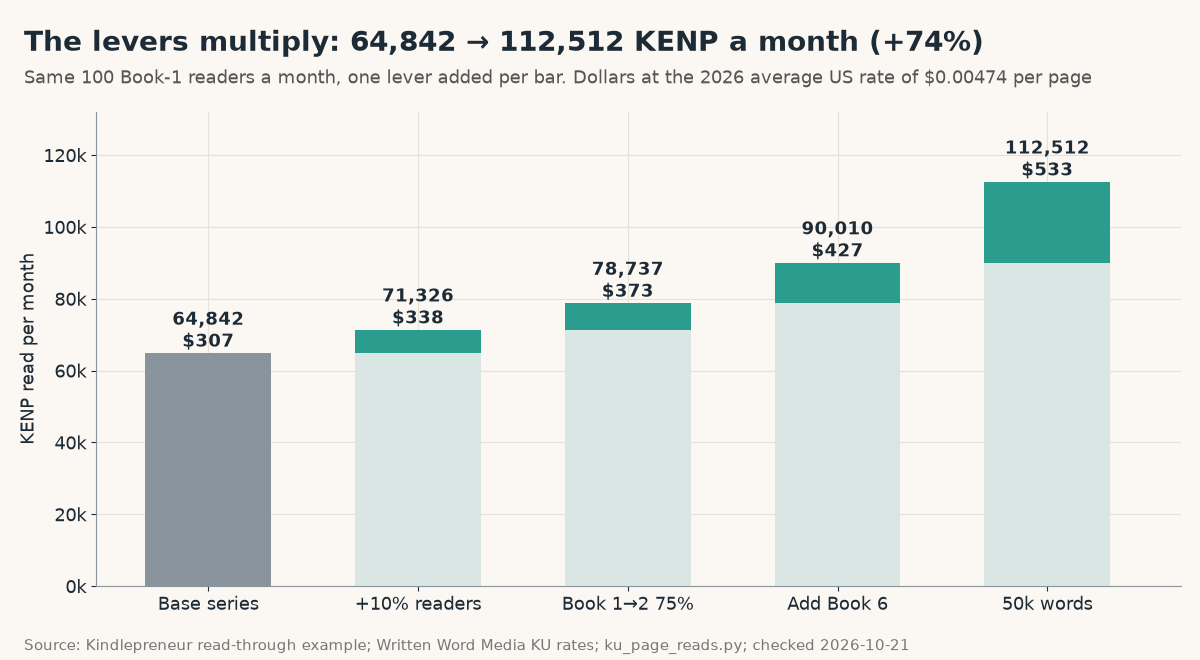
The levers multiply because each one scales a different factor: readers × read-through × series length × pages per book. Together, 64,842 KENP becomes 112,512 (+73.5%), about $533 instead of $307 a month at the 2026 average rate. A 31% rate swing could wipe that out or double it, which is why you track pages, not dollars.
There’s a fifth lever I didn’t model because I found no reliable numbers on it: audiobooks. Kindle+ pays for pages listened, but only in the US, and a reader who already read the eBook earns you nothing extra by listening. So audio adds new listeners, not double pay per fan.
| Lever | Page-read gain | Costs money? | What to do |
|---|---|---|---|
| Book 1 → 2 read-through | +10.4% (65% → 75%) | No | Read 1-3 star reviews of Book 1; aim for 75%+ in KU |
| Series length | +13.7% (Book 6) | Drafting/editing time | Write sequels to series that already have readers |
| Book length | +25% (40k → 50k) | Drafting/editing time | Write to the upper end of your genre’s length, no padding |
| Book-1 readers | +10% (10% more) | Ads yes; KDP promos no | One Free Book Promotion (5 days) or Countdown Deal (7 days) per 90-day term |
| Per-page rate | -14% to +13% vs. 2026 avg | Not in your control | Track KENP, not dollars |
Where this can be wrong
- The funnel is one example month, not a benchmark. Your read-through is in your KDP reports; plug it in.
- “Everyone finishes” is generous. Partial reads lower every number here, so treat them as upper bounds.
- Rates are author-reported. Written Word Media’s numbers are US-only and backed out of KDP data; your Prior Months’ Royalties report is the truth.
- Levers interact. A longer book can lower read-through if the extra length is filler.
For the per-sale side of the same series, run our KDP royalty calculator in Python. For drafting costs per book on raw APIs, see what a 50,000-word AI novel costs on the OpenAI and Claude APIs. The charts here are plain Matplotlib; Finxter’s Matplotlib guide covers the basics.
The takeaway
How do you get more Kindle Unlimited page reads? Don’t start with ads. Raise Book 1 → Book 2 read-through to at least 75%, give loyal readers a Book 6, write to the full length your genre expects, and only then buy Book-1 readers. On one five-book series, that stack is worth +74% page reads.
If you want to add that next book to a series, draft it in ImagineYourBook. The 7-day trial is $0 today but needs a card. It includes one complete 10,000-word book, and the first $29.99 Author payment starts after 7 days unless you cancel before day 8. Then check Book 2’s read-through, and rerun the script.
Sources (checked October 21, 2026): KDP: Royalties in Kindle+ · KDP: Kindle Edition Normalized Page (KENP) · KDP: Kindle+ · KDP: Free Book Promotions · KDP: Kindle Countdown Deals · Written Word Media: KDP Global Fund payouts · Kindlepreneur: How to calculate series read-through · ImagineYourBook pricing · Related: Kindle Unlimited Pays Half a Cent a Page. Here’s What a Novel Earns (Medium) · ImagineYourBook is listed in the community-curated Awesome Generative AI list on GitHub.
