

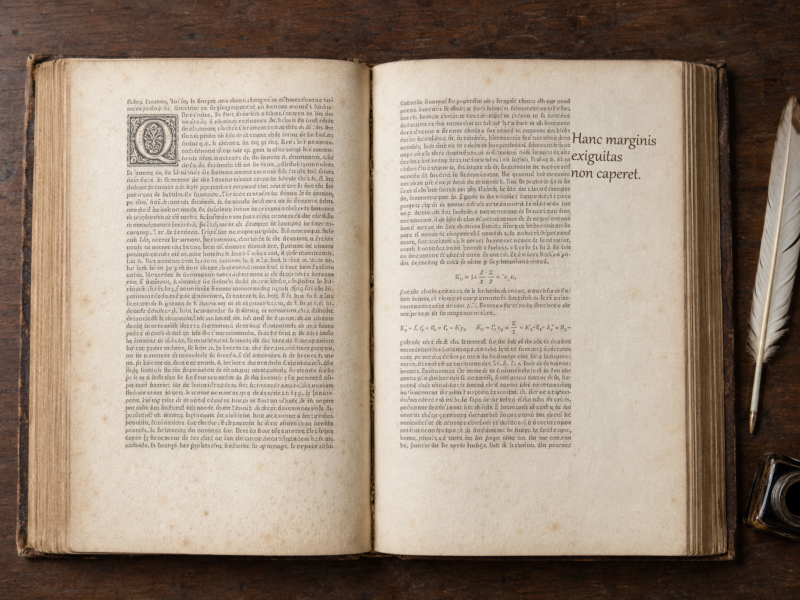
In about 1637 a lawyer in Toulouse was reading a mathematics book in his own time. He had an idea, wrote it in the margin, and added that he had a marvelous proof which the margin was too narrow to contain. That note kept mathematicians busy for the next three and a half centuries. Let us talk about what Fermat left in a margine.
Hanc marginis exiguitas non caperet. This margin is too narrow to contain it.
It is the most famous thing he ever wrote. No proof of the general claim survives from him.
I want to tell that story. I also want to tell the other one, because Pierre de Fermat was quietly building things we still use every day, and almost nobody mentions them.
A Lawyer With a Hobby
Fermat was born in 1601 and died in 1665. He was appointed to the Parlement de Toulouse in 1631 and spent his working life in the law.
Mathematics was his hobby. That is worth sitting with for a moment. One of the finest mathematical minds of the century was doing this in the evenings, for pleasure, with no intention of building a career out of it.
How Mathematics Was Done Then
There were no journals to publish in. There was no peer review in any form we would recognize. What there was, was the post.
Mathematicians wrote to each other. They announced results in letters, set each other problems, and issued public challenges to see who could solve what. It was competitive, it was personal, and it ran on paper.
Fermat fitted that world perfectly, and he had one habit that drove everybody mad. He communicated most of his work in letters to friends, often with little or no proof attached. Here is a thing that is true, he would write. Prove it yourself.
The book he was annotating was a Latin translation of Diophantus, published by Claude Bachet in 1621, and his notes are in Latin too. The famous one ends like this.
Hanc marginis exiguitas non caperet.
This margin is too narrow to contain it.
He rarely published formally in his lifetime. Most of his mathematics circulated as manuscripts and letters, and much of it only reached print after he died.

Why Anybody Took the Note Seriously
Because of who wrote it.
In 1654 he and Blaise Pascal worked out, in letters, how to split the stakes of an interrupted gambling game fairly. Their exchange helped lay the foundations of probability theory. They were arguing about a game. The mathematics reached much further.
He was doing analytic geometry before Descartes published. Newton later said his own ideas on calculus came from Fermat’s way of drawing tangents. The principle in optics known as the principle of least time carries Fermat’s name too.
He also stated a small theorem about primes and remainders. It became a foundation for primality testing and has a place in modern cryptography. Not bad for something passed around in letters.
So when a man like that says he has a proof, people believe him and go looking.
The Proof He Did Not Leave Us
Which brings us back to the margin.
His claim was simple enough to say out loud. Take a to the power n, plus b to the power n, equals c to the power n. When n is 2 that is the right angled triangle from school. Three, four, five, and there are infinitely many more like it. Fermat said that once n is a whole number above 2, there are no answers at all in positive whole numbers.

He did leave a proof for one case, n equal to 4, using a technique he invented called infinite descent. Everything else was in that sentence.
He died in 1665. His son Clement-Samuel gathered up the annotated copy and published it in 1670, so the world got the claim five years after the only person who might have explained it had gone.
Three Centuries of People Trying
What happened next is the best part of the story, and it is why I do not think of those centuries as wasted.
Leonhard Euler proved the case n equal to 3 in 1770. His proof had a significant gap in it, which somehow makes me like him more. Legendre and Dirichlet independently settled n equal to 5 around 1825. Gabriel Lame did n equal to 7 in 1839.
Sophie Germain came at it from a completely different direction. She made progress on families of prime exponents at once, rather than taking them one at a time. Her results covered what mathematicians call the first case, where the prime exponent divides none of the three numbers. She did this at a time when the institutions of mathematics were closed to her.
Ernst Kummer brought tools from another problem. His work on roots of unity had led him to ideal numbers, a way to recover the factorization rules that failed in these unfamiliar number systems. In 1847 he used them to prove Fermat’s claim for a large class of primes.
Kummer did not settle the theorem. His work helped build algebraic number theory, which is a decent consolation prize.
That is the pattern for three hundred years. People failed to prove it, and in failing they built tools that mathematics still runs on.

The Boy in the Library
In the nineteen sixties a ten year old stopped at the library on his way home from school. He found a book called The Last Problem, by Eric Temple Bell, and inside it he met Fermat’s note.
What caught Andrew Wiles was that he could understand it. He was ten, he could follow the entire statement, and nobody in three hundred years had proved it. He decided he would be the one who did.
Then he grew up enough to see that he did not have anything like the mathematics he would need, and he put it away.
In 1986 the work of Gerhard Frey and Ken Ribet turned the problem into a route. Wiles was thirty three. He went at it for six years in near total secrecy, telling his wife and almost nobody else. Six years of a career spent on something he could not discuss and might never finish.
He announced it over three lectures in Cambridge in June 1993. He did not say what he was building towards until the closing minutes of the last one. It was in the newspapers. A three hundred year old problem was closed.
Two months later a referee named Nick Katz, reading it line by line, reached a step that did not hold. A great deal rested on that step.
This gets told as a disaster. I would tell it the other way round. Somebody had read it properly, all the way through, which is the system working exactly as intended.
What followed was the hardest year of it. Wiles worked on the gap alone, then with his former student Richard Taylor. By his own account he came very close to accepting that it could not be closed at all. Seven years of his working life, and the thing he had wanted since he was ten, both about to go.
Then on the nineteenth of September 1994 he saw it. The repair came from an approach he had tried years earlier and abandoned as a dead end.
The corrected work filled an entire issue of the Annals of Mathematics in May 1995.

A Language With a Word for Not Yet
Here is the detail I find genuinely delightful, and it is where Fermat’s habit comes back around.
There is a language called Lean. You write mathematics in it the way you write code, and a machine checks every step.
Lean has a keyword called sorry. You use it when you want to assert something now and prove it properly later. The documentation calls it a way of stubbing out an incomplete part while keeping a syntactically correct skeleton, which is a very polite way of saying that this bit is a promise.
Lean warns you every time a declaration uses one. You can also ask any theorem what it rests on. If a sorry is hiding several layers underneath, in something you imported and forgot about, it shows up in that list.
Somebody built a language where you may say “I have a marvelous proof of this and no room for it right now”, and it writes that down and tells anybody who asks.
Fermat would have loved it. He would also, I am fairly sure, have used it constantly.
The theorem now has a complete machine-checked proof in Lean, published in September 2026. There is no sorry underneath it anywhere, and nothing assumed beyond the axioms the logic is built on. The note took three hundred and fifty eight years to settle, and now anybody who wants to can check the whole thing for themselves.
What I Take From It
Fermat wrote down what he saw and left the checking to everybody else. By modern standards that is poor practice, and I would fail a code review for it.
And then the note stopped being his. It belonged to Euler, who got it wrong in an interesting way. To Germain, working around every door that was shut to her. To Kummer, who brought tools from another problem and opened a way forward. To a ten year old in a library, and to a referee who did the unglamorous thing and read every line.
None of them could have finished it alone. All of them are in the answer.
The book, correspondence and library scenes are AI-generated illustrations, not historical photographs. The Latin remark was added to the book image afterward. It is not Fermat’s own copy. The diagrams are mine.
One more thing, and then I will leave the margin alone. The question underneath this whole story, which parts of the checking a machine can take over and which parts stay ours, is the argument running through all thirty essays in my book AI: Nobody’s in There. But we’re still in here. Every essay is free to read at pinaldave.com, and there is a paperback on Amazon if you would rather hold something real.
Fermat’s note was never much of a proof, it was a very good question, and a good question outlasts the person who asked it.
Published by Pinal Dave on SQLAuthority. More of my work at pinaldave.com.
