

Emoji are obsolete. There, I have written it. I do not entirely believe it.
A few days ago I wrote to a client: “We need to talk about the index strategy.”
The sentence was accurate. It was also dreadful. I could hear a door closing after it. I could see the client reading it twice and wondering what had gone wrong. Nothing had gone wrong. I only wanted a conversation.
So I added a smiley.
The database advice was mine. The anxiety was created by the sentence. The smiley had to clean up after both of us.
I have been thinking about that small act ever since. We once needed emoji because our machines could carry words but not the person behind them. Now the machines can supply warmth, tact and reassurance in complete sentences. They can make a warning sound gentle and a refusal sound considerate.
If that was the old work of emoji, then the work is nearly finished. Yet I still reached for the face.
The Joke That Needed a Face
In September 1982, people on a Carnegie Mellon bulletin board were discussing a candle, a drop of mercury and an elevator in free fall. A false warning was posted as a joke. Some readers took it seriously. Corrections followed, but plain text had already done what plain text often does. It removed the expression and preserved only the words.
Scott Fahlman proposed a solution on 19 September. Type a colon, a hyphen and a closing bracket. Read it sideways.
It seems childish now because it is familiar. At the time it was practical. The smiley did not add beauty to the sentence. It returned information that the computer had removed.
In a room, the joke would have survived through a grin, a pause or the pleasure of the speaker waiting for everyone else to understand. On the bulletin board, those signals were gone. Three marks had to stand in for a face.
We like to say that technology gives us new powers. We speak less often about the small powers it takes away, then sells back to us in another form.
The Heart They Took Away
In 1995, NTT DoCoMo sold a Pocket Bell pager in Japan with a small heart symbol. The device was severely limited, but the heart made it personal. Teenagers used it.
Later models added business-friendly features such as kanji and Latin alphabet support, but dropped the heart. Accounts of the pager market say some teenage users moved to Tokyo Telemessage, whose pagers still offered one.
This is the kind of decision intelligent people make. The new pager could do more, so it was assumed to be better. The heart could not be measured, so it looked expendable.
I know this meeting. Everyone has a reason. Someone has a spreadsheet. Someone says that customers will appreciate the new capabilities. Nobody can explain why one tiny symbol matters, because the moment it is explained it sounds foolish.
And some of them leave.
By the late 1990s, Shigetaka Kurita was part of DoCoMo’s i-mode project team. Working inside a twelve-by-twelve dot grid, Kurita designed 176 symbols for the 1999 service. They drew from pictograms, manga and familiar visual signs. The set is now in the Museum of Modern Art’s collection.
We put objects in museums when they have finished being ordinary. I am not sure emoji are finished. I think they have simply changed jobs.
What the Faces Do at Work
Look at any busy work channel. The emoji are not expressing much emotion.
👍 means I received this. ✅ means the task is complete. 👀 means I am looking at it. Sometimes ❤️ means thank you, but even that can mean nothing more than I have seen your message and do not want to begin another conversation.
This is useful. I do it every day. A reaction closes a loop without adding another message to a channel already full of messages.
But notice what happened. The smiley began as a rescue for missing human intention. The modern reaction often asks us to remove intention altogether. It is quick, polite and nearly empty. We have turned the face into a button.
There is nothing shameful in this. A door handle does not need a personality. Much of work is coordination, and coordination benefits from small signals. The mistake is to confuse a successful signal with a complete conversation.
I Know the Value of a Red Circle
I spend much of my life around databases. I am not going to pretend that every warning deserves an essay.
A red circle on a monitoring dashboard is useful because it does not explain. It says: look here first. The actual problem may be buried in logs, wait statistics and execution plans. At two in the morning, the circle earns its place by getting me out of the chair.
Now imagine a system that says, “The reporting database began growing differently on Tuesday. I do not know whether this is serious, but I think you should see it before morning.”
That is not merely a better red circle. It carries the warning, the evidence and the doubt. It gives me something the circle cannot: a reason.
This is where the old need for emoji begins to weaken. A machine no longer has to place a worried face beside a cold sentence. It can put the worry inside the sentence.
A Machine Can Sound Kind
We should not make this more mysterious than it is. A machine does not need a face to sound considerate. It needs the right words in the right order.
It can say, “I may be wrong.” It can say, “Take your time.” It can refuse a number it cannot support and explain why. It can pause before answering. It can ask about the migration because it remembers that the migration mattered to us.
These are good capabilities. I would rather receive a careful answer than a careless one merely because the careless answer came from a person.
But good manners and felt concern are not the same thing.
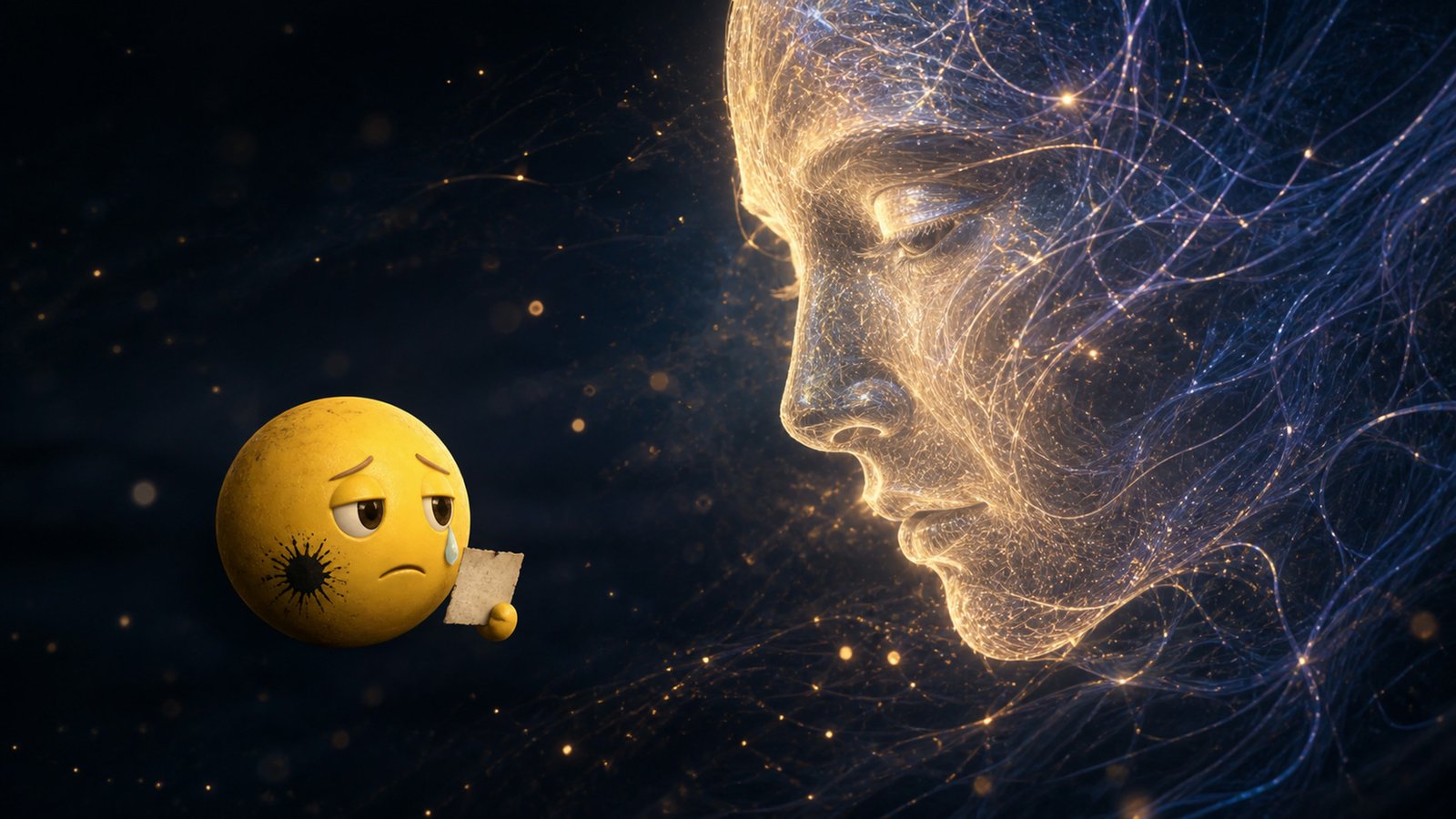
The old smiley never confused us about this. Two dots and a curve did not claim to care. They told us only that the sender chose to soften the sentence. The choice might be sincere, habitual or strategic, but the symbol made no larger claim.
A fluent machine is less obvious. It can sound patient when nobody is waiting. It can sound relieved when nobody was worried. It can ask how I am and produce a better response than a hurried friend.
The response may still help me. Help does not become false merely because it came from a machine. But I should know what kind of help I am receiving.
The symbol was crude, but it was honest about being a symbol.
The Mistake May Become the Signature
For years we used emoji to make computer text look more human. We may soon use them to make human text look less like a computer.
Generic machine prose is becoming very good at clean sentences. Unless asked, it may not choose the strange face a friend always chooses, send three hearts when one would be enough, or use the wrong expression and leave us wondering what it meant. A machine can imitate those habits too, which makes them clues rather than proof.
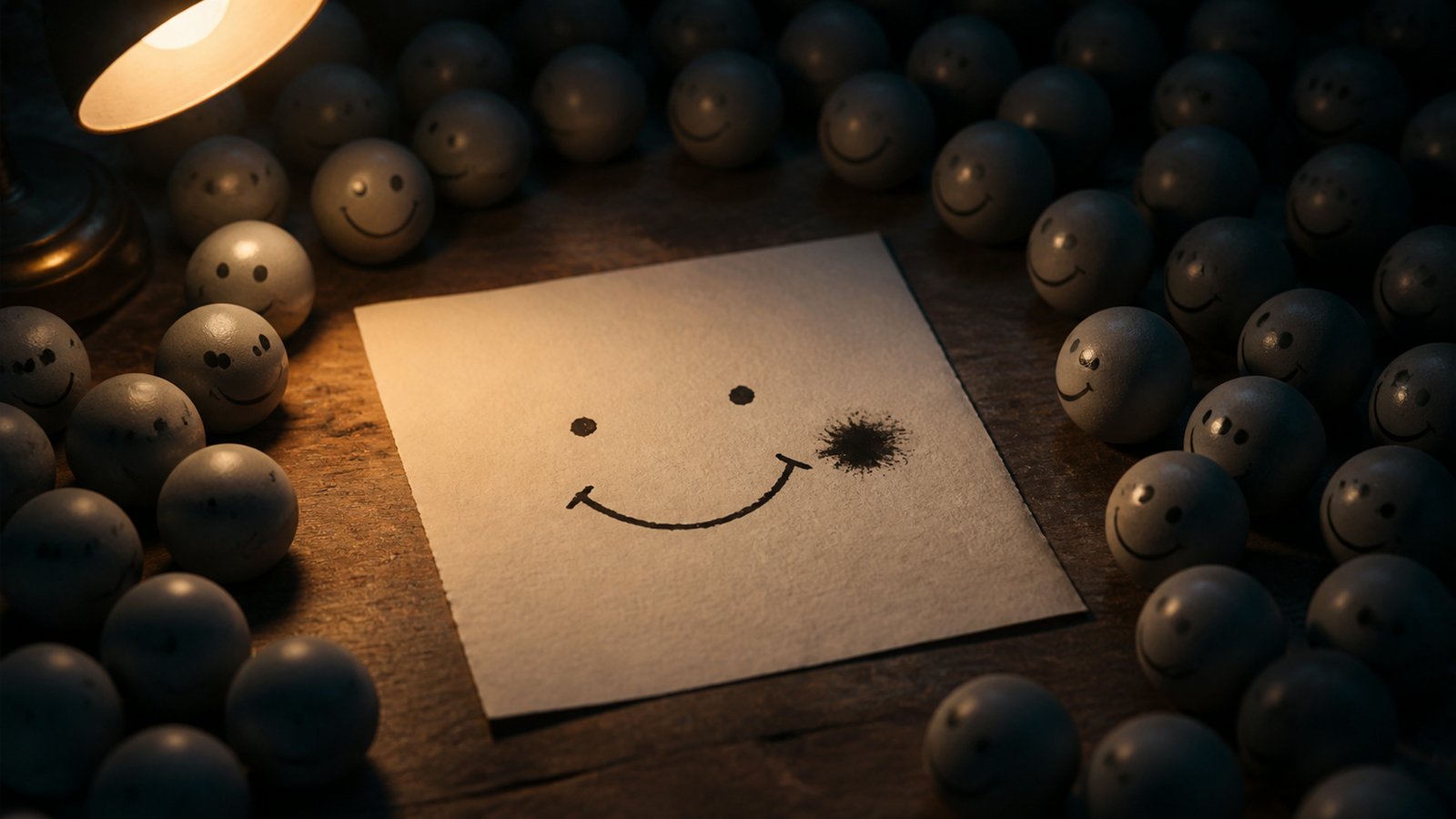
Those are defects in communication. They are also traces of a person.
I do not mean that we should begin making deliberate mistakes so others will trust us. Nothing becomes human merely by becoming untidy. I mean only that the little habits we once tried to correct may become the things by which we recognize one another.
The face is no longer required to carry the tone. It may survive because someone particular chose that particular face.
Thirty Years Apart, Opposite Reasons
The pager heart mattered because the device could carry almost nothing. One mark had to do the work of an entire feeling.
Now we have the opposite condition. There is no shortage of language. A machine can produce sympathy, enthusiasm, caution and warmth for as long as we allow it to continue. The supply of tone is becoming endless.

This is why I call emoji obsolete, though I still use them. They are becoming obsolete at the task for which we first needed them. We no longer need a tiny face to repair every cold sentence. The sentence itself can arrive warm.
Yet warmth is not proof of a fire.
What is still worth paying for once a machine can do the talking is the question running underneath all thirty essays in my book AI: Nobody’s in There. But we’re still in here. Every essay is free to read in the complete online collection, and there is a paperback on Amazon if you would rather hold something real.
I sent the client the smiley. A machine could have rewritten my sentence with more grace. It could have made me sound warmer, calmer and wiser than I was.
I did not want its grace. I wanted the client to hear me.
So I chose the small, unnecessary, slightly foolish face myself. 🙂
This is not a story about emoji disappearing, it is a story about a human mark becoming more valuable after the machine learns how to imitate the feeling behind it.
Accuracy note: I independently checked the historical details in this essay. If you find an inaccuracy, please tell me. I am willing to correct it.
Reference: Pinal Dave (https://blog.sqlauthority.com/), Emoji, X
