
The term “tokenmaxxing” left the developer lexicon just as quickly as it arrived, and like most viral technology concepts, it means different things depending on who’s using it. In practice, the term is being applied in two ways: maximizing total token consumption as a proxy for AI adoption and effort, or optimizing output per token as a measure of efficiency and skill. These are two very different things, and conflating them is causing organizations to reach for the wrong measurement framework at the wrong time.
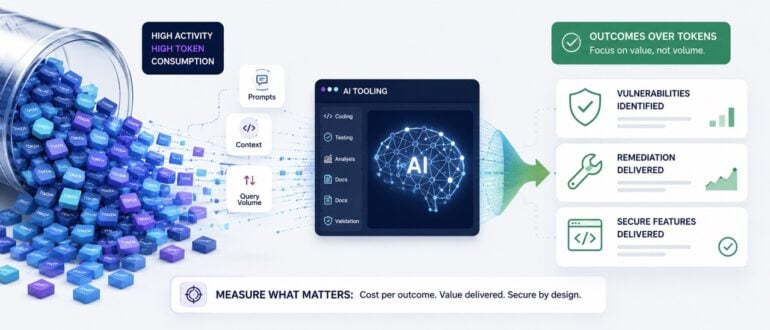
Why might this be happening? Token usage is a function of query volume and context: how many prompts are sent and how much information is loaded into and out of a model with each exchange. That means token consumption reflects how actively a developer is engaging with AI tooling. In the early stages of adoption, that signal has value: it can tell you whether someone is using AI at all, but unfortunately it cannot tell you whether that usage is producing anything meaningful. And using “a lot of AI” is not the same as using AI well.
Activity vs. Productivity Metrics
Token usage as a productivity metric suffers from the same fundamental flaw as lines of code. When developers are evaluated on lines of code, the incentive is perverse: verbose, redundant, and unnecessarily complex code scores better than clean, efficient solutions. The metric rewards activity over quality, creating an imbalanced dynamic.
For example, if two developers are using the same AI tool to complete the same task, one who submits poorly scoped prompts, lets context drift across long conversations, and relies on the model to repeatedly reconstruct the same background information will accumulate far more tokens than a developer who achieves the same outcome with a well-configured, concise workflow. Under a tokenmaxxing framework, the first developer looks more productive. In reality, they’re just noisier. The lesson the industry learned from lines of code is worth applying here before organizations build incentive structures around a metric that will actively reward bad habits.
The challenge becomes even more apparent as development workflows evolve beyond AI-assisted coding. The industry is already moving toward AI-directed development environments where developers coordinate specialized agents responsible for coding, testing, analysis, documentation, and validation activities. In these environments, measuring token consumption becomes as disconnected from business value as measuring CPU utilization to evaluate software quality. What matters is whether the resulting system delivers secure, validated outcomes efficiently.
A Better Model: Cost Per Outcome
For security teams in particular, the right framework isn’t choosing between “maximize tokens” or “minimize tokens.” It’s measuring what you actually get for what you spend. Token-based pricing is a rational commercial model for AI providers selling compute. The failure mode is on the buyer side: importing a supplier’s billing unit into your own internal productivity scorecards.
More capable models often do consume more tokens and find more vulnerabilities. Extended reasoning, deeper agentic trajectories, and multi-attempt scaffolding all cost tokens, and on hard problems they meaningfully improve outcomes. That relationship is real and worth acknowledging. But it is not universal. The same token spend across two configurations, models, or prompting strategies can produce very different results. Inefficient scaffolding, poor context management, and sloppy prompting all drive token consumption without proportional gains. This is why BountyBench, an independent evaluation framework that benchmarks AI models against real-world bug bounty programs, is useful: it measures cost-per-finding across models and configurations, giving security teams a way to evaluate outcome relative to spend rather than treating either number in isolation. For security teams, this reframes the productivity question entirely. The goal isn’t maximizing AI usage. It’s minimizing the cost to find a real finding.
This logic should guide how development organizations think about AI tooling broadly. The question isn’t, “how much AI did we use?” but rather, “what did we actually deliver, and at what cost?” I’d recommend security leaders evaluate the following:
Remediation value per token spent: Measure whether AI usage is materially reducing security debt, accelerating patching efforts, or improving remediation quality. High token consumption without measurable remediation impact is activity, not efficiency.
Vulnerabilities surfaced per query: Evaluate how effectively AI-assisted workflows are uncovering meaningful security findings. The goal is not simply generating more output, but increasing the signal quality and depth of discovery from each interaction.
Secure features delivered: Measure whether AI is accelerating the delivery of production-ready functionality that meets security and quality standards. The objective is not generating more code, but reducing the time and effort required to deliver secure, validated outcomes.
While tough to calculate, these metrics actually reflect whether AI is accelerating outcomes, or just accelerating activity.
Governance, Token Budgets, and the Constrained Engineer
From a governance perspective, one of the most underappreciated dynamics in enterprise AI adoption is the tension between token budgets and developer productivity. Many engineers today can clearly see the productivity gains AI provides, and they’re running into artificial ceilings. When organizational token quotas are set too conservatively, developers who understand the value of AI-assisted work face a real constraint: slow down, or find another way.
The result is predictable. Engineers reach for personal accounts, alternative tools, or free-tier options to maintain velocity. This isn’t reckless behavior. It’s a rational response to being token-constrained while having work to ship. But it does create a governance gap: usage that happens outside enterprise-controlled environments means no visibility, no auditability, and no ability to ensure that outputs are meeting security or accuracy standards.
Organizations that want meaningful AI adoption need to give security engineers the token budget to run a full vulnerability assessment, and measure what comes back. That kind of intentional allocation, outcome-anchored and audited within controlled environments, is what separates a mature AI program from one that’s just tracking utilization numbers and calling it productivity.
Token usage was never meant to carry the weight of a productivity KPI. As AI programs mature, the measurement conversation will inevitably shift from “are we using it?” to “is it working?” At that point, tokenmaxxing will look like what it always was: a vanity metric dressed up as an engineering discipline. The organizations that build outcome-aligned measurement frameworks now will be better positioned for that shift, and they’ll have the security posture and audit trail to prove it.
