

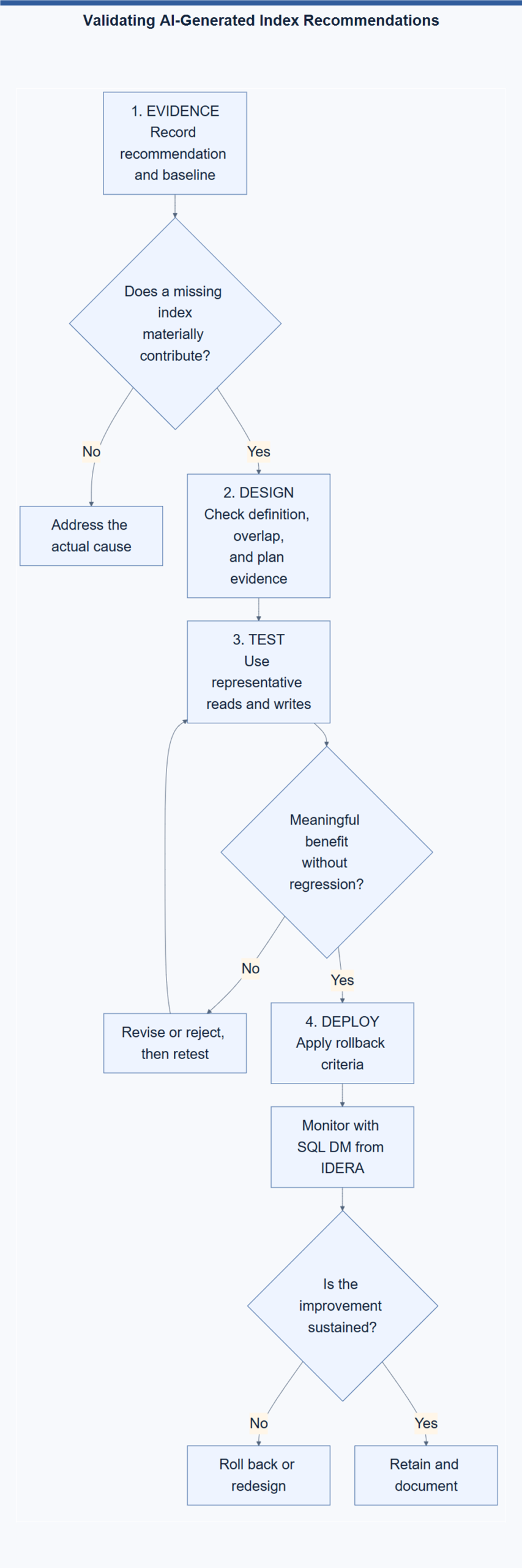
Validating AI-generated index recommendations is the step between a persuasive script and a change you can defend in production.
AI-generated index recommendations look persuasive. Consider an illustrative script promising a 92 percent cost reduction. It adds three keys and eight included columns to the busiest order table. The suggestion is specific, confident, and ready to copy.
Two existing indexes already cover most of that shape. The DBA now faces an awkward choice. Accept the projected gain today, or question it while users stay slow. Creating another index feels safer than asking one more question.
The Script Is a Candidate, Not a Verdict
Native missing-index guidance carries clear limitations. Those suggestions start as optimizer estimates for one query. They are not tested after execution and omit the full maintenance cost of another index.
AI proposals reach the DBA by a different path. Better context improves candidates, but does not create certainty. Inside the enabled desktop workflow of SQL DM from IDERA, each AI suggestion remains guidance. The DBA owns review, testing, approval, deployment, and rollback.
Preserve the Case Before You Touch It
Save the recommended definition before editing it. Record the source queries, parameters, plans, time range, and expected benefit. Note the symptoms in business language, because “checkout exceeds three seconds” beats “the index score is high.”
Capture a baseline from representative periods, not only the incident spike. Include duration, CPU, logical reads, execution count, waits, and write volume. Record typical behavior and slow outliers separately. A single average can hide both success and pain.
When available, Query Store helps preserve plans and runtime history. Match the same query identity across normal and busy windows, then check whether a plan change caused the slowdown. An index is not a universal fix for parameter sensitivity, stale statistics, blocking, or memory pressure.
Compare It With What Already Exists
Start with the table’s current indexes. Compare key columns in order, included columns, filters, compression, size, and usage. A near duplicate may call for consolidation instead of another object. Another copy adds storage and work for inserts, deletes, and qualifying updates.
Do not merge indexes by appearance, because different key order can serve different predicates. Check which queries use each design and how often. An index that looks redundant may protect a month-end report.
Read the Plan Before Reading the Promise
Capture an actual execution plan with representative parameters. Compare estimated rows with actual rows at important operators. Check scans, seeks, lookups, residual predicates, spills, and memory grants. The proposed index should address an observed cost, not merely remove a warning.
Then test the query with and without the candidate under controlled conditions. Keep data, parameters, cache state, and server activity comparable. Measure elapsed time, CPU, and logical reads. Estimated plan cost is optimizer math, not a stopwatch.
Watch for plan movement elsewhere, because a new index can attract queries that never requested it. That change may help, do nothing, or produce a regression. One attractive plan does not represent the table’s entire workload.
Test the Whole Cost, Not One Read
Each nonclustered index can add work to inserts, deletes, and updates affecting its indexed values. Wider keys and long include lists can enlarge that invoice. Measure write latency, log generation, storage growth, and maintenance duration. Read improvement is only half of the decision.
Use production-like data volume and distribution in a safe test environment. Replay common parameters, concurrency, and representative writes, including the busiest period the change must survive. A perfect test on tiny data proves almost nothing.
Define success before running the experiment. Set required gains for latency, reads, or CPU, and acceptable limits for writes, storage, and blocking. Without thresholds, every result becomes a debate after the team is tired.
The Fair Objection: Speed Still Matters
If everything still needs testing, why use AI? Rapid candidate discovery moves the DBA from a blank page to a focused experiment. A reasonable starting hypothesis can save an hour of manual plan reading.
During an incident, that head start matters. The sensible middle is rapid discovery followed by disciplined proof. That balance respects the person carrying the pager at two in the morning.
A Validation Sequence You Can Reuse
Keep the workflow boring and repeatable. Production changes need checklists.
| Step | Validation Requirement |
|---|---|
| 1 | Save the recommendation. Record the problem, owner, observation window, and expected improvement. |
| 2 | Check indexes for overlap. Compare ordered keys, included columns, filters, size, and meaningful usage history. |
| 3 | Capture baseline metrics. Preserve plans, parameters, duration, CPU, reads, waits, executions, and write activity. |
| 4 | Test the workload safely. Compare read gains against write cost, storage, blocking, maintenance, and plan changes. |
| 5 | Define approval and rollback thresholds. Assign an observation period and person responsible for reversing the change. |
Deployment Is Still Part of the Test
Choose the deployment method for edition, table size, traffic, and business window. Prepare the rollback statement before creating the index. Confirm available disk and expected log impact. Tell application owners what signals you will watch.
After deployment, compare the same metrics used in the baseline. Watch query plans, tail latency, CPU, reads, writes, blocking, and log growth. Observe peaks and scheduled work. Ten quiet minutes cannot validate a change intended for peak sales traffic.
Do not remove an overlapping index immediately. First confirm that no important query still depends on it, then extend observation through the business cycle. Then simplify the design with the same care you used to add it.
Where the Monitoring Workflow Fits
SQL DM from IDERA shows the selected query, table definitions, and existing indexes before submission. The DBA can inspect that material first, then receive proposed changes and a rollback script. Query Monitor keeps the recommendation beside the runtime evidence that prompted it. No recommendation is applied automatically.
A useful recommendation needs evidence and a safe way back. Supply both, and the decision becomes defensible. Users will never see your checklist, but they will feel the result.
AI can recommend the index, but only your workload can prove it belongs.
Reference: Pinal Dave (https://blog.sqlauthority.com/), X
