


An anonymous interview with a database professional who did everything the company asked. There is no lesson at the end of this one. I looked for one. AI Training
I write about databases. I write about things that are broken and can be fixed, because fixing things is the work I know how to do and it is the work that makes me feel useful.
This one cannot be fixed. I am publishing it anyway.
They completed the AI development plan their employer assigned them, paid for, and tracked in a system with a progress bar. Eleven days later they were on a video call with somebody they had never met, being read a paragraph about role elimination.
Before you read another line, I owe you the truth about what this is. This is not a transcript, and this is not one person. If you go looking for them you will not find them, because I built them. They are assembled out of two years of conversations with people this happened to, in hotel lobbies and airport queues and long messages sent to me at two in the morning by people who could not say any of it out loud in daylight. The questions are mine. The answers are theirs, taken apart and redistributed until nobody is identifiable, because nearly all of them are still job hunting and several of them signed a piece of paper promising not to say what they said to me. Every detail that could point at a company or a person has been changed, including every detail that would tell you who is speaking. The one thing I have not touched is what it feels like, and I did not have to, because that part came back identical every single time.
That is why there is no name here, and it is why I stopped worrying about which details belonged to which person. Somewhere around the ninth conversation I realised I was not collecting nine stories. I was hearing one story with the furniture moved around.
Every article about layoffs is written by somebody who still has a job. Including this one. Please hold that against me while you read it, because they would.
My questions are in bold. Their answers are in plain text. Where I wanted to soften something, I left it alone.
Part One: When They Felt Safe

Tell me what you did, and how long.
Fourteen years. Database side. I ran the platform that the operations business sits on, and by ran I mean I was the person who got called. Not the only one on paper. The only one in practice.
I knew where every body was buried in that system because I buried most of them.
What were you proudest of?
Nobody knows about it. Which is sort of the answer.
There was a night a few years ago. Something started going wrong at about half eleven, and it was the kind of wrong where if I get it right, nothing happens, and if I get it wrong, several thousand people find out about it in the morning and some of them are customers.
I got it right at ten to four. I sat in the dark kitchen for a while afterwards with the adrenaline draining out of me, and then I went to bed, and I got up at seven and went in.
Nobody mentioned it the next day, because there was nothing to mention. Nothing had happened. That is the entire job. You are only ever visible when you fail.
I was invisible for fourteen years, on purpose, and I was proud of it. I would like somebody to understand that being invisible that well, for that long, is not nothing. It is actually the whole thing.
How safe did you feel?
You are going to think I am being dramatic if I answer honestly.
I did not feel safe. I never thought about it. That is different and it is worse. Safe is something you feel when the question has occurred to you. The question had not occurred to me in about nine years.
I had a mortgage sized amount of confidence that if things got bad, I would be one of the last ones. Not because I was special. Because somebody has to keep the lights on and I was the person who knew where the switch was.
What was your last review?
Four months before. Highest band. The written comment said I was critical to continuity of operations.
Critical to continuity of operations. I have that phrase in a PDF. I have read it more times than I want to tell you.
Tell me about the AI development plan.
It came down in the spring. Every technical person got one. Mine was built with my manager in a one on one, and I want to be fair here, it was not a bad plan. It was actually thoughtful. Two certifications, a set of internal modules, and a project where I was supposed to apply it to something real in my own area.
It was in the performance system. There was a progress bar. My manager referenced it in our one on ones. There was a session where a director stood up and said the company was investing in its people rather than replacing them, and I remember thinking, alright. Good. That is the right answer.
Did you believe it?
Completely.
And I want to say something about that, because people are going to read this and think I was naive.
I believed it because believing it was the rational thing to do. They were spending money. My manager was spending time. The plan was specific to my role, not a generic slide deck. Everything a reasonable person uses to judge whether something is real, was there.
I was not naive. I was correct about all the evidence and wrong about the conclusion. Those feel identical from the inside and I have not worked out yet how you tell them apart.
How much time did you put in?
Around two hundred hours over five months. Most of it evenings. A lot of it weekends.
Do you regret the hours?
Not the way you mean.
We went away in July. A week, the coast, the kind of thing we do once a year and talk about for the other fifty one. I took the laptop because I had two modules left and I wanted to finish before the review cycle.
My youngest asked me to come in the water on the second day and I said in a bit. Asked again on the third day. On the fourth day they did not ask.
Nine years old. Not sulking, not making a point, just quietly updated the model of me and moved on. That is the part I cannot put down.
There is a photograph from that week. My partner took it, from the beach, and it is a lovely picture, the two of them up to their waists in the sea, both laughing at something.
And right at the edge of the frame, small and slightly out of focus, there is a plastic table with somebody sitting at it under a parasol.
That is me. I am in the photograph.
I am just not in it.
So no, I do not regret two hundred hours. I regret about forty minutes of it, on a Wednesday, and I know exactly which forty minutes.
Part Two: The Things They Can See Now

Looking back, were there signals?
There were seven. I have counted them. I counted them at three in the morning about two weeks after, which I do not recommend as an activity.
And every single one of them had a completely reasonable explanation at the time. That is what I want people to understand. They were not hidden. They were explained.
Go through them.
Hiring freeze in February. Explained as financial discipline in an uncertain market. Everybody said the same thing, which was that it is better than layoffs. We actually said that to each other. Out loud.
Reorg in March. I moved under a different VP. Never met them. Explained as aligning the technology function to the business units. It came with an org chart that was genuinely tidier than the old one.
Then in April I was asked to properly document my systems. Runbooks, dependencies, escalation, all of it. Explained as operational resilience, and here is the thing, it was overdue. I had been meaning to do it for years. I was pleased somebody finally made me.
I wrote a very good document. I was proud of it. I have thought about that document a lot.
Keep going.
In May my new VP asked me, in a corridor, how long it would take somebody else to pick up my systems if I were hit by a bus.
That is a normal question. It is a good question. A responsible manager should ask it. I gave a straight answer, which was that with the documentation I had just written, a competent person could be dangerous in three weeks and safe in three months.
I answered it well. I was pleased with my answer.
That is the one that is still with you.
That is the one, yes.
Not because I was being lied to. I do not think I was being lied to. Somebody was gathering information and I gave it to them accurately and helpfully, because that is what I am like and it is not a bad thing to be like.
But I answered the question about how quickly I could be replaced, and I answered it enthusiastically, and I made sure my answer was true by writing the document first.
The rest?
One on ones went from forty five minutes to twenty. Then they started being moved. Then twice they were cancelled and not rebooked, and I was relieved because I was busy. I was relieved.
Consultants on site in June. Assessment work. Told they were looking at process efficiency. Everybody assumed it meant a new tool was coming.
And the seventh one is the training. The AI plan itself.
Say more about that.
I read it as investment. Companies invest in people they intend to keep. That is not a stupid inference, it is the correct inference nearly all of the time.
What I would say now is that it is not evidence of anything. It costs a few thousand and it buys a great deal of goodwill and it makes the quarter feel like a company that is doing the right thing. It is the cheapest possible signal for the largest possible amount of trust.
I am not saying anybody set out to deceive me. Honestly, I do not think anybody sat in a room and planned it that way. I think the training was real and the decision was real and they were made by different people in different rooms who never had to reconcile with each other.
Which is somehow worse. If it had been a plan I could at least be angry at somebody specific.
Part Three: Eleven Minutes

Tell me about the day.
The invite arrived at 9:40 the night before. No title. Just a time, 9:00, and thirty minutes booked, and two attendees I had to look up. One was HR. One was from a function I had no dealings with.
I knew. I want to be honest about that. I knew at 9:41.
I did not sleep, and then I got up and showered and put on a proper shirt, because I did not want to be the person who found out in a t shirt. I have thought about why I did that. I think I wanted to arrive at my own execution with my dignity organised in advance.
And then I did something I find harder to talk about than any of the rest of it. I opened a notebook and I wrote down two questions.
Just in case. In case it was a project, or a restructure, or a promotion, or anything at all that a competent person might need to ask a sensible question about. In case I was wrong.
I still have that page. Two questions, in my own handwriting, written at ten to nine by somebody who had eleven minutes left and was trying to be useful.
What happened on the call?
The person from HR was reading. You can hear it. There is a particular flatness to somebody reading something they did not write.
They were not unkind. I want that on the record because it would be easy to make them the villain and they were not. They had a job to do that day and I would guess I was not the first call and I was probably not the last.
The phrase was role elimination. Said twice. Careful to separate it from performance, and careful to say your role, not you, several times, which I understand is the training and which does not land the way it is meant to when you are the person occupying the role.
Eleven minutes. I timed it afterwards from the calendar.
And then?
I was still asking a question when the laptop logged me out.
Not after. During. I was mid sentence, asking something about the handover, whether they wanted me to write anything else down, and the screen changed and asked for credentials that no longer worked.
I sat there for a moment thinking it was a glitch. That is the detail I would take out if this were a film. Too neat. But it is what happened, and it took me a few seconds to understand that it was not a glitch, it was the schedule working correctly.
Somebody had put a time on a calendar for the access revocation, and it was the same time as the call, and the call ran slightly long.
Did you say goodbye to anyone?
No.
Fourteen years. I did not say goodbye to a single person I worked with. I could not, because the mechanism by which I spoke to those people was the laptop, and the laptop was gone.
I did not have most of their personal numbers. Why would I. I saw them every day.
Did you ever get your things back?
A courier brought a box eight days later.
Somebody had packed my desk for me. A plant I had kept alive for six years, a photograph, a stack of notebooks, a phone charger, and my mug.
They had wrapped the mug in bubble wrap.
I sat on the floor in the hall with that box open for a long time, because whoever did that did not have to. Nobody was standing over them. There is no version of that afternoon where anybody would ever have known if they had just dropped a mug in a box with a plant on top of it.
Somebody who was still employed, and frightened, and busy, stopped and found bubble wrap.
I do not know who it was. I have never found out and I have no way to ask. I would like to know. Of everything in this whole story, that is the thing I would most like to know.
What did you do for the rest of that day?
I tidied the kitchen.
My partner was at work and the kids were at school and there was about four hours before anybody came home, and I could not think of a single thing to do with a Tuesday.
So I cleaned the kitchen properly. Behind the appliances, the whole thing. And then I sat in the clean kitchen until half past three.
What happened at half past three?
The eldest came in first. Fourteen, and notices nothing, which is normal and healthy and I would not want them any other way.
Stopped in the doorway with the bag still on, looked around, and said, why is the kitchen like that.
And I said I had a day off.
That was the first lie. It was not even a big one. But I have thought about it more than almost anything else, because I said I had a day off, and then I had to keep on having a day off, morning after morning, for nine days, while they walked past me at that table on the way to school.
Part Four: The Brutal Part

Do you think AI took your job?
No.
And I need you to understand that no is the worse answer. Everybody wants it to be yes. Yes is clean. Yes is a story with a villain in it, and it is a story where you were beaten by something historic, which is almost flattering.
No is worse.
Then what happened to the work?
The work is still there. Every bit of it. Those systems did not become simpler on the day I left the building.
Somebody is doing it. It is being done by fewer people, further away, for less money, using a document I wrote in April that explains exactly how.
That is all this was. It is the oldest thing in business and it has been happening since long before any of this. It is not a technology story at all.
Then where does AI come into it?
AI is the sentence you can say out loud.
You cannot stand up in front of a room and say we moved the work somewhere cheaper. It sounds like what it is. But you can say we are transforming how we operate, we are becoming AI enabled, we are reducing operational overhead through automation, and everybody nods, and the share price does not mind, and nobody has to feel like the kind of person who does the other thing.
AI did not take my job. AI provided the vocabulary that made taking my job sound like progress.
That is a hard thing to say.
It is a hard thing to have watched.
And look, I am not claiming this is universal. I am sure there are places where it genuinely is the technology. I am telling you what happened where I was, and where I was, the cost line moved and the story was written afterwards.
Was the training worthless, then?
No, and this is the part that I find hardest to explain to people, because they want it to be worthless. That would be tidier.
The training was good. I am better than I was. I can do things now that I could not do in March, and in interviews I can talk about them and it lands.
The company paid to make me a stronger candidate for a job that no longer exists at that company. They improved me and then released me, improved, into a market full of other people who had also been improved.
It was not a waste. It just was not for me. It went into my hands and it belonged to somebody else’s quarter.
Do you regret being loyal?
I have tried to make myself regret it and I cannot get there, and I have thought about why.
If I say yes, then the fourteen years were stupid. And they were not stupid. I was good at that job. I liked the people. I am proud of some of what I built and it is still running right now, which is a strange kind of continuing.
Regretting it means agreeing that the correct way to work is to hold something back, and I have met people who work like that and I do not want to be one of them and neither do you.
So no. I do not regret being loyal.
What I regret is thinking loyalty was reciprocal. Those are different things and it took me a while to separate them. I gave loyalty to an organization, which is not a thing that can hold it. Only people can hold it, and the people I gave it to had mostly moved on or moved up or left.
Be loyal. Be loyal to people, by name. Just do not send it upward into a structure and expect it to come back down.
Part Five: After

What were the first two weeks like?
Shame.
Which is insane. I want to say that clearly for anybody reading this in the same position. It is insane and it is not logical and you will feel it anyway.
Nothing I did caused this. I know that. I knew it on the day. And I still could not go to the shop at eleven in the morning on a weekday because I did not want to be seen being somebody who was not at work.
I went at seven. For a month, I went at seven, so that nobody would have to work out what I was.
Who did you tell?
My partner, that afternoon, before the kids came in. Better about it than I was, immediately and completely, which I had not expected and which broke something open in me a bit.
My parents, five weeks. Nearly six.
One of my parents worked for the same firm from twenty two until retirement. I did not know how to explain it in a way that would be heard as something other than me having failed. When I did tell them there was a long pause and then, that sounds like it was nothing to do with you, and that was the first time I properly cried about it.
And the children?
Nine days of days off, and then my partner said we have to tell them, and they were right and I knew they were right and I made them say it twice anyway.
The eldest took it the way they take everything, which is to say they asked two practical questions and then went upstairs, and I have no idea what happened up there and I have never been told.
The youngest asked if we were going to lose the house.
Nine years old. Nobody in that house had said one word about the house. That came from somewhere, a film or a playground or a thing half heard, and it had been carried around alone for however many days, doing sums that a nine year old should never be doing.
I said no. And it was true, I want to be clear, it was true, we were alright, the severance was decent and my partner works. But I had to say it twice before it landed, and the second time I heard my own voice do something I did not like the sound of.
That is the worst minute of the whole thing. Not the call. Not the laptop. A nine year old asking me a question they should never have known to ask.
They stopped here. It was a long stop. I have left the question in and I am not going to describe what it looked like, because they did not agree to that, and because you already know.
How is your partner?
Steadier than me. Has not once, not for a second, made me feel like a problem that needs solving.
Around week three I noticed the shopping was coming from a different supermarket. The cheap one, twenty minutes further out, the one we stopped going to years ago when we did not have to any more.
Nothing was said. No conversation, no let us sit down and look at the numbers, no sigh. The shopping simply started arriving from somewhere else.
I have never mentioned it. Neither has my partner. It has been months now.
I have tried twice to say thank you for it and both times the sentence would not come out, because to say thank you I have to say that I noticed, and the moment I say I noticed it stops being something quietly handled and becomes something we are dealing with. And I think that is exactly what was being protected. That is the whole point of doing it silently.
So we do not talk about the supermarket.
That is the most anybody has ever loved me and it is a shop twenty minutes away.

And the identity part?
Fourteen years of being the person who knows the system.
Not a job title. That was who I was in that building and in a small way outside it. There was a version of me that existed because those systems existed and I was the one who understood them.
That person got switched off at nine eleven on a Tuesday along with the laptop.
I still wake at ten past six. Every day. I have stopped fighting it. I get up and I make tea and I sit at the kitchen table with a laptop that has none of it on it and I apply for things.
And I dream about the systems. Not nightmares, that is the thing. Boring dreams. I am fixing something ordinary, something routine, and somebody is asking me a question and I know the answer.
Then I surface out of it and there is a gap of about four seconds before I remember.
Four seconds where I still have it. Every morning. Months of this now.
That is the worst part of my day and it happens before I have opened my eyes.
And I drink the tea out of that mug. The one from the box.
I did not decide to. It was just in the cupboard with the others and my hand goes to it.
What do you miss?
Not the things you would think.
I miss the Tuesday morning call, which I complained about for eleven years and would have told you was a waste of my life.
I miss the walk from the far car park, because the near one was always full. Four minutes. It was the only four minutes in the day when nobody could reach me and I resented every one of them.
And I miss somebody putting their head round the door and saying, have you got a minute.
I did not know that was a thing a person could miss. Nobody has needed a minute of my time since October.
That is the actual thing, underneath all of it. Not the salary. Being needed. I had it every single day for fourteen years, the way you have air, and I did not know what it was worth until it stopped.
What about the people you worked with?
This is the one I did not expect and it is the one I would warn people about most.
They went quiet.
Not all at once. There was a flurry the first week. Messages, calls, this is outrageous, let me know if you need anything, I will ask around. All of it meant sincerely, I think.
Then it thinned. By week three it was almost nothing. By week six, nothing.
Somebody posted a photograph in December. A team lunch. Twenty odd people squeezed into one frame doing the face people do in those pictures.
I looked at it for a lot longer than I am comfortable telling you.
And it was not because I was missing from it. It was because everybody in it looked completely fine. The thing I had been at the dead centre of for fourteen years had closed over the top of me like water, and it had taken about nine weeks to do it.
That is not a complaint. It is what is supposed to happen. It is exactly what I would have done.
It is just a very strange thing to watch.
Are you angry about that?
I was. For about a month I was very angry about it, more angry than I was at the company, which tells you something.
I am not now, and I will tell you why, and it is not a generous reason.
It is because I know exactly what I would have done. If it had been somebody else, I would have sent the message in week one and meant it, and then I would have had a difficult week, and I would have got busy, and I would have thought about them on a Thursday and not messaged, and then it would have been too long, and then I would have felt awkward, and then I would have said nothing at all.
They are not cold. They are frightened. Every one of them is doing arithmetic about whether they are next, and I am the walking evidence that being good at your job does not settle it. Nobody wants to look directly at that.
And here is the part I cannot get to sit still.
Whoever packed that box and found the bubble wrap is one of the people who went quiet. It has to be. It is the same twenty people. There is nobody else it could have been.
Somebody sat at my desk on a Tuesday afternoon, alone, and carefully wrapped my mug so that it would not break in the post, and then never sent me a message again.
I have turned that over for months and the only place I get to is that both of those are the same thing. Both of them are what frightened looks like. People will do you a kindness in an empty room that they cannot do with their name on it.
I do not blame them. But I would tell anybody still employed and reading this, message the person. In week five, not week one. Week one they are drowning in messages. Week five they are alone in a kitchen.
Was there anyone?
One. Somebody I worked with for six years and was never especially close to.
They have sent me a message every Friday since. Every single Friday. Not about jobs. Something stupid, usually something that went wrong that week, the kind of thing I would have laughed at if I were still there.
Never once asked how the search is going, which is the single kindest thing anybody has done, because everybody else asks and there is never any news and every time I have to say no, nothing yet, and watch them try to arrange their face.
I have not told this person what those messages have meant. I probably should. I might send them this.
What was the first practical thing that went wrong?
Writing my own CV.
I sat down in week two feeling quite businesslike about it, and I could not do it.
Fourteen years, and I could not turn any of it into bullet points. Everything I was genuinely good at came out as a sentence like, knew which things were fragile. Or, was the person you rang. Or, could tell from the shape of a complaint which system had caused it.
None of that goes on a page. The things that made me worth keeping are the exact things that do not survive being written down.
That is a joke I would enjoy a great deal more if it were happening to somebody else.
In the end I wrote something generic with the word stakeholder in it. I hated it. I have now sent it to over ninety places.
And the market?
I am going to be blunt because you asked me to be.
It is bad and it is bad in a way that nobody prepares you for. Not empty. Bad differently.
There are roles. I apply. Most of them go nowhere with no response at all, which I had expected. What I had not expected is the ones that go well. Four rounds, a technical exercise on a weekend, meeting the team, talking about the future, and then a role put on hold. Not rejected. On hold. Which is a word that means nothing and cannot be argued with.
That has happened to me three times. Three times I have been almost employed.
The rejections are fine. It is the almosts that take something out of you, because each one requires you to hope again from the start, and hoping gets more expensive every time.
Part Six: What They Would Tell You

What would you say to someone who feels safe right now?
I am not going to give you a lesson because I do not have one, and I want to say that plainly. I have not grown from this. I have not found myself. I am not grateful for the journey.
But here are things I would actually do.
Write down the names. The people you would want to be able to reach if your access stopped working in the middle of a sentence this afternoon. Get their personal contact into your own phone. Not because anything is coming. Because it takes four minutes and mine took eleven days to reconstruct, partly through somebody’s relative on social media, and I felt like a ghost doing it.
Know what your documentation is worth. I am not telling you to write bad documentation. Do not do that, it is beneath you and it hurts the people you work with. But be clear eyed. The document that makes you a responsible professional is the same document that makes you portable. Write it, and understand what you have written, and price yourself accordingly rather than assuming it will be noticed.
Watch what people ask, not what they announce. The announcements are written by people who want you calm. The questions are asked by people who are actually working something out. Nobody announced anything to me. But somebody asked me in a corridor how fast I could be replaced, and that was the whole thing, right there, four months early.
Treat training as a gift, not a contract. Take everything they will pay for. Take all of it. But the moment you have it, it is yours, and it is a thing you own that has nothing to do with them. Do not file it in your head under they must be planning to keep me.
Keep one thing that is yours. One skill, one relationship, one small thing that does not live inside the company’s systems and would survive the badge stopping working. Mine was almost nothing. Fourteen years of everything I was good at was on the other side of a login.
Is there anything you would not do differently?
Yes, and I want this in, because I do not want somebody reading this and becoming a worse colleague on Monday because of me.
I would still help people. I would still stay late for the outage. I would still explain the thing patiently to the new person for the fourth time.
I would do all of it again, because that was not a strategy that failed. That was just being a decent person at work, and it is most of what I liked about myself for fourteen years, and I am not handing that in as well. They got the job. They are not getting that.
What does a company owe you?
Money for work. Honestly, that is the list.
And I am not saying that bitterly, this is the part I have actually made peace with. A company is not a family and not a friend and not a person, and the mistake I made was not that I trusted mine too much. It is that I asked it for a kind of thing it is not built to give, and then I was hurt when it did not give it, which is a bit like being disappointed by a filing cabinet.
They owed me money for work. They paid it. They owed me notice and severance and they gave it, correctly, and the person on the call was professional and kind.
Everything else I felt about that place, I brought. That was mine. I gave it to something that had no way to hold it.
What I want is for somebody reading this to work that out four years earlier than I did, and not become cold about it, because those are two different things and the trick is doing the first one without the second.
Is there anything you want to say to the person reading this?
Yes. And I think I know who is reading this.
You are at your desk. You have this open in a second tab and you have glanced at the door twice since you started. You have read this far because something small happened in the last fortnight that you have not been able to put down. A meeting that got moved. A document somebody asked you to write. A question in a corridor.
I am not going to tell you it is nothing. I do not know, and every single person who told me it was nothing turned out to be wrong.
But I will give you the only thing I have that is worth anything.
You are not the job.
I know how that sounds. It sounds like a fridge magnet. I thought it was a fridge magnet too, for fourteen years, and then I found out it was load bearing, and I found out the hard way, on a Tuesday, in a clean kitchen.
Put the numbers in your phone tonight. It takes four minutes.
Then close the laptop and go and be with whoever is in your house.
Last question. Is there anything good?
One thing. And I feel ridiculous offering it after everything I have just said to you.
We went back to the coast in April. Same place. Off season, so it was half the price, which is why we could go at all, and the water was absolutely freezing.
The youngest asked me to come in on the first morning.
I said yes before the sentence was finished. I did not say in a bit.
I have not said in a bit to that child once since October and I am not going to say it again as long as I live.
I was in that sea for forty minutes. I could not feel my legs. It was the best I have felt since any of this started, and I want to be careful here because I am not telling you it was worth it, it was not worth it, I would take the job back tomorrow.
But I was in the water. I have that. I know exactly how that sounds and I do not care.
What I Have Done With This
Most of them are still looking. Some took something smaller and are quietly ashamed of it and should not be. Two found something better, and both of them told me so in a way that sounded almost like an apology, which I did not understand until I sat with it for a while.
Two of them cried while we were talking. Both of them apologised to me for it.
Apologised. To me. A person with a job, holding a notebook, who had asked them to go back through the worst thing that has ever happened to them so that I could write it down and put my name on it.
I did not know what to say either time. I still do not. I said it was alright, which is what you say, and it is not enough, and neither of those two moments has left me since.
I am not going to give you an ending, and it is not for effect. When I went back through my notes looking for one, the endings turned out to be the least interesting part and they were all different. It was the middles that were identical. The middles were the same story told to me nine times by people who had never met each other, and none of them knew that, and every one of them thought it had been something particular to them.
One of them said a thing I have not been able to put down. In the first month they went looking for something that told the truth about it, and everything they found was either a corporate statement or somebody selling a course on resilience. Not one honest account of what it actually does to a person. Then they said, and I wrote it down at the time because of how it was said: if you ever write it, write it for somebody at three in the morning.
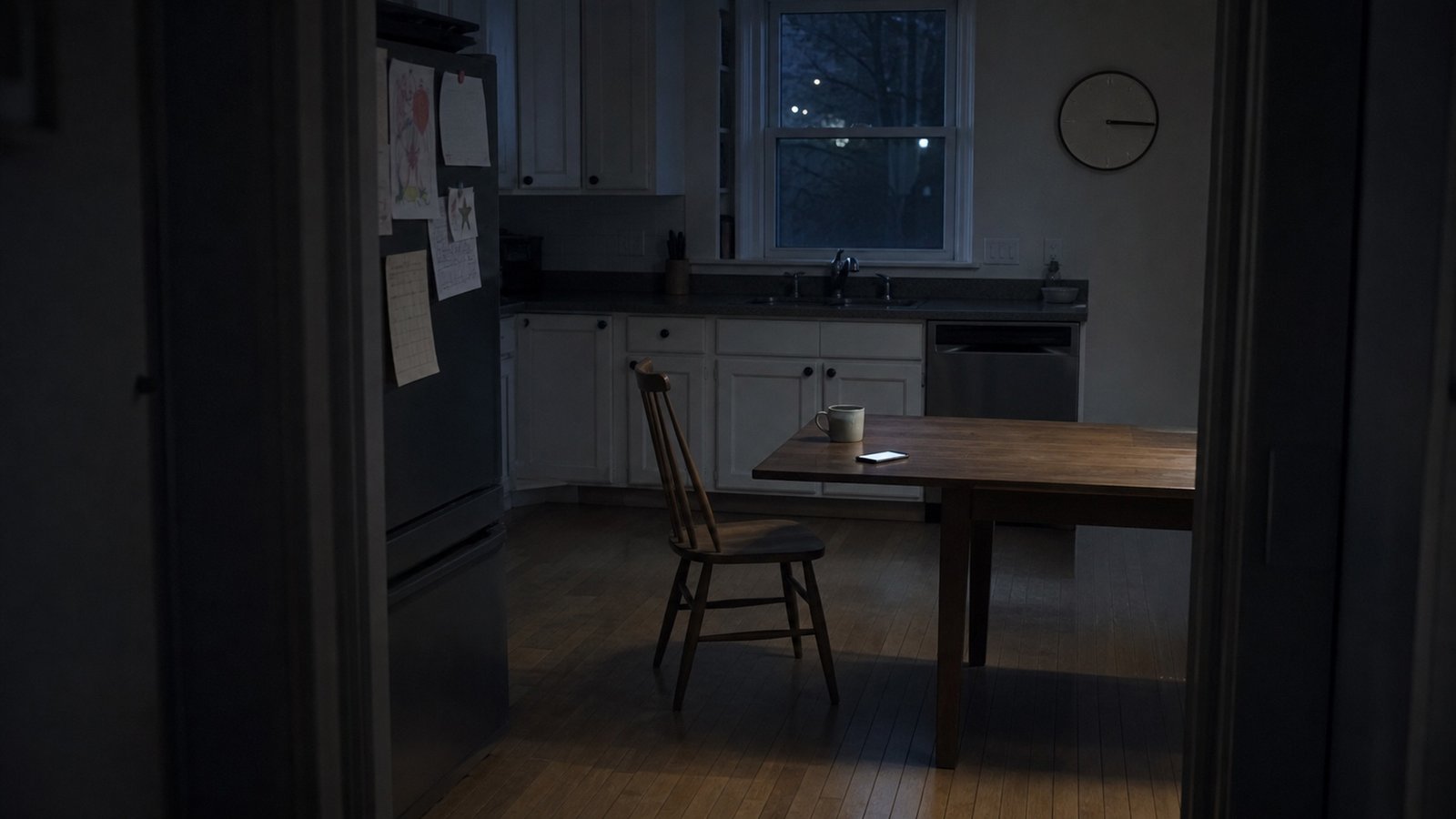
So that is who this is for. Not for the people who feel safe. For the one person reading this in a clean kitchen at three in the morning, who is going to think it is only them.
And now the part I have rewritten more times than anything else here, and very nearly left out.
Go back and look at the sixth signal. Consultants on site in June, doing an assessment.
I have been that consultant.
Not at that company, because that company does not exist. But I have walked into buildings with a badge on a lanyard and spent a week working out how everything fits together. I have sat down with the person who knows the system inside out and asked them careful, intelligent questions, and they answered every one of them fully, because people in this profession are almost always helpful and it is the best thing about us.
Then I wrote a document. Then I was paid. Then I left, and I did not find out what happened next, because nobody tells the consultant what happened next.
I am not saying any assessment of mine was ever used that way. I do not know that. What I know is that I would have no way of knowing, and that in all those years it never once occurred to me to wonder.
So this is not a piece where I get to stand outside the thing and point at the people who did it. I am somewhere inside the machinery of it, and I cannot tell you exactly where, and that has cost me some sleep while writing this.
What it has changed in my own work is smaller than it should be, and I will be honest about that too. I have started asking a different question in client engagements. Not whether the team is being trained. Whether anybody has been asked how quickly they could be replaced. It is a rude question. I ask it anyway now, because it is the one that turned out to matter and it is the one nobody was listening for.
The uncomfortable thing underneath all of this is that none of it was done by a machine. Every decision here was made by people, in rooms, who then reached for the word AI because it made the sentence easier to say out loud. That is the argument running through my book AI: Nobody’s in There. But we’re still in here. All thirty essays are free to read at pinaldave.com. If you would rather hold a copy, it is on Amazon in paperback, Kindle and audiobook.
If you are the person in the kitchen: it was not your fault, the shame you are feeling is a liar, and somebody should message you in week five. If nobody has, I am sorry, and you can consider this the message.
And if you are reading this feeling safe, please notice that they were too, four months ago, holding a review that called them critical to continuity of operations.
This was never a story about a machine replacing a person, it is a story about a decision that borrowed a machine’s name so nobody would have to sign it.
Reference: Pinal Dave (https://blog.sqlauthority.com/), X
