


Everyone is arguing about AI and entry level jobs. Almost nobody is watching the other end of the ladder.
A few days ago I wrote about a young developer who cannot get past the first interview and cannot tell whether he got worse or the door got narrower. I have not stopped thinking about him. The conversation about AI and entry level jobs is loud, crowded, and mostly correct. The junior work is gone because the machine does it in eight seconds and does not ask about health insurance. But there is a second thing happening at the same time, quietly, at the other end of the ladder, and almost nobody is saying it out loud. So I will.
A quick note. The people in this piece are composites, blended and reshaped from twenty five years of my own work and the lives of people close to me. Nothing here refers to any specific person, employer, client, or company. This is a personal reflection and nothing more.
Nobody Was Ever Made Senior by Approving Things
Think about how you actually got good. Not the story you tell in interviews. The real one.
You got good by being wrong in public, over and over, on things small enough that nobody got hurt. You shipped the thing that looked fine. It was not fine. Somebody older sighed, showed you why, and you felt that particular hot flush of embarrassment that welds a lesson permanently into your bones. Then you did it again three months later in a slightly different costume.
That is the whole training program. It is not elegant. It is a scar collection.
Seniority is not a rank. It is the accumulated memory of every way you have personally made a mess.
Here is the uncomfortable part. All of that learning happened inside exactly the work we just handed to the machine. The boring first draft. The report nobody wanted to build. The tedious middle. That was not filler. That was school, and we just closed the school and kept the diplomas.
What Happens to a Senior Who Stops Doing the Middle

Now watch what a good senior person’s day looks like this year.
The machine drafts. They approve. The machine drafts again. They approve again. And here is the thing, they approve well. For a while. Their judgment is sharp because it was forged in a world where they had to build the thing themselves before they could have an opinion about it.
But that world is not running anymore, and judgment is not a diploma. It is a muscle, and muscles are appallingly honest about neglect.
So the approvals get a little faster. A little softer. The comment that used to be four paragraphs becomes two lines. Then it becomes looks good to me. Nobody notices, because nothing goes wrong. Nothing goes wrong for a long time. That is the entire trap.
Then one ordinary Thursday, the thing they wave through is wrong in a way the version of them from two years ago would have caught in four seconds. Not two hours. Four seconds. It would have jumped off the screen and grabbed them by the collar.
The scary moment is not when a senior person cannot find the bug. It is the first time they look straight at it and feel nothing.
The Query That Ran Fine
Let me put this in a room I know well.
A team asks the machine for a query. The query comes back looking confident and well dressed. They run it. It returns rows. The rows look plausible. Everybody nods and ships it.
Nobody in that room read the execution plan, which is just the server’s own honest note explaining how it plans to go get your data. Nobody noticed it had decided to read the entire table forty thousand times, because on a small test set that costs nothing and on Monday morning it costs everything.
Two years ago that team had someone who would have opened the plan out of pure reflex. That person is still on the team. They just have not opened one in a while, and reflexes are use it or lose it, same as everything else your body knows how to do.
But We Have Done This Before, Haven’t We
Here is the fair objection, and I want to give it real room, because I have heard it from people I respect.
We panicked about the compiler. We panicked about the IDE. We panicked when everyone started copying answers off the internet instead of reading the manual. Every one of those tools removed drudgery, and the sky stayed up. Older engineers grumbled, younger engineers shipped, and the world kept turning. Why is this different?
I have thought about it a lot, and I think it comes down to one distinction.
Every earlier tool removed the typing. This one removes the reasoning. The compiler saved you from writing machine code, but you still had to decide what the program should do and why. Stack Overflow gave you a snippet, but you still had to figure out whether it applied to your mess, which meant understanding your mess.
The new tool hands you the finished decision, already argued, already formatted, sounding certain. And reasoning was the exact place where all the learning used to live.
Autocomplete made typing cheaper. This makes thinking optional. Those are not the same event.
I could be wrong about this. People were wrong about the calculator, and they were extremely confident while being wrong. But the calculator never told anyone it was sure.
The Math Nobody Wants to Do
Put the two halves together and the picture gets uncomfortable fast.
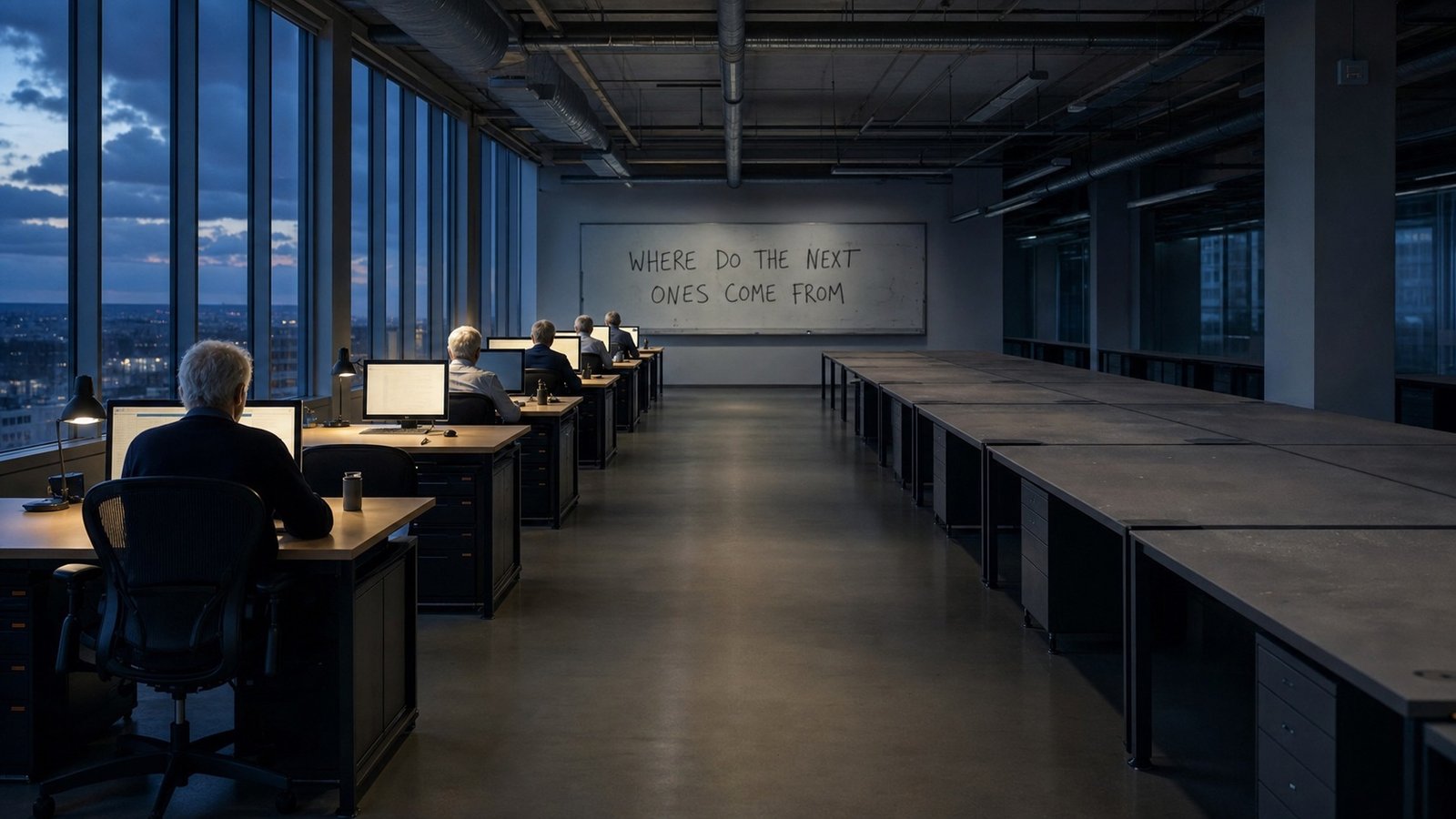
The bottom rung is gone, so no new seniors are being manufactured. And the people currently holding the title are slowly being deskilled by the same tool that removed the rung. One supply line is cut, and the existing stock has a quiet expiration date nobody printed on the box.
Ten years from now, somebody is going to stand in a very expensive meeting and ask where all the people who can actually tell went. And the honest answer is going to be that we stopped making them in 2025 and nobody filed a report about it, because nothing broke that quarter.
Every quarter it does not break, the decision looks smarter. That is what makes it so hard to argue against.
What I Am Actually Doing About It
I am not going to hand you a five point framework and pretend I have this solved. I do not. But here is what I have changed in my own week, and what I have watched work on real teams.
Do one thing the hard way, on purpose, every week. Not everything. One thing. Write the query yourself before you ask. Read the plan before you accept the fix. It is the professional equivalent of taking the stairs, and it works for exactly the same reason.
Make the machine defend itself. Do not ask for the answer. Ask why the other three options are worse. A confident answer is easy to manufacture. A defended answer makes the thin spots visible, and if it cannot defend it, you have just learned something free.
Keep a wrong list. Every time the tool was confidently wrong, write down one line: what it said, what was true, how you caught it. After a month you will have a personal map of where it lies to you specifically, in your domain. Nobody else can write that document for you.
Give the juniors the work you now find boring. This is the one that costs you something real, and it is the one that matters. The boring work was never boring. It was the school. If you hand all of it to the machine because it is cheaper, you have optimized this quarter and quietly mortgaged the decade.
Notice the four second test. If you look at something and feel nothing, sit with that. That flatness is information. It is the closest thing to an early warning system you are going to get.
Nobody Is Coming to Fix This For You
There is no policy landing next quarter that solves this. No company is going to voluntarily pay to train juniors it does not need in order to protect a supply of seniors it will not need for ten years. That is not villainy. That is just how budgets work, and every one of those decisions is defensible on its own.
Which means the maintenance is yours. Personally. Deliberately. On a Tuesday, when nothing is on fire and there is no reason to bother.
That is genuinely annoying, and I wish I had something warmer to tell you. But I would rather say the true thing than the comfortable one.
I have been chasing this question, what is actually left for a person once the machine can do the task, for a couple of years now, and it turned into thirty short essays and a book called AI: Nobody’s in There: But we’re still in here. The Disappearing Junior is one of the chapters. This piece is the part I only understood after the book was already printed, which is either bad planning or proof that I am still learning. Every essay is free to read at pinaldave.com, and there is a paperback on Amazon if you would rather hold something real.
So the ladder is missing its bottom rung, and the people standing at the top are quietly forgetting how they climbed. Both of those are fixable, but only by somebody who noticed. Now you have.
The risk was never that AI would replace your senior people. It is that it will quietly stop making any new ones.
Reference: Pinal Dave (https://blog.sqlauthority.com/), X
