

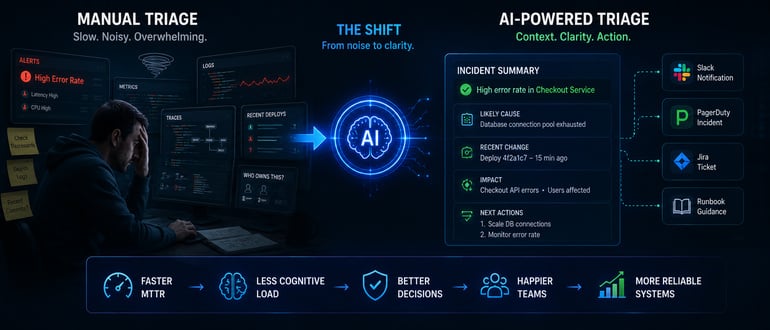
TL;DR — Key Takeaways
- Manual triage is becoming the slowest part of incident response as engineers struggle to connect alerts, telemetry, ownership data and recent changes.
- Automated triage shortens the gap between detection and action by assembling context, ranking likely causes and recommending safe next steps.
- The strongest approach combines reliable observability with progressive automation, keeping humans responsible for judgment and higher-risk decisions.
Manual triage is becoming the slowest and most expensive part of modern incident response. In distributed systems, the problem is no longer detecting that something is wrong; the real problem is turning noisy alerts, scattered telemetry and recent changes into a confident next step fast enough to protect reliability.
That is why the future of SRE is moving away from human-first investigation toward machine-assisted triage with human judgment on top. The teams that win will not be the ones with the most dashboards. They will be the ones that can move from signal to context to action with the least wasted motion.
Why Manual Triage is Breaking Down
Manual triage was tolerable when systems were smaller, dependencies were clearer and a single engineer could hold most of the architecture in their head. That model breaks down in cloud-native environments, where one alert may touch dozens of services, recent deploys, feature flags, CI/CD events and infrastructure state changes at once.
The cost is not just time. It is cognitive overload. On-call engineers often spend the first critical minutes of an incident doing detective work: Opening dashboards, comparing logs, checking traces, looking for recent commits and asking who owns what. By the time they form a usable hypothesis, the business impact may already be growing.
This is why ‘manual triage’ is no longer a badge of operational maturity. In many teams, it is a symptom of missing automation around the very part of incident response that should already be accelerated by telemetry, context and tooling.
What Replaces It
The replacement for manual triage is not blind automation. It is context-aware triage. That means systems that can ingest an alert, correlate logs, metrics, traces, deployment data and known incident history, then produce a structured explanation of what is likely happening and what should happen next.
This is where agentic SRE becomes useful. Instead of forcing engineers to begin every incident from a blank page, agentic workflows can pre-build the first layer of understanding. They can identify the affected service, highlight the most likely blast radius, pull relevant runbooks, compare the issue with recent changes and produce an initial incident summary in seconds.
That does not remove engineers from the loop. It removes the waste at the beginning of the loop. Human expertise still matters for judgment, business trade-offs and unusual failure modes. However, the low-value correlation work no longer has to begin from scratch every single time.
The Triage Gap
Every incident has a triage gap: The time between ‘an alert fired’ and ‘the team understands enough to act safely’. In many organizations, this is where the most preventable delay occurs. Detection may be fast, escalation may be automated, but understanding is still painfully manual.
Closing that gap requires three things:
- Better telemetry correlation
- Better operational context
- Better automation around repetitive diagnosis
Without those, teams keep adding more alerts, more dashboards and more pressure to on-call rotations without solving the root issue. They are optimizing detection while neglecting interpretation.
What Good, Automated Triage Looks Like
A strong automated triage system does not just say that CPU is high or latency has increased. It connects the event to recent deploys, service dependencies, failing queries, noisy hosts, customer-facing symptoms, and prior similar incidents. It provides the responder with a prepared investigation rather than a raw alert stream.
- A good triage workflow usually looks like this:
- Alert arrives from an observability or incident platform.
- The system identifies the affected service and likely dependencies.
- It pulls correlated logs, traces, metrics and deployment history.
- It checks ownership, runbooks and known incident patterns.
- It produces a ranked set of likely causes and safe next actions.
That is a major shift. The engineer is no longer doing first-pass aggregation manually. The engineer is reviewing, validating and deciding based on pre-assembled context.
Why Observability Matters More Now
Automated triage only works if observability is strong enough to support it. If logs are incomplete, traces are missing, ownership is unclear or change history is fragmented, no amount of AI will make triage trustworthy. In fact, weak observability combined with aggressive automation can make incidents harder to understand, not easier.
This is why observability-first design matters. Metrics tell you something is wrong. Traces tell you where latency or failure is moving. Logs provide detail. Deploy data explains what changed. Incident history gives pattern memory. Automated triage becomes powerful only when these signals are stitched into one operational story.
The future of triage is therefore not ‘AI instead of observability’. It is ‘AI on top of observability’. Teams that already have a strong telemetry foundation are in the best position to reduce MTTR because they can automate understanding, not just detection.
Where Agentic Workflows Fit
Agentic workflows sit between raw observability and final remediation. They are the decision-support layer that interprets live signals, consults the right tools and recommends or triggers bounded actions. In triage, that often means pulling context from dashboards, CI/CD systems, ticketing platforms and runbooks, then building a structured response path.
This is why the current generation of AI SRE tools such as Aiden for SRE, Rootly, and Bits of DataDog is getting attention. They are not just adding chat to dashboards. They are helping teams automate the expensive thinking work around correlation, prioritization and first-response structure. That is where the operational leverage really is.
Still, the right model is progressive trust. Start with summarization, context gathering and correlation. Then allow guided recommendations. Then, for well-understood scenarios, let the system trigger low-risk actions inside strict guardrails. The end of manual triage does not mean the end of control.
A Practical Architecture
A modern automated triage architecture can be understood as five layers:
- Signal Layer: Metrics, logs, traces, alerts and deployment events from tools such as Prometheus, OpenTelemetry, OpenObserve, Datadog, Grafana, Elastic or cloud-native monitoring stacks
- Context Layer: Service ownership, dependency maps, incident history, runbooks and code or infrastructure changes
- Reasoning Layer: An AI- or rules-based triage engine that ranks hypotheses and suggests next actions
- Action Layer: Integrations with Slack, PagerDuty, Jira, GitHub, Kubernetes or internal tooling for guided response
- Safety Layer: Role-based access, approval workflows, audit logs and action limits to prevent unsafe automation
When these layers work together, the incident channel becomes a decision environment rather than a panic room.
Example Logic Flow
Here is a simple example of what automated triage logic can look like in practice:
This logic matters because it not just mirrors how experienced responders already work but does it faster and more consistently. Instead of searching six systems manually, the triage engine assembles the first draft of reality before the human starts deciding.
What Teams Should Do Next
Most teams do not need to jump straight to autonomous remediation. They need to eliminate the waste in first-response workflows. A smart rollout looks like this:
- Start with alert enrichment and incident summaries.
- Correlate telemetry with recent changes and ownership data.
- Build triage assistants into Slack or incident tooling.
- Add approval-based automation for low-risk steps.
- Improve infrastructure consistency so triage has fewer unknowns.
This matters because the end of manual triage is not a single tool purchase. It is an operating model shift. You are moving from fragmented, person-dependent investigation toward structured, system-assisted reliability work.
Closing Thought
Manual triage is ending not because engineers are no longer needed, but because manual correlation is no longer an efficient use of engineering judgment. In modern systems, the fastest path to better reliability is not more dashboards and more heroics. It is better context assembly, better automation and better infrastructure discipline across the entire life cycle.
That is why the future belongs to teams that combine observability, agentic workflows and infrastructure automation into one coherent reliability model. When alert understanding, change context and infrastructure intent all become easier to inspect and automate, SREs can spend less time hunting and more time solving with tools such as Aiden for SRE. That is the real meaning of the end of manual triage.
Frequently Asked Questions
Does automated triage replace SREs?
No. It removes repetitive context gathering and first-pass investigation. Engineers still make decisions involving business impact, unusual failure modes, remediation risk and operational trade
Why is observability essential for AI-assisted triage?
AI can only produce trustworthy conclusions when the underlying telemetry is complete and connected. Missing traces, incomplete logs, unclear ownership and fragmented deployment records weaken automated analysis.
How should teams introduce agentic SRE workflows?
Start with alert enrichment, incident summaries and telemetry correlation. Then add guided recommendations and approval-based automation before allowing tightly controlled actions in predictable, low-risk scenarios.
