

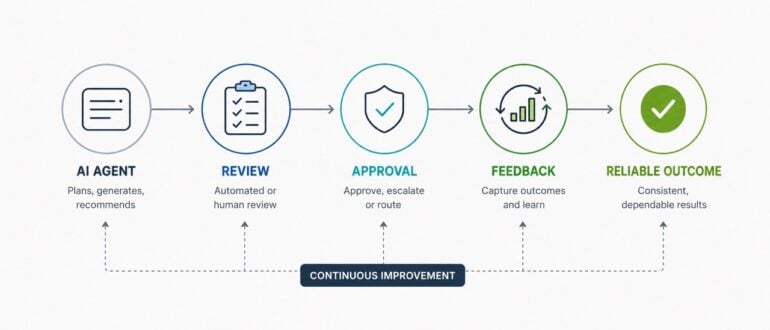
One of the most common questions executives ask right now sounds straightforward: is the agent reliable enough yet?
It feels like the right place to start, but the framing quietly points people in the wrong direction because it assumes something about reliability that has rarely been true in complex systems.
When people ask whether an agent is reliable, they are treating the agent itself as the unit of reliability, something you either trust or do not trust in the same way you would evaluate a database or an API.
That mindset comes directly from how software has traditionally been built over the last few decades. Teams evaluate components in isolation, stack them together, and expect the overall system to inherit the guarantees of the underlying parts.
High-stakes human work has never really operated that way, and agentic systems probably will not either.
Even today, most production agents are already layered systems in practice. One model plans, another executes, and a third reviews. Each layer brings different strengths and different failure modes. By the time somebody interacts with the “agent,” the underlying system already contains multiple components coordinating together behind the scenes.
How Mature Systems Handle Reliability
Industries that genuinely need reliability rarely try to make individuals perfect. They design systems that absorb imperfection.
Airlines do not assume a pilot will never make a mistake. They assume the opposite: even highly trained professionals will occasionally miss things, become distracted, or make poor decisions under pressure. The surrounding system exists to reduce the likelihood that a single mistake turns into a catastrophe.
Checklists, redundant instrumentation, standardized communication protocols, pilot and co-pilot cross-checks, air traffic control, post-flight reviews, and formal investigations all work together to create reliability at the system level rather than the individual level.
Hospitals operate similarly. Surgeons may be highly skilled, but surgical systems still include checklists, structured pauses before procedures, repeated instrument counts, second opinions, escalation paths, and post-incident reviews. In high-risk environments, review mechanisms are not signs of distrust. They are part of the operating model.
Sales organizations behave the same way. They do not depend on perfectly consistent sales reps. They build pipelines with stage gates, forecast reviews, approval flows, and coaching loops that reduce the impact of variation at the individual level.
Engineering organizations do this too through code review, testing pipelines, deployment safeguards, observability layers, and rollback procedures designed to catch failures before they affect production systems.
Across all of these examples, reliability is not a property of the individual actor. Reliability emerges from the surrounding system.
What Changes With Agents
Once you apply that framing to AI systems, the conversation changes substantially.
The goal is not to make a model perfectly deterministic. Traditional software already handles deterministic execution extremely well. The goal is to design workflows that produce reliable outcomes even when individual steps occasionally fail.
That pushes organizations toward a familiar set of operational mechanisms.
Approval gates ensure that important outputs receive the appropriate level of scrutiny before they move forward. Sometimes that means a human reviewing a customer-facing message. Sometimes it means a second model reviewing the output of the first. Either way, the workflow introduces a checkpoint before the consequence becomes real.
Feedback loops ensure mistakes are not merely corrected once and forgotten. Corrections get captured, reused, and fed back into the system so future iterations improve instead of repeating the same failure pattern.
Review cadences align attention with risk. High-impact outputs receive deeper review while lower-risk operational work moves more quickly without unnecessary friction.
Postmortems matter too, especially when they focus on improving the surrounding system instead of assigning blame to a single actor. The important question is rarely “who made the mistake.” The important question is what allowed the mistake to pass through the workflow unchecked.
None of these mechanisms are especially new. Organizations have spent decades developing them because they are how complex systems become dependable despite imperfect participants.
Why Many Teams Get Stuck
A pattern appears repeatedly when organizations begin experimenting with agents.
Teams test a workflow, notice that the system succeeds most of the time but not all of the time, and conclude that the technology itself is not ready yet. At that point, many organizations pause and wait for the next model release, assuming reliability will eventually arrive as a property of the underlying model.
That is a passive way to think about the problem.
A systems-oriented approach starts from the same observation but asks a different question: what additional structure would make the overall workflow reliable enough for production use?
Sometimes the answer is surprisingly lightweight. A well-placed approval step catches the minority of cases where the model fails before the output reaches customers. A review loop prevents recurring mistakes from reappearing indefinitely. A clear escalation path routes ambiguous cases toward human judgment rather than forcing the system to improvise.
Meanwhile, the models continue improving underneath the workflow. Over time, both layers compound simultaneously: the models improve and the surrounding operational system improves alongside them.
Designing the Workflow Around the Model
A more useful question than “can we trust the agent?” is “what does the workflow around the agent look like?”
Start with one workflow that actually matters and map it concretely.
Where does approval happen, and who owns it? How are corrections captured and reused? Which outputs receive regular review, and how does the level of scrutiny change based on risk? When something fails, how does that information flow back into the system so the process itself improves over time?
Many organizations discover that these controls were already inconsistent even before AI entered the picture. Reviews happened irregularly. Feedback loops were informal. Approval steps existed on paper but not consistently in practice.
Agents often expose those weaknesses rather than create them.
That exposure is useful because it forces organizations to operationalize workflows that previously depended too heavily on individual heroics and tribal knowledge.
Reliability is an Organizational Property
Reliability has rarely come from any single component in isolation. It comes from how systems handle failure.
A pilot is not perfectly reliable, but commercial aviation systems are designed to tolerate human imperfection. A surgeon is not perfectly reliable, but surgical procedures are structured to catch mistakes before they escalate. A sales rep is not perfectly reliable, but a strong sales organization still produces predictable outcomes. Agents work the same way.
The competitive advantage in the next phase of AI adoption probably will not come from selecting the single best model. Models will continue improving and gradually converging across many capabilities.
The advantage will come from designing workflows that continue producing reliable outcomes even when individual steps remain imperfect.
That is ultimately less a tooling problem than an organizational design problem.
