

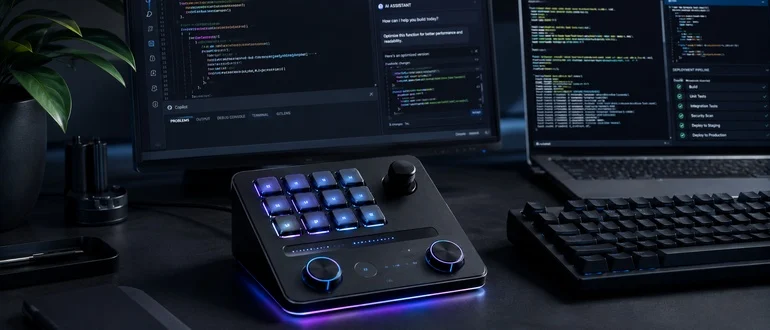
OpenAI is preparing to launch its first branded hardware product, but rather than entering the crowded consumer device market, the company is starting with a tool designed specifically for software developers.
The company has scheduled a July 15 unveiling for Codex Micro, a compact input device created in partnership with keyboard manufacturer Work Louder. OpenAI began teasing the product on social media with the message, “Your favorite Codex shortcuts are getting an upgrade,” offering a glimpse of a square-shaped controller while withholding technical specifications.
The short promotional video posted on X received nearly one million views within 24 hours, despite being short on details.
The launch marks OpenAI’s first branded hardware release and demonstrates a focus on improving developer productivity rather than introducing new AI capabilities. The device is built to complement Codex, OpenAI’s AI-powered coding assistant, by providing dedicated physical controls for common development tasks.
The teaser and demonstrations of the product shown during AI Engineer World’s Fair suggest Codex Micro is based on Work Louder’s Creator Micro 2, a programmable macro pad aimed at developers and creative professionals. That existing device includes mechanical keys, a joystick and touch-sensitive controls that can be customized for application-specific shortcuts.
OpenAI spokesperson Dominik Kundel described Codex Micro during the event as a keyboard “designed to supercharge people’s Codex usage,” indicating the hardware will be tightly integrated with the company’s coding assistant.
The collaboration is a sign of growing interest in specialized hardware that improves how developers interact with AI tools. Rather than relying exclusively on keyboard shortcuts or browser interfaces, programmable input devices can trigger frequently used actions like generating code, launching prompts, running tests or switching between development environments with a single press.
Workflow Optimization
Work Louder has previously produced customized macro pads for companies including Figma, making a Codex-specific version a logical extension of its existing product portfolio. The partnership also allows OpenAI to enter the hardware market without developing a device entirely from scratch.
Many questions remain unanswered ahead of the July launch. OpenAI has not announced pricing, OS compatibility or whether users will be able to create custom key mappings. It is also unclear whether the device will integrate directly with development environments through IDE extensions, expose an API for customization or rely primarily on predefined shortcut profiles.
The existing Creator Micro 2 sells for approximately $199 in the US, providing a possible indication of where Codex Micro could be positioned price-wise, although OpenAI has not confirmed pricing.
For software engineering teams, the significance of Codex Micro is about workflow optimization. Physical macro controllers have often been used to reduce repetitive actions in creative software and developer environments. Applying that approach to AI-assisted coding could simplify repetitive interactions with coding agents and reduce the time spent navigating menus and issuing recurring prompts.
In other words, even though using AI enables developers to work far faster, hardware support can offer an even more streamlined experience.
In any case, OpenAI’s first hardware product suggests the company sees developer experience as a significant competitive advantage as it works to differentiate itself from other leading AI model providers.
