
Amazon Web Services (AWS) today previewed a release management capability for the artificial intelligence (AI) agent it developed to automate DevOps workflows.
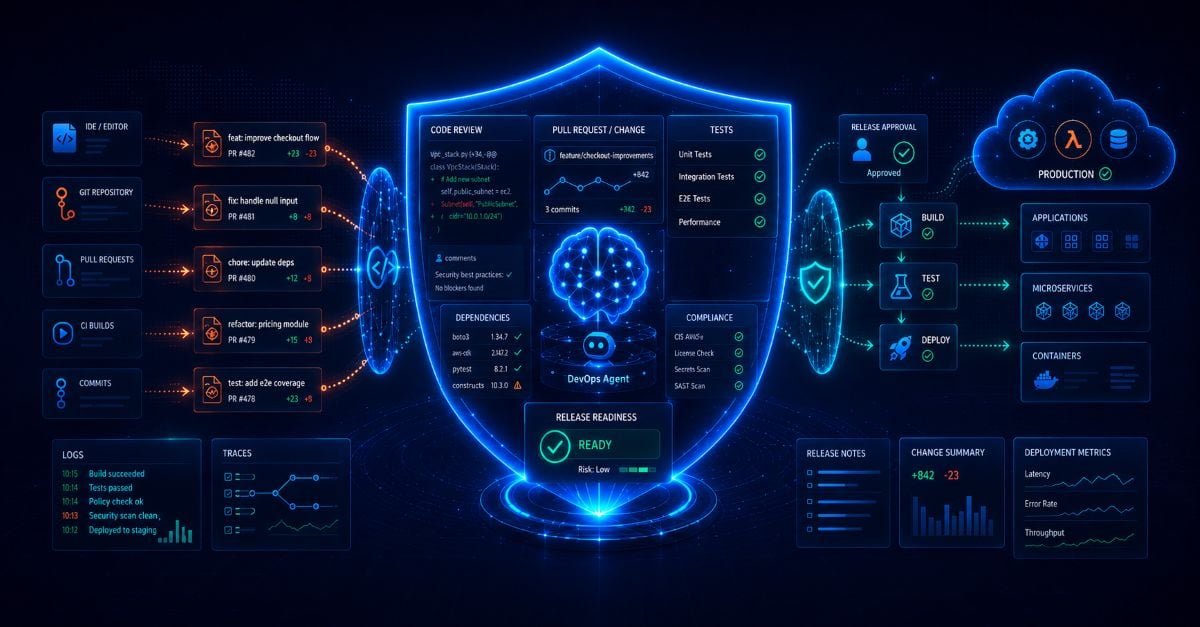
Announced at the AWS New York Summit, the latest release of the AWS DevOps Agent makes available in preview an updated version of the AWS DevOps Agent that can now review and test code changes to evaluate their readiness to be deployed in a production environment.
Rather than running a static test suite, the agent reasons about what the change does and constructs tests tailored to it, covering functional correctness, behavioral regressions, and integration scenarios that a manual test might overlook.
The release readiness review feature evaluates every code change against production requirements, dependency safety, and the standards and best practices that a DevOps team has defined for the agent. The DevOps agent then checks cross-repository dependency risks that could affect other services, access control changes against best practices defined in the AWS Well-Architected Framework best practices, and any compliance mandates the DevOps team is required to meet.
Developers can also invoke reviews directly from within their integrated development environment (IDE) using Kiro Power extensions or a Claude Code plugin. Every test run produces structured artifacts, including metrics, logs, traces, and summaries, to provide a consistent record of what was tested and what the results were.
As part of the review, the agent runs the software it is testing in an AWS-managed isolated environment to execute lightweight tests to verify the software builds, runs, and to make sure code passes basic functional checks before the change enters the pipeline. Findings appear in the AWS DevOps Agent console and as comments on pull requests in GitHub or, now GitLab.
Neha Goswami, director of agentic DevOps at AWS, said this next iteration of the AI agent will make it simpler to determine if code created using, for example, an AI coding tool is of sufficient quality to deploy. As AI agents are incorporated into DevOps workflows, more tasks will be asymmetrically automated to increase the rate at which applications are deployed and subsequent features are added, she noted.
The overall goal is to enable DevOps teams regardless of what tools and platforms they already have to rely more on AI to cope with that massive amount of code that is now being generated in the AI era, said Goswami.
The AWS DevOps Agent is already being used to autonomously investigate incidents, provide root cause analysis and mitigation steps, and deliver recommendations to prevent recurring issues. The challenge many DevOps teams are now wrestling with is how best to incorporate AI agents into existing workflows.
Mitch Ashley, vice president and practice lead for software lifecycle engineering at the Futurum Group, said AWS is moving the DevOps Agent beyond incident investigation to now gating what coding reaches production. The release decision, once a human judgment backed by static pipeline checks, becomes something an agents own, he added.
The constraint, as a result, shifts from writing code to deciding what is fit to deploy, which means engineering leaders must now govern the readiness criteria the agent enforces, noted Ashley.
It’s still early days so far as the embedding of AI agents into DevOps workflows is concerned, but at this point it is now more a question of when and to what degree to rely on those AI agents to automate a wide range of tasks at a time when DevOps pipelines are already being overwhelmed by massive amounts of code being generated by AI coding tools.
