
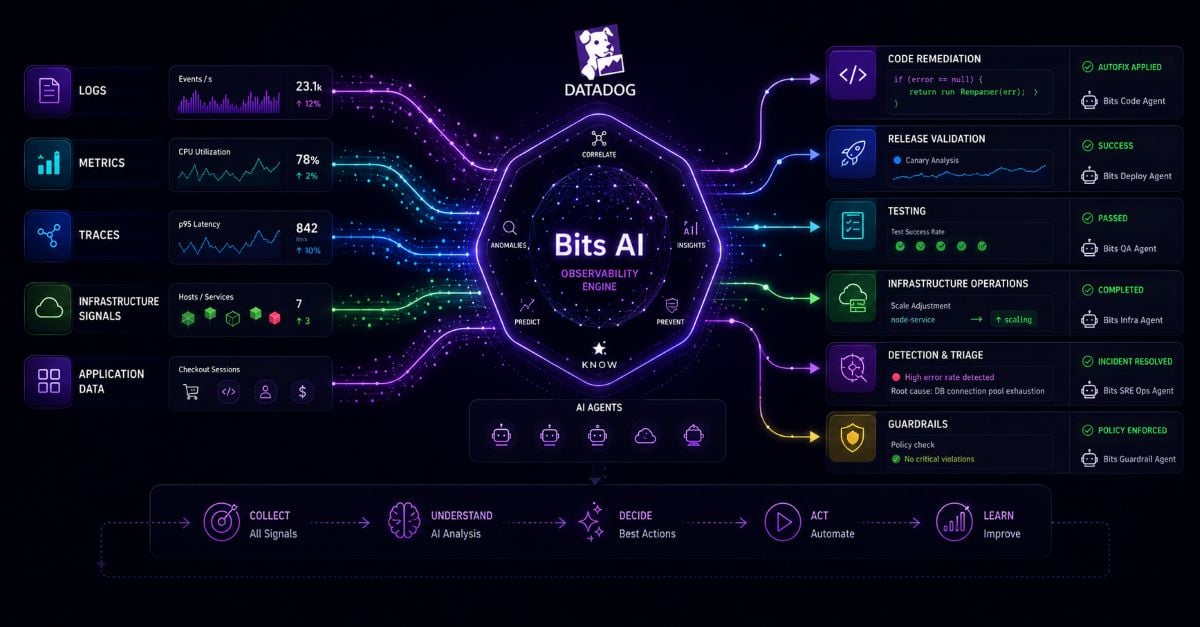
Datadog this week significantly extended the reach of its Bits artificial intelligence (AI) framework to enable DevOps teams to automatically discover and resolve issues based on the telemetry data collected by its observability platform.
Announced at the company’s DASH 2026 conference, Datadog is now embedding an AI coding tool, dubbed Bits Code, across its entire portfolio that proposes remediations and generates the code to resolve issues based on the data residing in the Datadog observability platform.
There is also a Bits Release agent that verifies every code change by analyzing the intended impact of the change, including generating a validation plan, running checks in staging, and monitoring how that change is rolled out. There is also a Bits Testing Agent that automates synthetic test generation and maintenance by exploring applications, identifying critical user journeys, and generating test suites, while a Datadog Agent Console provides a unified view of activity across all the AI coding agents that software engineering teams have adopted.
At the same time, Datadog is adding Bits Remediation, which enables DevOps teams to invoke the AI framework to configure and run remediation scripts within the confines of a set of guardrails defined by a DevOps team. Datadog is also previewing Bits Infrastructure Operations, which autonomously detects, investigates, and remediates common and repetitive infrastructure issues based on actions that DevOps teams have previously approved.
Additionally, Datadog has added a Bits Memories that enables its AI framework to automatically retain information from investigations, runbooks, postmortems, Slack conversations and prior remediations to create a script and run it automatically.
Datadog is also previewing Bits Detection that automatically extends the reach of the company’s observability platform as new endpoints and workloads are added to an IT environment. Datadog is also previewing a Federated Logs capability that enables DevOps to query external data.
The company is also extending its observability platform to observe AI agents, including an Agent Eval tool that can debug and generate fixes as needed and a tool that enables IT teams to build their own agent. There is also an AI Guard tool that uses telemetry tracing to track behavior and surface anomalous behavior.
Datadog is now giving DevOps teams the option of deploying its observability platform in the cloud environment of their choice and making available an Infinite Cardinality Metrics that enables DevOps teams to consume observability data in a way that is priced per named metric.
Datadog is also extending its observability reach deeper into networks and providing a tool to optimize database queries.
Finally, Datadog has added a Bits Data Analysis tool that uses the Datadog Data Context graph to enable end users to launch natural language queries to explore revenue, sales pipeline, churn, and product adoption.
Datadog CEO Olivier Pomel told conference attendees that software engineers are clearly struggling to keep pace at which code is now being developed and deployed. In fact, application development is becoming more complex because most humans don’t have a mental model in their heads for code they did not write, he added. As a result, there is now a much greater pressing need to be able to automatically discover and remediate issues by relying more on AI, noted Pomel.
Mitch Ashley, vice president and practice lead for software lifecycle engineering at the Futurum Group, said that, in general, observability is moving from describing production to governing it. The telemetry that surfaces an incident can now be used to propose a fix, validate it before release, and bounds the agent’s authority, to provide a control plane for agentic operations, he added.
Platform and reliability teams now weigh how much authority an agent earns and whether the platform can verify each action, noted Ashley. That autonomy is capped by the evidence behind each decision, which makes verification and guardrail design the deciding factor in adoption.
Regardless of the approach to observability, significant investments are now being made. A recent Futurum Group survey finds well over a third (36%) of organizations plan on spending more than $1 million on observability in 2026, with 7% planning to spend in excess of $5 million. While it’s not clear which observability platforms will become market leaders, the one thing that is clear is that even as application environments become more complex, the overall pace at which code is generated and remediated is now occurring at a machine speed that human software engineers are not going to be able to manage without help from AI.
