
As AI speeds up software delivery, the real bottleneck isn’t scanning or CI. It’s how safely and predictably change moves across tools, teams, and companies.
Something strange is happening in DevOps right now. AI copilots are writing code, generating tests, triaging incidents, and even summarizing pull requests before a human looks at them. The tooling has genuinely improved, and teams are shipping faster than ever.
But somehow, the end-to-end delivery pipeline doesn’t feel that much faster. Escalations still get lost between teams, and status updates still arrive late, wrong, or not at all. The bottleneck has shifted, and most organizations haven’t caught up to where it went.
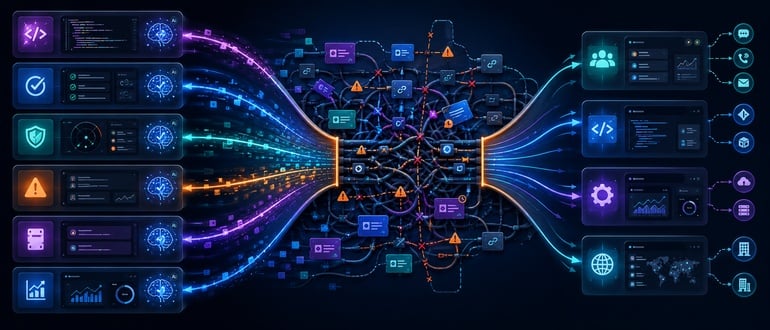
The code is not the problem anymore. The problem lies in the gaps between the tools.
AI Made Individual Tools Smarter Without Fixing the Wiring Between Them
The past two years have been a gold rush for AI in the DevOps stack. GitHub Copilot, Amazon CodeWhisperer, Snyk’s AI-assisted scans, and PagerDuty’s intelligent grouping.
Code generation is faster, vulnerability detection is more reliable, while incident noise is filtered before it hits the on-call engineer.
But each of these tools operates in its own world. A Jira ticket lives in Jira, a Zendesk case lives in Zendesk, and a ServiceNow incident lives in ServiceNow.
AI made each tool smarter within its own boundary. It did almost nothing for what happens when data has to cross from one tool to another.
And in any moderately complex organization, crossing boundaries is where the real work happens.
The Integration Tax Nobody Budgets For
Here’s a scenario most DevOps leads recognize.
A customer reports a bug through the Zendesk portal. Support triages it, and lines it up in Jira for engineering to act on.
But the Zendesk ticket and the Jira work item are two separate objects in two separate systems, maintained by two separate teams with two separate workflows.
Somebody copies the information over manually or shares it through Slack. Or a basic webhook fires and creates a stub ticket. Either way, something gets lost along the way.
The customer’s priority level, status updates, and custom fields (environment, affected version, reproduction steps) that matter to engineering don’t make it across.
Why Traditional Integration Approaches Break Down
Most organizations have some version of integration infrastructure: native connectors, iPaaS platforms, custom scripts, and REST API glue code maintained in-house.
These approaches work well enough for simple scenarios such as syncing a status field and sending a notification. But they break down fast when the requirements get complex.
These problems don’t go away when you bolt AI onto individual tools. They actually get worse because AI increases the volume and velocity of changes in the pipeline.
That means more automated PRs, more auto-triaged incidents, and even more machine-generated status updates. If your integration layer can’t keep pace, the faster tools just create a bigger backlog at every handoff point.
Where AI Actually Helps Integration (When Applied Correctly)
Plain-Language Configuration
A traditional Jira-to-ServiceNow integration takes two to three weeks to configure, test, and deploy. AI-assisted configuration with a tool like Aida compresses that to hours.
You describe what you need conversationally: “Sync high-priority incidents from ServiceNow as bugs. Sync internal comments and update statuses bidirectionally.”
The AI generates working Groovy scripts based on both systems’ actual schemas. You review, test, and deploy.
Status and Custom Field Mapping
“Open” in Zendesk doesn’t mean “Open” in Jira. “Pending” maps to “In Progress” in some workflows, “To Do” in others. Add custom fields, dropdown lists, and fields that only exist on one side, and manual mapping doesn’t scale.
The scripting AI analyzes schemas on both ends and proposes mappings based on field names, data types, and usage patterns. Instead of scripting every status transition by hand, you describe the mapping, and the AI generates the conditional logic.
Also, users can consolidate multiple Zendesk tickets into a single Jira work item, or route “feature-request” tags to Stories and “bug” tags to Bugs in different Jira projects automatically.
Cross-Company Integration
For MSPs sharing ticket data with clients, vendors syncing with implementation partners, and enterprises coordinating with suppliers, each side needs to independently control what they share and how incoming data maps internally.
Real example: An MSP serving 15 clients routes Jira escalations to the correct client’s Azure DevOps project based on organization identifiers. Each client sees only their work items. The MSP keeps visibility across all accounts.
Error Handling and Troubleshooting
APIs time out, schemas change, and rate limits are hit during bulk operations. AI-powered troubleshooting analyzes the error in context, explains, and suggests fixes based on your specific sync rules.
At scale, that’s the difference between a 15-minute fix and a day-long fire drill.
Closing the Sales-to-Support Loop
A customer creates a Salesforce case requesting a product upgrade. Support needs to evaluate it in Freshdesk or Zendesk. If both systems are out of sync, someone copies the details manually and hopes context is not lost along the way.
With AI-assisted integration, account data, SLA details, and custom fields replicate automatically based on triggers. When support resolves the issue, status updates flow back to Salesforce.
For engineering escalations, a Zendesk ticket tagged “VIP” at critical priority auto-creates a P1 Jira bug in the right team’s sprint board, with attachments and conversation summary.
The Bottleneck Has Moved, But Has Your Architecture?
AI is speeding up coding and testing.
But software delivery is a system, not a collection of tools. And in any system, the constraint moves to the weakest link. Right now, that link is the integration layer: the place where change, data, and context move between tools, teams, and companies.
Organizations that recognize this shift will treat integration as a first-class concern and build architectures that handle cross-company data exchange with the same rigor they apply to internal pipelines.
The rest will keep wondering why all this AI investment hasn’t made them meaningfully faster.
