

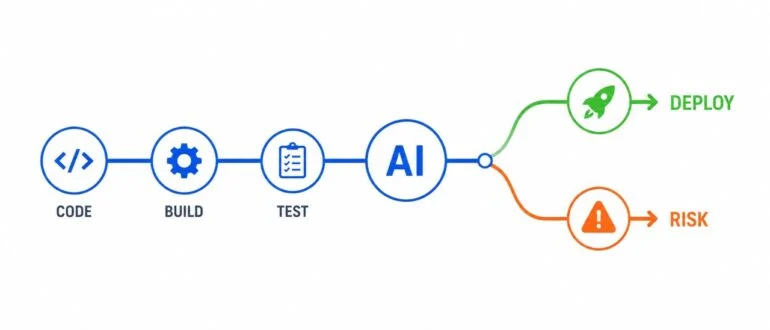
The moment you push your code, deployment fires off on its own. The pipeline kicks in, the tests sail through, and within a few minutes your app is live in production. There is no manual sign-off and no one scanning through the final changes. Everything is running on the decisions of an AI agent plugged straight into the pipeline.
At first it feels great. Stuff moves faster. That long stretch from development to live is just a sprint now. Teams get hooked because it slashes delays and smooths over all the bottlenecks everyone used to grumble about.
And for a while it just works.
Then things start to drift. Maybe there is a small config tweak made by the agent that changes how a service handles heavy loads. The tests pass, but in production it acts odd. Nothing explodes. No alarms go off. But users start to feel tiny delays here and there. The system is up yet something is definitely off.
By the time somebody really figures out what happened, that change is baked into every environment.
This is the point where speed slams straight into control.
Automated Pipelines, Autonomous Choices
Originally CI/CD pipelines were all about running the same steps again and again with no surprises. Build, test, deploy. Each step was lined up and mostly untouched except for the times engineers decided to adjust it. The system never made calls on its own. It just did what it was told.
Drop AI agents into the mix, though, and the game changes. Now the pipeline is not just checking boxes. It is watching patterns, learning from history, and adjusting its own behavior in real time, sometimes even skipping or modifying steps without anyone asking.
Suddenly the pipeline is not a dumb delivery truck. It is starting to drive itself and choosing when to ship and how to roll back or change the roads it takes to get there.
That opens up a lot. It also adds risk.
Speed As the Default Setting
Let’s be honest: AI agents make pipelines fast. Repetitive stuff that usually needed a human now just happens. There are mistakes the pipeline might spot and fix before you have even noticed. Redeployments and configuration tweaks are handled on the fly.
You start trusting that because everything keeps moving.
But here is the catch: When things run that quickly, those little pauses where engineers used to check for weirdness disappear. All those pause points were actually checkpoints. Humans would catch something odd before it could hit production.
When you lose those moments, the issues do not go away. They just surface later and usually it is messier.
Speed becomes the norm, not a tool you reach for when you need it.
What Control Actually Means
People talk about control in DevOps as if it is just having a big red stoppage button. In reality it is about knowing what is happening, seeing why the pipeline makes the choices it does, and having systems behave in ways you expect.
Once an AI agent starts calling the shots, things get tricky.
Maybe the agent decides to skip a test because it has consistently passed in previous runs. Or it ships faster since things look fine. In some situations that makes perfect sense. But the problem is the team may not even know those choices were made.
If you lose visibility you lose control.
Control is not about stopping everything. It is about understanding what is happening.
Partial Understanding, Hidden Risk
Just because the pipeline says everything is green does not mean the right choices were made.
AI agents can slip in little changes that do not break things right away. A config tweak here, skipping a check there, or shifting deployment tactics. On their own these do not look dangerous. Over time, though, they build up.
And when things finally go wrong, tracing the cause becomes difficult because now you are not dealing with your original pipeline. It has changed step by step until no one is fully sure how it reached that state.
Autonomy, With Limits
AI agents make sense for repetitive work. The risk starts when they begin making bigger decisions. Ones that need context.
Imagine the agent choosing a safe deployment time based on past data. But today conditions are different, maybe traffic is higher or something unusual is happening. Or maybe it triggers a rollback based only on short term signals.
These are not mistakes. They are decisions made with incomplete context.
Without boundaries, AI reacts to what has happened and not what should happen.
That difference matters.
Observability Has to Step Up
If the pipeline is acting on its own, you need more than simple pass-fail feedback. You need to understand how decisions were made. What changed and why.
Logs, metrics and traces become more important. They are not just for debugging anymore they are for understanding system behavior.
Without that visibility you are operating without clarity.
Blending Speed With Thoughtful Design
Removing AI is not the answer. The goal is to keep both speed and clarity.
Speed is useful. Faster feedback helps teams. Automated recovery reduces effort. Smarter pipelines support engineers better than traditional scripts ever did.
But structure matters. Some steps should always stay in place. High impact decisions should still involve human review. The goal is not to reduce automation but to guide it.
Strong systems define boundaries. Weak systems allow unrestricted behavior.
What DevOps Teams Need to Get Right
DevOps today is no longer just about building pipelines. It is about managing systems that evolve.
Engineers now have to decide how much autonomy to allow. Where should AI act freely and where should human judgment step in.
This is not just a technical concern. It directly affects reliability, security and long-term stability.
Treat AI like a capable system with boundaries and you gain its benefits. Remove those boundaries and you risk losing control.
What’s Ahead
AI-driven pipelines will continue to grow. Systems will become more adaptive, faster, and more independent.
At the same time, infrastructure will become more complex. More dependencies, more moving parts and more risk.
This creates a situation where both capability and risk increase together.
The teams that succeed will not just move fast. They will understand their systems deeply.
AI agents are changing how CI/CD works. They introduce speed and adaptability but also reduce visibility into decision making.
The challenge is not adopting AI. The challenge is maintaining control while using it.
Speed alone is not enough. Systems need to be fast but also understandable and reliable.
