

Zencoder today extended its artificial intelligence (AI) agent platform for generating code to include an offering that enables application developers to automate a range of tasks that go well beyond writing code.
Company CEO Andrew Filev said Zenflow Work takes advantage of the core orchestration platform that Zencoder created to automate planning, reporting and communication tasks. In effect, it provides developers with a secure alternative to general-purpose OpenClaw AI agents in a way that is easier to deploy and manage, he added.
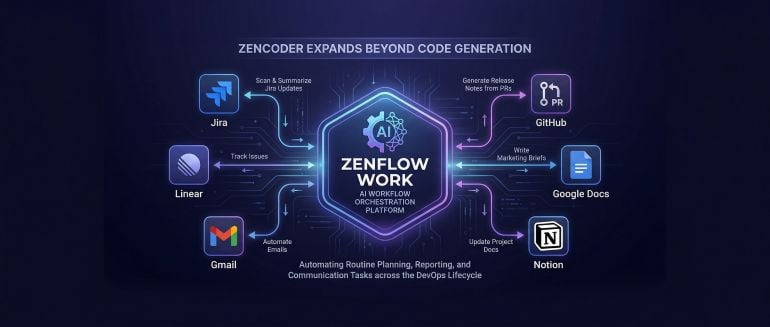
Designed to integrate with Jira, Linear, Notion, Gmail, Google Docs, and other applications that support the Model Context Protocol (MCP) and OAuth interfaces, the overall goal is to enable application developers to more easily automate the routine tasks that today consume as much as three-quarters of their time, said Filev.

For example, Zenflow Work can be configured to search the Jira project management application from Atlassian to discover any updates in the last 24 hours. In addition to creating a summary, it will then group them by what shipped, what’s in progress, and what has been blocked.
Zenflow Work can also be used to read pull requests (PR) that have been recently merged, which can then be categorized by feature, fix, and improvement before creating release notes in a Google Docs file. The agent can also pull completed and rolled-over issues, calculate completion rate by team member, identify re-estimated items, and write findings in the Notion AI application that many developers now use to track projects. Similarly, after an AI agent reads a PR that has been merged it can write a marketing brief for each user-facing change.
Mitch Ashley, vice president and practice lead for software lifecycle engineering at the Futurum Group, said Zencoder’s expansion into workflow orchestration across planning, communication, and reporting will make it simpler to coordinate tasks across the full software lifecycle.
Application development teams evaluating AI platforms for engineering productivity now face a broader question: which vendor owns the coordination layer surrounding the code, he added. Teams that instrument only code generation leave the majority of workflow friction untouched, and orchestration platforms are filling that gap, noted Ashley.
In general, Zencoder is making a case for an AI coding agent platform that is agnostic in terms of which large language models (LLMs) are employed. That approach enables application development teams to dynamically assign tasks to an LLM based on cost and the level of reasoning required, said Filev. In some cases, Zencoder customers have been able to reduce their costs by as much as 70%, he added.
Regardless of approach, the one thing that is clear is that each provider of an LLM is leap frogging the other in terms of the reasoning capabilities, so DevOps teams should take care not to find themselves locked into one provider. Each DevOps team will need to decide how best to achieve that goal but increasingly LLMs are becoming commodities much like any other service a DevOps team already invokes.
