
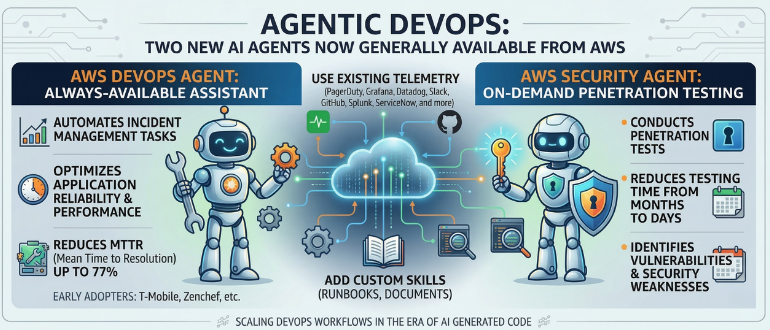

Amazon Web Services (AWS) today made a pair of artificial intelligence (AI) agents to manage DevOps workflows and conduct penetration tests generally available.
Neha Goswami, director of Agentic DevOps at AWS, said AWS DevOps Agent provides software engineering teams with an always-available assistant that can automatically optimize application reliability and performance in addition to automating specific incident management tasks.
The AWS Security Agent, meanwhile, provides on-demand penetration testing capability that reduces the time required to test an application for vulnerabilities and other security weaknesses from months to days, said Goswami.
The overall goal is to provide DevOps teams with AI agents that use the telemetry data collected by existing observability tools and relationships between runbooks, code repositories, and continuous integration/continuous delivery (CI/CD) pipelines to proactively resolve issues before there is an outage, noted Goswami.
In fact, since its initial launch late last year, AWS has added integrations with Azure, Azure DevOps, GitHub Enterprise, PagerDuty and Grafana along with existing support for tools and platforms from Datadog, Dynatrace, New Relic, Splunk, GitHub, GitLab, ServiceNow, and Slack.
Additionally, DevOps teams can now use AWS DevOps Agent to generate artifacts such as charts and dashboards, index code to identify opportunities to fix code, and add custom skills, such as a runbook, and other documents to provide the context needed to customize the AI platform for a specific IT environment.
AWS reports early adopters of the AWS DevOps Agent, including T-Mobile, Zenchef, Western Governors University, and Granola, have achieved up to 77% reductions in mean time to resolution (MTTR) of IT incidents.
It’s not clear at what pace DevOps teams are embracing AI agents to manage code but as the volume of code being generated by AI tools continues to increase it’s only a matter of time before existing DevOps workflows and pipelines are overwhelmed. AWS is making a case for safely using AI agents to automate tasks that today prevent DevOps teams from being able to manage code bases at higher levels of scale, said Goswami.
At this juncture it’s not a question of where DevOps workflows will evolve in the age of AI so much as it is how rapidly. A recent Futurum Group survey finds a full 60% of respondents said their organization is now actively using AI to build and deploy software. Top areas of investment over the same period are AI Copilot/AI code tools (38%), AI agent development (37%), AI-assisted testing (37%), followed closely by DevOps (37%), automated deployment (34%), software security testing (31%).
The challenge is that the pace at which AI coding tools are being adopted, unfortunately, is outpacing the rate at which AI is being applied to manage the software engineering processes used to validate, test and deploy code. Hopefully, that current imbalance will be rectified sooner than later, but in the meantime DevOps teams should, at the very least, now be evaluating the degree to which AI can be relied on to automate a wide range of tasks today and, just as importantly, in the near future.
