
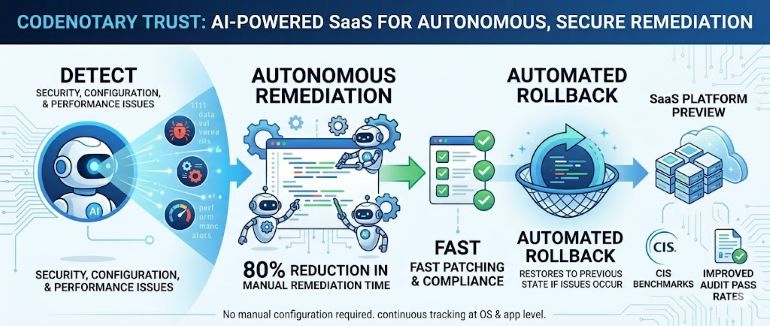

Codenotary is previewing a software-as–a-service (SaaS) platform that enables artificial intelligence (AI) agents it has developed to autonomously detect, prioritize, and fix security, configuration, and performance issues.
Company CEO Moshe Bar said the Codenotary Trust platform also enables continuous vulnerability tracking at both the Linux operating system and application level. Once an issue is detected, AI agents will automatically address security, configuration, and optimization issues without any manual intervention required, he added.
In the event the updates applied create another issue, Codenotary Trust also provides an automated rollback capability that restores the IT environment to its previous state, he added.
In general, DevOps teams are moving away from needing to review every patch before it is applied to apply them automatically to resolve issues as fast as possible, said Bar. That shift is becoming more feasible because AI coding tools have reduced the time required to not just create a patch but also test it before being automatically applied, he added. Anytime a patch creates an issue it can now be replaced in a matter of minutes, noted Bar.

Scheduled to be made generally available in the second quarter, pilot users of Codenotary Trust are already reporting an 80% reduction in manual security remediation time while at the same time seeing significant improvements in compliance audit pass rates.
Designed to be installed in minutes without any configuration wizards being required, the Codenotary Trust platform continuously analyzes system behavior to detect inefficiencies, including compliance issues using benchmarks created by the Center for Internet Security (CIS) without having to deploy external scanners.
The overall goal is to make automation accessible to application developers, software engineers and IT administrators of almost any skill level, said Bar. That’s critical because even in the age of AI there is still a critical shortage of IT expertise, he added.
Auto remediation has for decades been an aspirational goal for many IT teams but there has always been a reluctance to apply patches without thoroughly testing them for months. The concern has always been that the “cure” might be worse than the disease if the patch winds up taking an application offline.
The issue that approach creates is that a known vulnerability might not be remediated for months, which then provides malicious actors with plenty of time to develop the exploit needed to launch a cyberattack. However, as cyberattacks become more costly many organizations are concluding that the risks associated with not patching as quickly as possible might be greater than any disruption to application availability that might ensue.
Mitch Ashley, vice president and practice lead for software lifecycle engineering at the Futurum Group, said legacy scan-and-fix-later solutions are increasing under pressure from AI that solves problems at the source. Autonomous remediation shifts security from a review process to an execution loop, he added.
Codenotary Trust signals that the constraint holding back automated patching was never technical; it was trust: trust that the fix would not break something else. Rollback capability addresses that constraint directly, which changes the calculus for teams still running manual review cycles, noted Ashley.
The operational consequences are significant as autonomous agents, self-healing pipelines, and AI-driven remediation gain footholds in IT workflows. Known vulnerabilities sitting unpatched for months because teams fear regression are the attack surface malicious actors depend on, said Ashley. That loop is finally tightening, he added.
In fact, the ability to fix a patch in a matter of minutes might mean organizations are finally ready to embrace auto remediation.
