
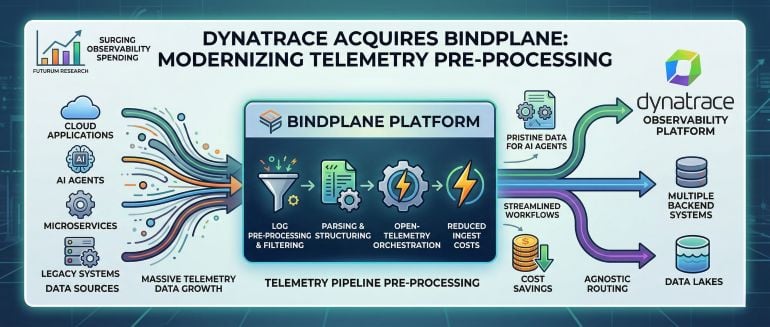

Dynatrace this week revealed it has agreed to acquire Bindplane, a provider of a platform for pre-processing and routing telemetry data.
Bob Wambach, vice president of market and customer insights for Dynatrace, said the addition of the Bindplane platform will further accelerate a rapid expansion of the log management capability that Dynatrace already provides. However, instead of requiring all telemetry data to be processed in the backend on its observability platform, IT teams will have the option to pre-process that data to reduce costs and streamline workflows, he added.
Additionally, Dynatrace is committed to ensuring the Bindplane platform remains agnostic after the acquisition closes this month, which means IT teams will be able to route telemetry data to multiple backend systems, noted Wambach.
While there has been some debate over the merits of using, for example, an OpenTelemetry agent to pre-process telemetry data, the massive expansion of the amount of telemetry data being generated, especially in the age of artificial intelligence (AI), is likely to force the issue. Good data, after all, is now a prerequisite for good AI, said Wambach. Arguably, one of the reasons that so few organizations have operationalized AI agents is that they are unable to ensure the data they access is pristine enough to reliably act on, he added.
One of the primary benefits of the Dynatrace platform is that it includes multiple types of predictive and causal deterministic AI models that can be used to help ensure AI agents are performing tasks as expected, said Wambach.
Bindplane has, in part, been addressing that issue by first making it possible to orchestrate the deployment of fleets of open source OpenTelemetry collectors. The company also provides a Blueprints capability that makes it simpler to reuse instances of validated telemetry pipelines for specific use cases. Additionally, IT teams can also use AI to automatically identify log types, apply parsers, and optimize configurations to streamline the management of OpenTelemetry data.
Mitch Ashley, vice president and practice lead for software lifecycle engineering at the Futurum Group, said as deployments of cloud‑native and AI applications continue to increase, IT teams are seeing rapid growth in telemetry. In fact, telemetry pipelines that capture, optimize, and deliver this data in an actionable form have become foundational to modern software ecosystems, he added.
The Bindplane platform optimizes and governs telemetry data at the edge to improve quality, reduce ingest costs, and enhance compliance, noted Ashley.
That’s crucial because IT teams are increasingly investing in observability platforms to operationalize and analyze all that telemetry data. A recent Futurum Group survey finds well over a third (36%) plan on spending more than $1 million on observability in 2026, with 7% planning to spend in excess of $5 million.
Each IT organization will need to determine to what degree to reduce their reliance on legacy monitoring tools to embrace observability, but as IT environments become more challenging to manage there will be a clear need to rely more on AI. The only issue that remains to be resolved is what type of AI to use when depending on the task at hand.
