

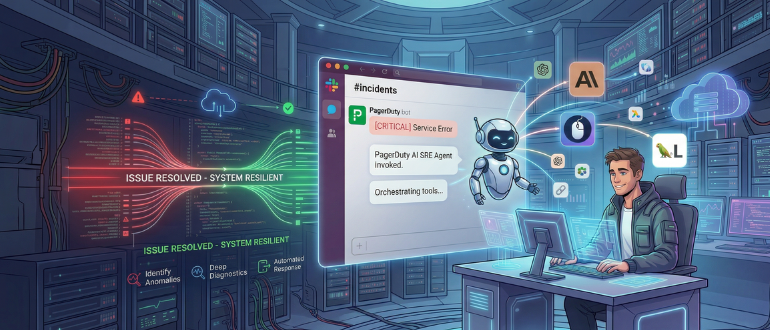

PagerDuty has extended the capabilities and reach of its artificial intelligence (AI) agents to enable them to be invoked directly from within the Slack messaging platform.
Additionally, the AI SRE Agent that is embedded within the PagerDuty Operations Cloud platform can now also leverage the Model Context Protocol (MCP) and an expanded library of application programming interfaces (APIs) to automatically respond to incidents by invoking more than 30 AI tools commonly used by DevOps teams, including coding tools from Anthropic, Cursor and LangChain.
David Williams, senior vice president of product for PagerDuty, said those capabilities make it simpler for AI agents to alert the right personnel when there is an incident and invoke the tools needed to resolve any given incident. The SRE Agent can also identify anomalies, assess the technology stack, and perform deep diagnostics before a human is ever contacted, he added.
The overall goal is to rely more on AI agents to improve IT resiliency while at the same time reducing the level of stress DevOps teams experience when being on-call to respond to any potential incident, noted Williams.
A survey of 1,000 business and IT decision-makers and senior developers suggests that while IT resilience has been improving there are still significant gaps. Conducted by Wakefield Research on behalf of PagerDuty, the survey finds 71% of respondents believe their organization is more resilient than it was 12 months ago. However, when there is a major incident half of respondents (50%) also noted that recovery and remediation costs have the greatest financial impact on their organization, second only to brand reputation (52%).
Overall, the survey finds 68% of organizations lose more than $300,000 per hour during a major IT incident, with 34% losing at least $500,000 per hour during a disruption.
Not surprisingly, well over three quarters (77%) plan to increase resilience spending in the next 12 months, with 15% planning substantial increases of more than 25%, the survey finds. A total of 59% are already actively incorporating artificial intelligence (AI) into operational resilience workflows., with another 34% discussing the role AI might have.
Additionally, a full 95% of respondents report that senior leadership understands that faster incident recovery creates a competitive advantage, with 41% describing their senior leadership as being strongly aligned with minimizing downtime.
It’s not clear to what degree organizations are embedding AI agents into DevOps workflows but at this point it’s more a question of when rather than if. Each member of a DevOps team will have access to their AI agent that will interact in real time with AI agents that other members of the team have deployed. Additionally, IT organizations will also set up dedicated AI agents that will automate specific tasks on behalf of the entire team. As reasoning capabilities of AI agent continue to improve it will only be a matter of time before the confidence level in AI agents increases.
The challenge, as always, will be finding a way to orchestrate the management of all those AI workflows that in many instances will occur faster than most DevOps engineers might currently be able to comprehend.
