

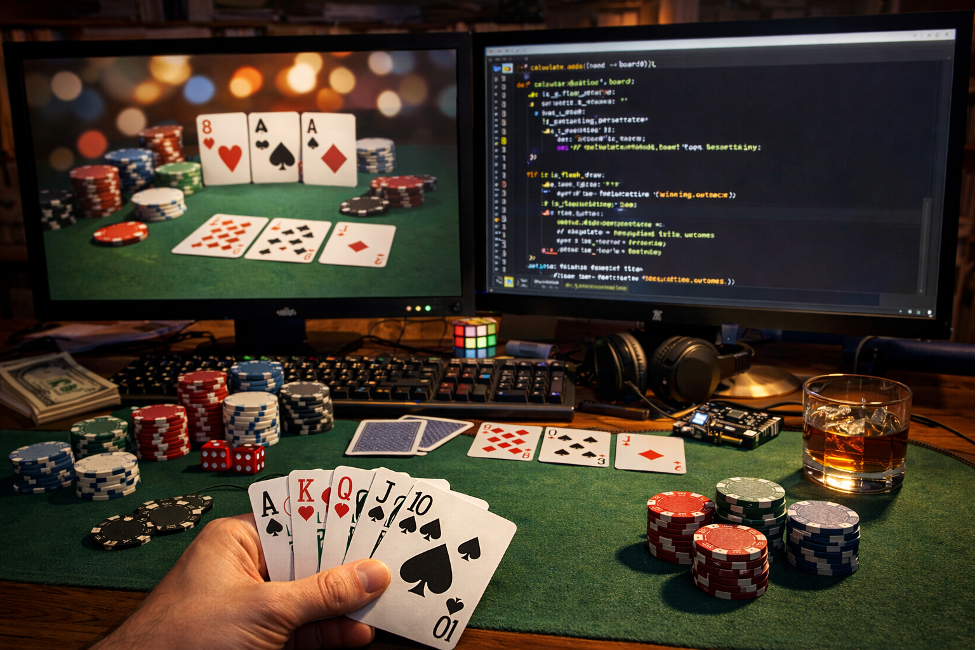
Artificial intelligence, advanced algorithms, and the evolution of software design have made the intersection of poker and programming more intricate than ever. Developers, experimenting with neural network-driven bots, turn to custom code that churns through endless scenarios, simulating unlikely hands, rethinking probabilities. In this shifting landscape, the old guesswork at high levels of play starts to fade.
Poker Software Engineering’s analysis from 2016, for instance, found top poker engines crunching through over 100,000 hands in a single second. By 2023, fresh research keeps bringing new twists, machine learning keeps finding ways to handle the uncertainty of games where you never know everything and the clock keeps ticking.
AI and Machine Learning in Poker
Few fields challenge modern programming quite like poker’s deeply hidden information. Here, algorithms can’t simply hunt for facts; they must make predictions with parts of the truth blacked out by design. Developers behind Poker Online Canada and similar digital platforms have adapted by relying on techniques found in AI, such as reinforcement learning and supervised machine learning.
DeepStack, rolled out in 2017, built its approach by training on over ten million hands, recalculating its next move mid-game as the cards changed. Untamed Science writes about how DeepStack manages to re-evaluate its strategies constantly as the board evolves, almost like a human, though it does so at a speed and depth that, realistically, humans can’t match.
Pluribus, a different AI, widened the experiment for tables with more players. Its neural model reacts in real time and learns from the quirks of new opponents. Back in 2019, Carnegie Mellon University’s team observed Pluribus besting top pros across thousands of hands in six-player matches.
With every round, these bots study their own actions and tweak their strategies. Reinforcement learning, rewarding and reinforcing better play, moves these systems toward ever more durable tactics despite all the uncertainty and shifting information.
Breaking down Poker with Math and Code
Game theory sits quietly behind the scenes, reshaping how people and programs understand poker. Programmers tackle the game by turning it into a logic puzzle, Nash equilibrium, linear programming, probability trees, all tools on the table. Sometimes they use open-source kits like Gambit to peel the game down to basics using variants such as Kuhn Poker, then walk through the layers of uncertain choices.
In 2018, the Open Works Independent Study detailed how linear programming can edge out maximum value or minimize risk, depending on the hand. Mathematicians use primal-dual relationships to lock in balanced pairs of strategies.
Strip away the drama, and the math pushes poker into something much closer to a contest of models and statistics. Software now charts every hand, every possibility, sending back results in seconds; high-level games creep toward math class in disguise, leaving less room for bluff or impulse, more for algorithms and well-worn simulations.
Poker software in everyday use
The reach of poker programming isn’t limited to theory. Web servers built with tools like Ruby keep multi-table games running smoothly and track the actions of both real and virtual players.
Above all, they prize speed, low-latency play, quick database pulls, seamless logging. Even small, open-source projects, according to developer notes from 2013, can now take on live bot-versus-human matches, sometimes with nothing more than an average laptop.
Beyond the felt, estimation tools like Planning Poker take inspiration from poker’s hidden bets to guide project management, letting teams “wager” their estimates in a card-based voting. As for GTO analyzers, these let players upload hand histories and get feedback based on game theory models, hunting for strategic weaknesses or suboptimal lines. Tools like these, GTOWizard says, let users throw different what-ifs at their own decisions, stress-testing and improving strategy with every session.
Programming’s ripple effects
With computers running probability models and learning on the job, poker’s upper echelons shift. The edge once held by seasoned players grows thinner as automation sharpens. Software Engineering Daily argued back in 2016 that, at least in set environments, bots have started leveling the playing field, or even tipping it. Beyond gaming, these programming advances are shaping approaches in finance, logistics, and risk anywhere uncertainty and reward matter.
Debates about transparency and the role of autonomous bots persist. Yet, the methods born in poker now ripple far beyond the game, a toolkit for any field where decisions get made quickly and data hides key details.
Playing responsibly in a digital era
No matter how code-driven poker becomes, responsible play needs to stay at the center. Players should keep limits on time and money spent at the tables. Leading online platforms provide tools for self-checks and account management to promote awareness and healthy boundaries.
Industry advice echoes this: stay alert to any warning signs, act early if problems start to appear. Ultimately, the aim is a space where people play thoughtfully and safely, keeping poker a fair, open, and genuinely sustainable pursuit.
