

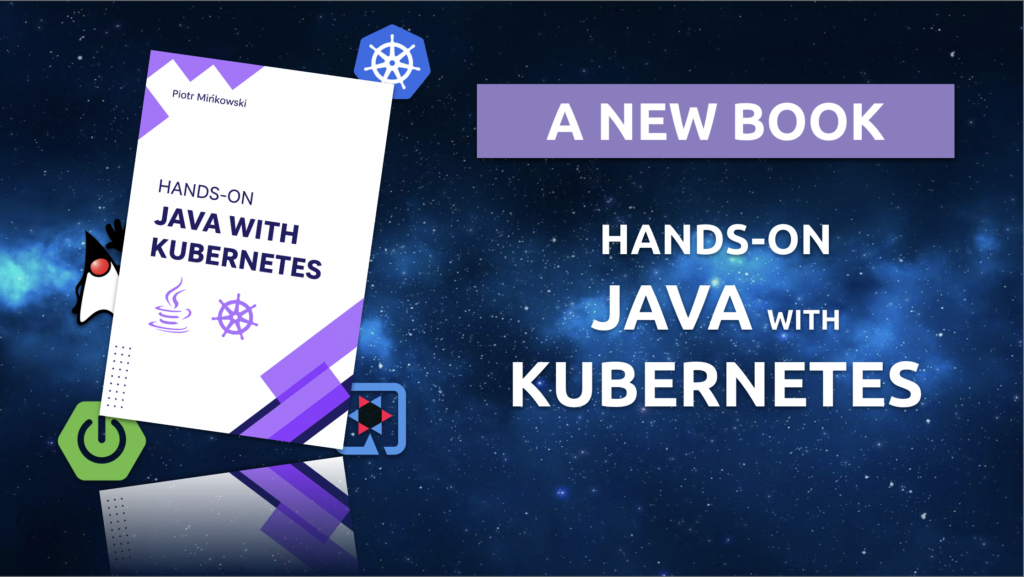
My book about Java and Kubernetes has finally been published! The book “Hands-On Java with Kubernetes” is the result of several months of work and, in fact, a summary of my experiences over the last few years of research and development. In this post, I want to share my thoughts on this book, explain why I chose to write and publish it, and briefly outline its content and concept. To purchase the latest version, go to this link.
Here is a brief overview of all my published books to date.
Motivation
I won’t hide that this post is mainly directed at my blog subscribers and people who enjoy reading it and value my writing style. As you know, all posts and content on my blog, along with sample application repositories on GitHub, are always accessible to you for free. Over the past eight years, I have worked to publish high-quality content on my blog, and I plan to keep doing so. It is a part of my life, a significant time commitment, but also a lot of fun and a hobby.
I want to explain why I decided to write this book, why now, and why in this way. But first, a bit of background. I wrote my last book first, then my first book, over seven years ago. It focused on topics I was mainly involved with at the time, specifically Spring Boot and Spring Cloud. Since then, a lot of time has passed, and much has changed – not only in the technology itself but also a little in my personal life. Today, I am more involved in Kubernetes and container topics than, for example, Spring Cloud. For years, I have been helping various organizations transition from traditional application architectures to cloud-native models based on Kubernetes. Of course, Java remains my main area of expertise. Besides Spring Boot, I also really like the Quarkus framework. You can read a lot about both in my book on Kubernetes.
Based on my experience over the past few years, involving development teams is a key factor in the success of the Kubernetes platform within an organization. Ultimately, it is the applications developed by these teams that are deployed there. For developers to be willing to use Kubernetes, it must be easy for them to do so. That is why I persuade organizations to remove barriers to using Kubernetes and to design it in a way that makes it easier for development teams. On my blog and in this book, I aim to demonstrate how to quickly and simply launch applications on Kubernetes using frameworks such as Spring Boot and Quarkus.
It’s an unusual time to publish a book. AI agents are producing more and more technical content online. More often than not, instead of grabbing a book, people turn to an AI chatbot for a quick answer, though not always the best one. Still, a book that thoroughly introduces a topic and offers a step-by-step guide remains highly valuable.
Content of the Book
This book demonstrates that Java is an excellent choice for building applications that run on Kubernetes. In the first chapter, I’ll show you how to quickly build your application, create its image, and run it on Kubernetes without writing a single line of YAML or Dockerfile. This chapter also covers the minimum Kubernetes architecture you must understand to manage applications effectively in this environment. The second chapter, on the other hand, demonstrates how to effectively organize your local development environment to work with a Kubernetes cluster. You’ll see several options for running a distribution of your cluster locally and learn about the essential set of tools you should have. The third chapter outlines best practices for building applications on the Kubernetes platform. Most of the presented requirements are supported by simple examples and explanations of the benefits of meeting them. The fourth chapter presents the most valuable tools for the inner development loop with Kubernetes. After reading the first four chapters, you will understand the main Kubernetes components related to application management, enabling you to navigate the platform efficiently. You’ll also learn to leverage Spring Boot and Quarkus features to adapt your application to Kubernetes requirements.
In the following chapters, I will focus on the benefits of migrating applications to Kubernetes. The first area to cover is security. Chapter five discusses mechanisms and tools for securing applications running in a cluster. Chapter six describes Spring and Quarkus projects that enable native integration with the Kubernetes API from within applications. In chapter seven, you’ll learn about the service mesh tool and the benefits of using it to manage HTTP traffic between microservices. Chapter eight addresses the performance and scalability of Java applications in a Kubernetes environment. Chapter Eight demonstrates how to design a CI/CD process that runs entirely within the cluster, leveraging Kubernetes-native tools for pipeline building and the GitOps approach. This book also covers AI. In the final, ninth chapter, you’ll learn how to run a simple Java application that integrates with an AI model deployed on Kubernetes.
Publication
I decided to publish my book on Leanpub. Leanpub is a platform for writing, publishing, and selling books, especially popular among technical content authors. I previously published a book with Packt, but honestly, I was alone during the writing process. Leanpub is similar but offers several key advantages over publishers like Packt. First, it allows you to update content collaboratively with readers and keep it current. Even though my book is finished, I don’t rule out adding more chapters, such as on AI on Kubernetes. I also look forward to your feedback and plan to improve the content and examples in the repository continuously. Overall, this has been another exciting experience related to publishing technical content.
And when you buy such a book, you can be sure that most of the royalties go to me as the author, unlike with other publishers, where most of the royalties go to them as promoters. So, I’m looking forward to improving my book with you!
Conclusion
My book aims to bring together all the most interesting elements surrounding Java application development on Kubernetes. It is intended not only for developers but also for architects and DevOps teams who want to move to the Kubernetes platform.
